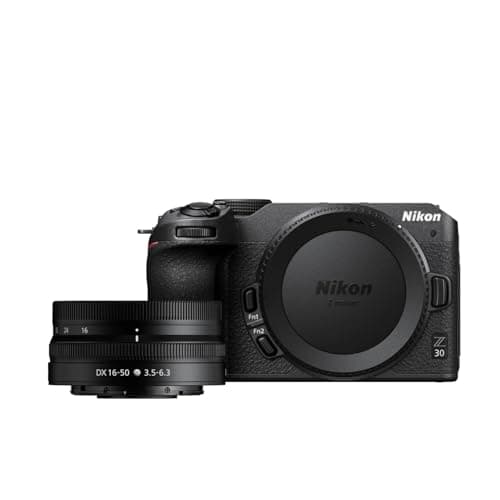
The closest alternative to a Sony ZV-E10 is the Nikon Z30: the same idea executed by another maker — a vlog-first APS-C body with no viewfinder, a fully articulating screen and a mic input — and it records uncropped 4K30, which the ZV-E10 does not. That is the pick if what drew you to the ZV-E10 was filming yourself. If you want to go the other way and buy the viewfinder Sony left out, the a6400 keeps the entire E-mount lens catalog and adds an EVF. Our budget pick is the Canon EOS R100, the cheapest route into an interchangeable-lens camera here — with a real caveat we spell out below, because its screen does not move. Live prices below, with the date they were read.
First, what the ZV-E10 is actually known for, because an alternative only makes sense against a fair description of the original. Sony built it as a vlogging camera on a 24MP APS-C sensor: a fully articulating screen that faces forward, real-time eye autofocus that is still among the best in this price class, a dedicated background-defocus button and a product-showcase mode that pulls focus to an object held up to the lens, a directional three-capsule microphone with a bundled windscreen, and a microphone input. Behind all of that sits the E-mount, which has more affordable third-party autofocus lenses — Sigma, Viltrox, Tamron — than any rival system. That combination is why it has been the default recommendation for video-first beginners for years, and why it still sits near the top of our beginner vlogging camera ranking.
So why look elsewhere? Three honest reasons come up. Price — the ZV-E10 is no longer the cheap option it was at launch, and the live prices on this page will tell you whether it is undercut today by bodies that did not exist when it arrived. Features it does not have: there is no viewfinder at all, no in-body stabilization, and its 4K is taken from a cropped, downsampled region with noticeable rolling shutter on fast pans. And fit: if you shoot mostly stills in bright sun, a camera with no viewfinder is the wrong tool whatever else it does well. None of that makes the ZV-E10 a bad camera. It is a very good one, and for solo video it is still the body the others are measured against.
How each alternative matches up
| Alternative | Matches the ZV-E10 on | Beats the ZV-E10 on | Gives up |
|---|
| Nikon Z30 | Vlog-first APS-C body, fully articulating screen, no viewfinder, mic input | Uncropped 4K30; grip comfort at arm's length; a front tally lamp | Lens choice — the Z DX range is small, and there is no headphone jack |
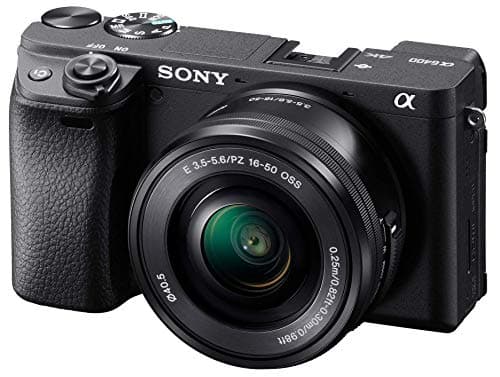
| Sony a6400 | The same E-mount lenses, the same 24MP APS-C class, Sony's autofocus | A built-in electronic viewfinder and a more stills-oriented body | The screen tilts up instead of articulating, so a mic or tripod blocks it |
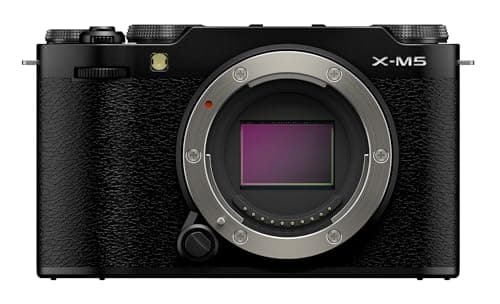
| Fujifilm X-M5 | Small creator body, flip screen, no viewfinder, 26MP APS-C | Video spec — 6K open-gate capture — plus a film-simulation dial | Autofocus tracking, and the cheap-lens depth of the E-mount |
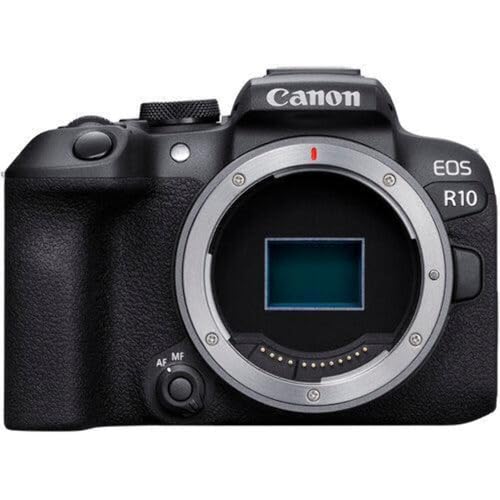
| Canon EOS R10 | APS-C body with a fully articulating screen and uncropped 4K30 | Burst speed and subject tracking; it has an EVF as well as the flip screen | Price, and the RF-S native lens range is thinner than E-mount |
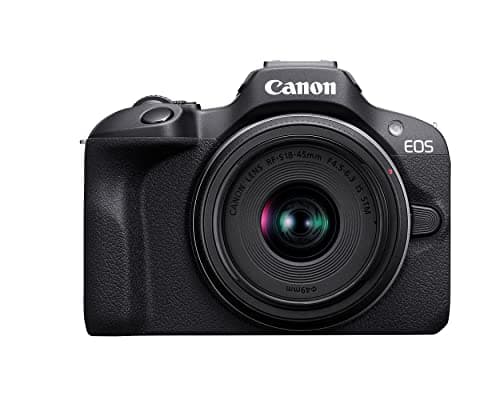
| Canon EOS R100 | Interchangeable lenses on a 24MP APS-C sensor | Price, by a clear margin | The screen is fixed, so you cannot see yourself; 4K is cropped |
If filming yourself is the whole point: the Nikon Z30
The Z30 is the one direct substitute on this list — Nikon built the same product. No viewfinder, a screen that flips out to face you, a 21MP APS-C sensor, a mic input, and a body deliberately shaped to be held at arm's length. Two differences matter in practice. Its 4K30 is uncropped, so your lens keeps its true field of view instead of being tightened by a crop — on a wide lens held at arm's length that is the difference between your head filling the frame and your room being in it. And the grip is genuinely one of the most comfortable on any small camera, which you notice twenty minutes into a handheld take. A front tally lamp and an oversized record button are small things that stop you filming nothing for ten minutes.
What you accept is the lens catalog. Nikon's Z DX range is the smallest of the four systems, and the cheap native wide options are limited; our best Nikon Z lenses page is honest about how short the list is. There is a microphone input but no headphone jack, so you cannot monitor audio on the camera. The full examination is in our Nikon Z30 review, and the Z30 is set against its stablemate in Nikon Z30 vs Z50 II.
If you want the viewfinder Sony left out: the a6400
This is the alternative that keeps everything about the E-mount and changes the body. The a6400 uses the same 24MP APS-C sensor class, the same real-time tracking autofocus the ZV-E10 is praised for, and every lens you were already considering. What it adds is a 2.36M-dot electronic viewfinder, which is what you want the moment you shoot stills outdoors — a rear screen in direct sun is a squint, and a viewfinder is not. DPReview also lists it as environmentally sealed, which the ZV-E10 is not.
The trade is the screen mechanism, and it is the single reason not to buy it for vlogging: the a6400's screen tilts up over the top of the camera rather than swinging out to the side, so a shotgun microphone in the hot shoe or a tripod plate underneath can block your view of yourself. For a hybrid shooter who films occasionally that is a shrug. For a daily vlogger it is disqualifying. We put the two side by side in Sony ZV-E10 vs a6400, and the body on its own in our Sony a6400 review.
If you want more video camera for the money: the Fujifilm X-M5
The X-M5 is the alternative that competes on video specification rather than on being a safer Sony. It is tiny, it has no viewfinder and a vlogging flip screen like the ZV-E10, and on paper it offers more: 26MP, 6K open-gate capture alongside 4K, and a film-simulation dial on the top plate that bakes Fujifilm's color into the file so a lot of owners never open an editor. If your output is short-form video with a look, that dial does more for your results than any spec on this page.
Two honest cautions. Fujifilm's autofocus still trails Sony and Canon for sticky face tracking, which is exactly the thing a solo creator cannot supervise while talking. And there is no in-body stabilization — the same as the ZV-E10, so this is not a downgrade, but it does mean walking footage wants a gimbal. The lens economics are different too: the X-mount has good third-party glass but not the sheer cheap-lens depth of E-mount. Details in our Fujifilm X-M5 review.
If you can spend more: the Canon EOS R10
The R10 is the step-up answer, and it is the only camera here that gives you both things the ZV-E10 makes you choose between: a fully articulating screen for filming yourself and an electronic viewfinder for shooting in sun. It also records uncropped 4K30, and its burst speed and subject tracking are the reason it is our pick for anything that moves — kids, pets, sport. DPReview lists it as not environmentally sealed, so it is not a wet-weather body.
It costs meaningfully more than the ZV-E10, which is the whole trade, and Canon's native RF-S lens range is the youngest of the four systems — the cheap primes are thin on the ground, as our best Canon RF lenses page sets out. If the extra money is available and you shoot stills as much as video, it is the most capable camera on this list. See the Canon EOS R10 review for the detail, or R10 vs a6700 if your budget has stretched further still.
If the budget is the binding constraint: the Canon R100
The R100 is the cheapest interchangeable-lens camera in our rankings, and we are not going to pretend it is a ZV-E10 substitute for vlogging: its screen is fixed. It does not tilt and it does not flip, so you cannot see yourself while filming, and its 4K is cropped and focuses with the slower contrast-detect system. If the ZV-E10's price is what sent you looking for alternatives and you shoot stills, the R100 is a real camera at a much lower number, with a viewfinder the ZV-E10 does not have. If you shoot yourself, this is the wrong one and the Z30 is the pick. That is the honest division, and it is covered further in our Canon R100 review and best budget mirrorless cameras.
The one alternative we could not price
The Canon EOS R50 is the body most people would name next to the ZV-E10 — uncropped 4K30, a fully articulating screen anda viewfinder — and it is our best all-round beginner pick. It is not given a buy row above for one reason: at the time this page's prices were read, the listing we track had no verified purchasable offer, and this site does not show a price it cannot verify or send you to a listing that cannot be bought. If that changes it will reappear in our rankings with a live number. In the meantime the camera itself is examined in our Canon R50 review and compared directly with the ZV-E10 in Sony ZV-E10 vs Canon R50.
What to check before you switch systems
Switching away from the ZV-E10 usually means switching lens mounts, and the mount is a longer commitment than the body. Count what you would need to buy: a normal prime and, eventually, a wide or a telephoto. On E-mount those exist cheaply from several makers; on Z DX and RF-S the cheap native list is shorter and some of the answers are first-party only. Price the two or three lenses you would actually buy, not just the body — our lens mounts guide explains why an adapter is not a shortcut, and best lens under $500 shows what each system offers at the budget most people really have. If you are starting from nothing rather than replacing a camera, the whole-kit arithmetic is in what a beginner camera kit really costs.
The same question, asked about the a6400
The ZV-E10 and the a6400 share a sensor class and a lens mount, and people shopping one routinely end up weighing the other. If the camera you are trying to replace is the a6400, the answer is a different list — it is in alternatives to the Sony a6400.