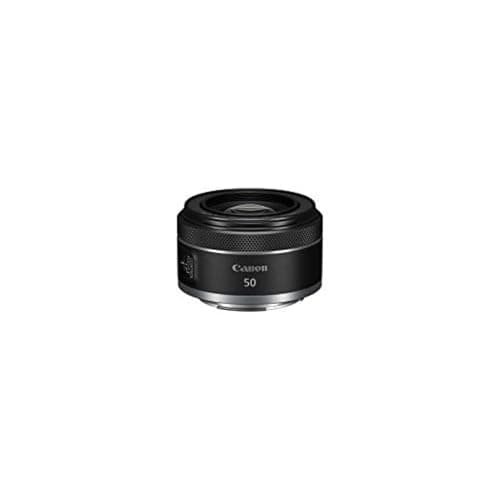
For most Canon mirrorless owners, the Canon RF 50mm f/1.8 STM is the first lens to add: it is tiny, sharp, one of the cheapest lenses Canon makes, and it gives your photos the soft-background look a kit lens never will. If you want one lens that does almost everything, the RF 35mm f/1.8 Macro is the most versatile prime in the range. Canon's newer mount is smaller than Sony's, but its core beginner lenses are genuinely good — here is how to pick the right ones for your camera.
First, the one thing that decides everything on Canon: the difference between RF and RF-S. RF lenses are built for full-frame bodies, but they also mount and work perfectly on Canon's crop-sensor cameras. RF-S lenses are designed for APS-C (crop-sensor) bodies only — the R50, R100, R10 and R7 — and on a full-frame body they force a heavy crop. If you own one of those popular beginner cameras, you can use both types; if you own a full-frame RF body, stick to RF lenses. Every pick below is labeled so you know which fits.
The second thing to understand is crop factor, because it changes how a lens frames. Canon's APS-C bodies apply a 1.6x crop, so a full-frame RF 50mm frames like an 80mm short telephoto on an R50 — great for portraits, too tight for an everyday "normal" lens. The RF 16mm frames like a ~26mm, and the RF 35mm like a ~56mm. That is why the native RF-S wides here (the 10-18mm and 18-150mm) matter so much for crop-sensor owners: they are designed to give a genuinely wide view on the smaller sensor. Our APS-C vs full-frame guide explains it plainly.
There is one more reason these lenses suit Canon beginners specifically: stabilization. Several entry-level Canon bodies lack in-body image stabilization, so a lens with its own optical stabilizer does the steadying instead — which is why four of these five (all but the RF 50mm) build it in. That matters for handheld video and for keeping low-light stills sharp, and it is worth weighing when you compare a stabilized zoom against an unstabilized prime on a Canon body without in-body IS.
An honest note on the ecosystem. Canon has kept tight control of its RF mount, so affordable third-party autofocus lenses are far thinner here than on Sony E-mount. That has started to loosen: Sigma now sells its 16mm, 23mm, 30mm and 56mm f/1.4 primes and its 18-50mm f/2.8 zoom for RF, made under license from Canon. They are APS-C lenses, so they suit the R50, R10 and R100 rather than full-frame bodies, and the list is still short next to Sony's. The upside is that Canon's own budget RF lenses are strong and reasonably priced, and the five here cover the shots a beginner actually takes: a first prime for everyday and portraits, a versatile do-it-all prime, an all-in-one travel zoom, and two ways to go wide. If you are still choosing the body, our Canon R50 review covers the most popular starting point.
How to choose a Canon RF lens
The order of decisions on Canon is simple: confirm whether your body is full-frame or APS-C, then buy the lens that gives the framing you want on that sensor. Because RF lenses work on both sensor sizes and RF-S lenses only on crop bodies, a quick check up front saves you from buying a lens that frames tighter than you expected — or one that will not properly fit a future full-frame upgrade.
Which body do you have — and does it change the lens?
The beginner Canon mirrorless bodies — the R50, R100 and R10 — are all APS-C, so every lens here works on them, and the crop factor makes each lens frame 1.6x tighter than its number. If you have stepped up to a full-frame RF body, use the RF lenses here (the 50mm, 35mm Macro and 16mm) and skip the RF-S zooms, which are built for the smaller sensor. Knowing this one thing steers the whole decision, so settle it before comparing anything else. Our APS-C vs full-frame guide is the quickest way to check which you own.
Start with the nifty fifty
The RF 50mm f/1.8 STM is the classic first upgrade, and for good reason: it is cheap, light, sharp, and its wide f/1.8 aperture delivers the blurred-background look people buy a "real camera" for. On a full-frame body it is a true normal lens; on an APS-C R50 or R10 it frames like an 80mm, which makes it a lovely, inexpensive portrait lens rather than an everyday one. If you want the everyday "normal" view on a crop body instead, the RF 35mm f/1.8 Macro (a ~56mm-equivalent) is the better fit — see our best 50mm primes for how the nifty fifty compares across systems.
The one versatile prime to own
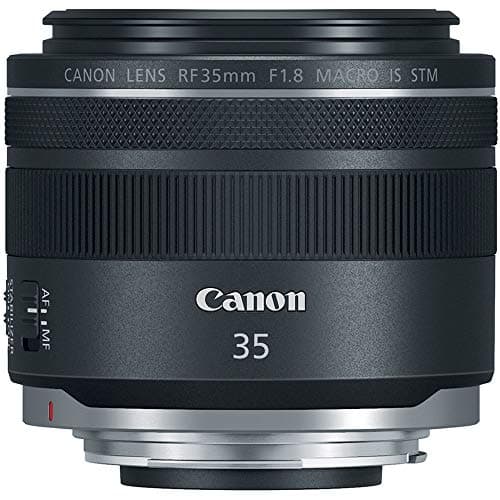
If you could keep only one prime, make it the RF 35mm f/1.8 Macro. On full-frame it is a natural wide-normal for street, interiors and groups; on an APS-C body it becomes a ~56mm everyday normal lens. Its f/1.8 aperture handles low light and background blur, its Hybrid IS steadies handheld stills and video, and its 0.5x close focus lets you shoot flowers, food and product details no kit lens can. Be clear-eyed about that macro claim, though: 0.5x is half-life-size, not the true 1:1 of a dedicated macro. For frame-filling shots of tiny subjects, see our best macro lenses for beginners.
The all-in-one travel zoom
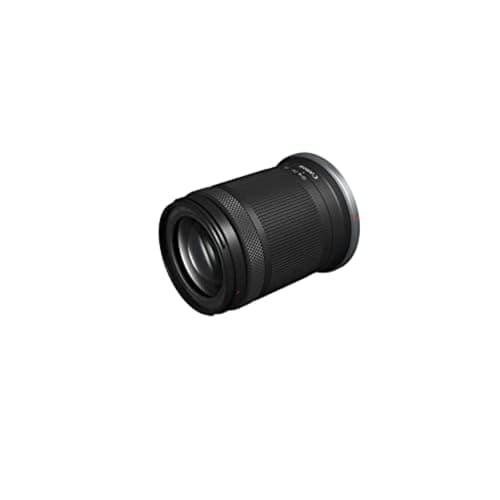
For travel and family days when you do not want to swap lenses, the RF-S 18-150mm is the convenience champion. Its ≈29-240mm-equivalent range covers wide scenes, portraits and distant subjects in one barrel, and its stabilization steadies the long end. The trade is the usual superzoom compromise: a slow variable aperture and image quality a notch below a prime or a fast zoom. It is the right lens when carrying one lens matters more than squeezing out the last bit of sharpness — exactly the priority on a busy trip.
Two ways to go wide
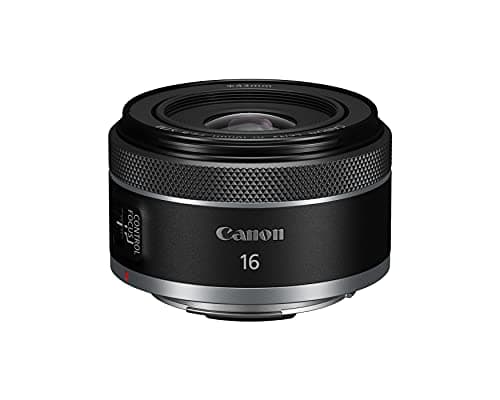
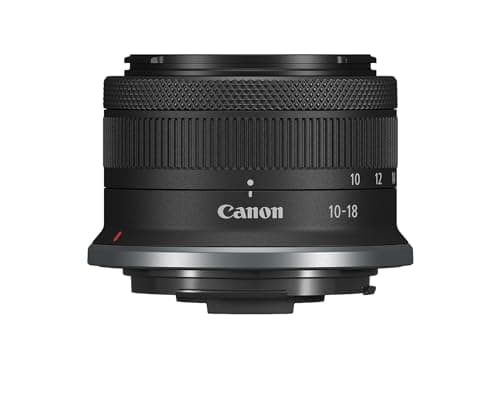
For landscapes, interiors and vlogging you have two routes. The RF 16mm f/2.8 is a feather-light full-frame prime that is astonishing value — wide and bright enough for arm's-length vlogging and big scenes, though its corners are soft wide open and it leans on in-camera correction. The RF-S 10-18mm is the dedicated crop-sensor ultra-wide, going far wider on an APS-C body than the 16mm can, with stabilization for handheld video; its catch is a slow f/4.5-6.3 aperture that limits low-light work. Choose the 16mm for a bright, cheap wide on any RF body; choose the 10-18mm when you need the widest possible view on a crop camera.
Where the RF mount is thin — and how to plan around it
It helps to know the limitation before you invest. Canon's restrictions mean there is no flood of cheap third-party RF glass, so you will pay a little more for equivalent lenses than a Sony shooter would. On a crop-sensor body, Sigma's licensed primes now add an affordable f/1.4 wide (the 16mm) and a brighter portrait prime (the 56mm f/1.4) to the mix; on a full-frame RF body, cheap third-party options are still scarce. Plan your kit around Canon's strong first-party budget lenses — the ones here — and buy deliberately rather than waiting for a cheap alternative that may not arrive. The good news is that these five genuinely cover the beginner range; you are not missing a shot type, only some of the bargain options other mounts enjoy.
Building a two-lens Canon kit
A tidy beginner kit is two lenses. The most flexible pairing is the RF 35mm f/1.8 Macro for everyday, low light and close-ups, plus either the RF-S 18-150mm for travel reach or the RF-S 10-18mm for wide scenes, depending on whether you shoot more distant subjects or more landscapes and interiors. If portraits are your thing, swap in the RF 50mm f/1.8 for its flattering ~80mm-equivalent framing on a crop body. Start with one lens that matches how you shoot most, add the second when you feel the first lens holding you back, and you will build a kit you actually use.
Autofocus, stabilization and video
For video and moving subjects, two things matter on Canon: how the lens focuses and whether it is stabilized. All five here use STM stepping motors, which are quiet and smooth for video though not the very fastest for sports; the primes focus confidently for everyday and portrait work. Stabilization is the bigger deal on Canon, because several beginner bodies have no in-body IS — the RF 35mm Macro's Hybrid IS and the optical stabilizers in the two RF-S zooms are a real help for handheld footage and dim-light stills. If you shoot a lot of video, favor a stabilized lens unless your body already has in-body stabilization.
Common Canon RF beginner mistakes
A few missteps are easy to avoid. The first is buying an RF-S lens expecting to use it later on a full-frame body — it will force a crop, so only buy RF-S if you are committed to APS-C. The second is forgetting the crop factor and being surprised when the RF 50mm frames like an 80mm on an R50; if you want a normal everyday view on a crop body, reach for the RF 35mm instead. The third is over-investing in a superzoom for image quality it cannot deliver — the RF-S 18-150mm is about convenience, not sharpness, so pair it with a prime when quality matters. Match the lens to your body and your priority and the RF range serves beginners well.
Mount, sensor and next steps
To recap the one rule that matters: RF lenses fit every Canon mirrorless body, RF-S lenses fit only the APS-C ones, and on a crop body every lens frames 1.6x tighter than its number. Get that right and any of these five will serve you well. If you are still choosing a camera, our best mirrorless cameras for beginners and Canon R50 review are the natural next reads, and the APS-C vs full-frame guide settles any lingering confusion about how these lenses frame on your sensor.
Why there is no Sigma column here
Canon's control of the RF mount is the single biggest difference between shopping for Canon glass and shopping for Sony glass, and it changes the whole buying strategy rather than just a few prices. What that restriction actually costs an RF owner, mount by mount, is laid out in third-party vs brand-name lenses.