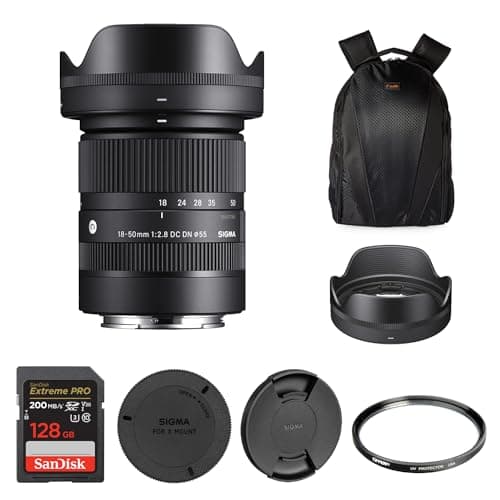
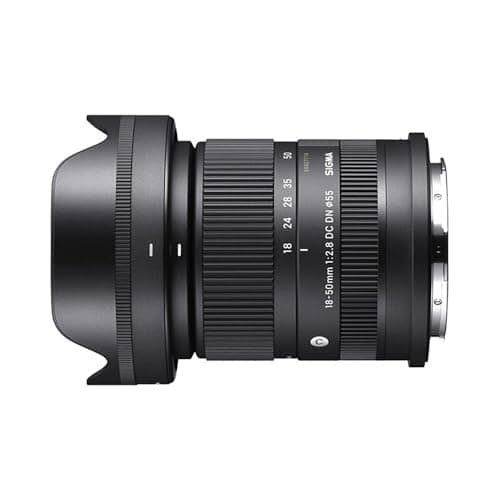
The Sigma 18-50mm F2.8 DC DN is the upgrade most crop-sensor owners should make before they think about a new camera body. It holds f/2.8 from one end of the zoom to the other, it is barely bigger than a prime, and it costs a fraction of what a first-party fast zoom does. It is also visibly imperfect at 18mm wide open, has no stabilization of its own, and stops at roughly an 80mm equivalent — three things worth knowing before you spend the money.
The usual disclosure: we have not lab-tested this lens. What follows is Sigma's published specification sheet, the optical findings of reviewers who did test it — named and linked in Sources — and our own read on who the lens suits, scored against our rubric. Informed opinion, not measurements.
Who it's for
This lens is for somebody who already owns an APS-C mirrorless camera, has shot the kit zoom for a while, and has run into the same wall twice: photos indoors come out dark or blurry, and backgrounds refuse to go soft. Those are not skill problems. They are aperture problems, and a constant-f/2.8 standard zoom is the most direct fix available for the money.
It also suits the video shooter who wants one lens on the camera all day. Because the aperture does not change as you zoom, exposure holds steady mid-shot, and at 290g on Sony E it leaves real payload headroom on a gimbal. That combination — light, fast, quiet — is why it appears in more of our rankings than any other lens.
Who should look elsewhere? Anyone who has not yet worn out a kit lens. If you have owned your camera a few months and cannot say which focal lengths you actually use, shoot the kit zoom until you can; our kit lens vs prime guide explains what to watch for. And anyone whose real complaint is reach rather than light is better served by a longer lens — see best telephoto lenses for beginners.
What it actually fixes
A constant f/2.8, from 18mm to 50mm
A typical kit zoom starts near f/3.5 at its widest and sags to about f/5.6 or f/6.3 zoomed in. Two things follow. Your exposure shifts every time you reframe, and at the long end — exactly where you would frame a portrait — the lens is at its dimmest. The Sigma holds f/2.8 the whole way. At 50mm that is roughly two stops more light than a kit lens gives you, which in practice is the difference between a sharp indoor photo at a sensible shutter speed and a smeared one. It is also the difference between a background that is merely slightly soft and one that genuinely separates your subject.
It is small enough to leave on the camera
Sigma lists the Sony E version at 290g and φ61.6 × 76.5mm, the Fujifilm X version at 285g, and the Canon RF version at 300g and φ69.2 × 74.5mm. Those numbers matter more than they look. A fast zoom is normally a heavy object; this one is close in size to a prime, takes common 55mm filters, and does not turn a small body into something you leave at home. It is the reason we rank it ahead of physically larger fast zooms for travel — see best travel lenses.
Close focus that gets you unexpectedly near
Sigma's specification lists a minimum focusing distance of 12.1cm at the wide end and a maximum magnification of 1:2.8 — close enough that PetaPixel's review described the 18mm end as focusing almost like a macro lens. It is not a real macro and will not give you 1:1 reproduction, but it means flowers, food and product details are within reach without carrying a second lens. If close-up work is the point rather than a bonus, our macro guide covers the lenses built for it.
Quiet autofocus that suits video
Sigma drives focus with a stepping motor and describes the result as smooth, quiet and high-speed. Reviewers who tested it agree the focusing is internal and effectively silent, which is what a camera microphone cares about. The optical construction — 13 elements in 10 groups, with one SLD and three aspherical elements — and a seven-blade rounded diaphragm are the rest of the published spec.
The honest catches
18mm wide open is the weak spot
This is the criticism that recurs across independent reviews and the one you are most likely to notice. PetaPixel found heavy vignetting at 18mm at f/2.8, needing f/5.6 or smaller before the corners cleaned up, and reported that corner sharpness at 18mm only peaked around f/6.3. The same review noted a fair amount of color fringing on high-contrast edges and visible ghosting when shooting into a light source stopped down. None of that makes it a bad lens — it is a compact third-party zoom at a third-party price, and the center is strong — but if you shoot wide landscapes at f/2.8 and pixel-peep the corners, you will find the limit quickly.
No stabilization, and almost no controls
There is no optical stabilization in any version of this lens. On a body with in-body stabilization that hardly matters. On the bodies most likely to be paired with it — the Canon R50, R10 and R100, the Sony ZV-E10, the Nikon Z30 — there is no IBIS either, so handheld video depends on the camera's digital stabilization or a gimbal. Our stabilization explainer covers what each system does. The barrel is also bare: no AF/MF switch, no focus-hold button, no aperture ring. Everything is set from the camera. Fujifilm shooters in particular tend to miss the clicked aperture ring their first-party lenses have.
It stops at 50mm
On Sony E and Fujifilm X that is a 27-75mm equivalent; on Canon RF, with Canon's 1.6× crop, about 28.8-80mm. Useful, but short of a portrait length. There is no version of this lens that reaches into telephoto, so the honest expectation is that you will eventually add something else — either a fast portrait prime like a 56mm f/1.4, or a lens with more range. The Sigma 18-50mm vs Tamron 17-70mm comparison is the page to read if you would rather buy the reach up front and accept a bigger lens.
Sealing is limited to the mount
Sigma describes a mount with a dust- and splash-resistant structure and rubber sealing — protection where the lens meets the camera, not a fully weather-sealed barrel. Treat it as a lens that survives a light shower rather than one you take out in weather on purpose.
Nikon Z owners cannot buy it
Sigma lists this lens in exactly four mounts: Sony E, Canon RF, Fujifilm X and L-mount. There is no Nikon Z version. If you shoot a Z30, Z50 II or Zfc, this page is not for you and our Nikon Z lens guide is — it covers what the Z DX range actually offers instead.
Which version to buy is mostly decided for you
The three listings below are the same optical design in three mounts, not three competing lenses. Buy the one that fits your camera — you have no real choice in the matter. We have ordered them by how much of the lens you get for the money on each system, which is why the Sony E version leads: it is the longest-established, the cheapest to find, and the mount with the deepest catalog of lenses to buy next. Live prices for each are below.
Mount by mount
Sony E — the default
The E-mount version has been on sale the longest and is usually the easiest to find at a sensible price. It is also the mount where this lens has the most company: Sigma, Tamron and Viltrox all build affordable APS-C glass for Sony E, so the 18-50mm slots into a real upgrade path rather than being a one-off purchase. If you shoot an a6400, an a6100 or a ZV-E10, this is the single most transformative lens purchase available to you. Our budget Sony E guide covers what to add next.
Canon RF — the one that fills a real hole
Sigma announced the RF version's launch schedule in June 2024 and put it on sale that July, and it matters more here than on any other mount, because Canon does not sell a fast constant-aperture RF-S zoom at all. Every RF-S zoom Canon builds is variable-aperture kit glass. If you own an R50, R10, R100 or R7 and want one lens that is meaningfully better than what came in the box, this is currently the answer. The catch is stabilization: none of Canon's cheap RF-S bodies has IBIS, and neither does this lens. Our Canon RF lens guide puts it in context with the first-party primes.
Fujifilm X — good lens, mixed handling
Optically this is the same lens, and at 285g it is the lightest of the three. Two caveats are specific to X-mount. Autofocus is quick but a step behind Fujifilm's own linear- motor lenses, which is most noticeable on fast-moving subjects, and the absence of an aperture ring breaks the tactile handling that draws people to Fujifilm in the first place. Neither is a reason to avoid it — it is still far cheaper than Fujifilm's fast zooms — but they are real. See best Fujifilm lenses for the primes that pair with it.
L-mount, and the Nikon Z gap
An L-mount version exists for Sigma, Panasonic and Leica bodies, but almost nobody reading a beginner APS-C guide is shooting one, so we have not ranked it. Nikon Z has no version at all, and there is no announced plan for one. Nikon shooters looking for a fast standard zoom do have a third-party option now: since July 2026 Tamron has sold its 17-70mm f/2.8 for Nikon Z, which our Sigma vs Tamron comparison covers. Otherwise it is Nikon's own Z glass or a slower DX kit zoom — our Nikon Z guide lays out the honest options.
What to buy alongside it
Two things make this lens better. The first is a fast prime for the dark and for portraits — a 56mm f/1.4 gives you the background blur and the flattering length the zoom cannot reach; see best portrait lenses. The second, if you shoot video handheld on a body without IBIS, is stabilization the lens does not provide: either a gimbal or, for locked-off shots, a tripod. A 55mm circular polarizer is the cheapest optional extra worth owning if you shoot outdoors — our CPL guide covers the sizes.
The verdict
The Sigma 18-50mm F2.8 is not a perfect lens and does not need to be. It is small, it is fast at every focal length, it focuses quietly and close, and it costs far less than the first-party equivalents — and those four things together fix the specific complaints that send people shopping for a new camera when what they actually needed was better glass. The soft, heavily vignetted corners at 18mm f/2.8 are the price of that size and that price tag, and for most people they are worth paying.
Buy it if you own an APS-C body, know your kit lens is holding you back, and shoot in the wide-to-normal range. Skip it if you need reach, if you need stabilization built into the lens, or if you shoot Nikon Z — in which case none of the three listings above will even mount on your camera.