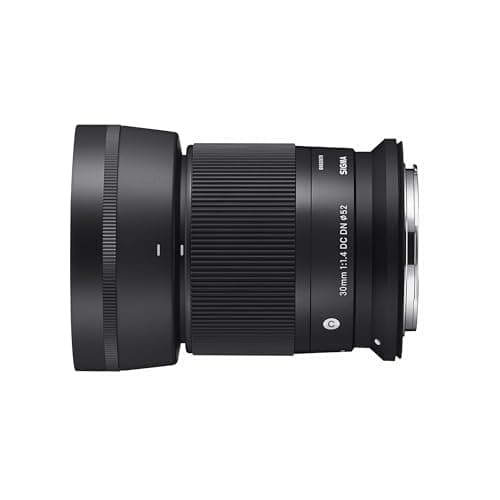
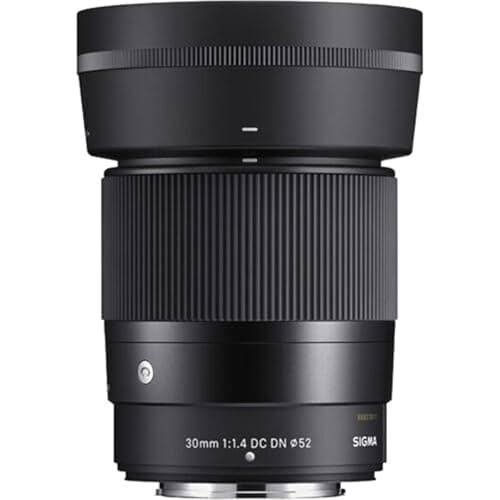
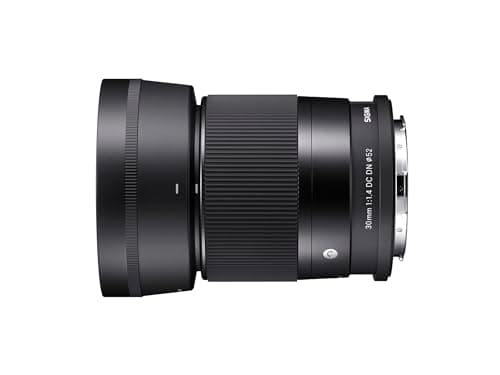
The Sigma 30mm F1.4 DC DN is the closest thing to a "nifty fifty" that a crop-sensor mirrorless camera can have. It frames like a 45mm lens, it opens to f/1.4 — roughly three stops brighter than the long end of a kit zoom — and independent lab reviewers rate its center sharpness above first-party primes costing more. It also bends straight lines noticeably, darkens its corners wide open, has no stabilization and no weather sealing, and cannot focus closer than 30cm. Four things worth knowing before you spend the money.
The usual disclosure: we have not lab-tested this lens. What follows is Sigma's published specification sheet, the measurements and findings of reviewers who did test it — named and linked in Sources — and our own read on who it suits, scored against our rubric. Informed opinion, not measurements of our own.
A note on why this page exists. We rank this lens first on best low-light lenses and recommend it on four other roundups, which makes it one of the two lenses we point readers at most often. It deserves more than a ranking blurb, and the mount question in particular deserves a straight answer, because Sigma sells this one optical design in seven different mounts and they are not equally good buys.
Who it's for
This lens is for somebody who owns an APS-C mirrorless camera — a Sony ZV-E10 or a6400, a Canon R50 or R10, a Nikon Z30 or Z50 II, a Fujifilm X body — and keeps running into the same two walls. Photos indoors and after dark come out dark, noisy or blurred. And backgrounds refuse to go soft, no matter what the camera is set to. Both are aperture problems, not skill problems, and a fast normal prime is the most direct fix money can buy.
It also suits the person who wants to stop thinking about zoom. A fixed 30mm on a crop sensor gives you roughly what your eye sees — Sigma lists the angle of view at 50.7 degrees on the APS-C mounts — which is wide enough for a room and tight enough for a person. Street, environmental portraits, food, interiors and talking-head video all sit comfortably inside that one focal length.
Who should look elsewhere? Anyone shooting full frame — this lens does not cover a full-frame sensor and the camera will crop to the APS-C area. Anyone whose real problem is reach rather than light, who wants a telephoto instead. And anyone who has not yet worn out their kit zoom: if you cannot say which focal lengths you actually use, shoot the kit lens until you can, and read our kit lens vs prime guide first.
What it actually fixes
f/1.4, and what that is worth in a dark room
A typical APS-C kit zoom runs from about f/3.5 at its widest to f/5.6 or f/6.3 zoomed in. At 30mm most kit zooms are already near f/4.5. f/1.4 is roughly three stops brighter than that, which means around eight times the light reaching the sensor. In practice that is the difference between ISO 6400 and ISO 800 in the same room, or between a shutter speed too slow to hold steady and one that freezes a person mid-sentence. It is also the difference between a background that is slightly soft and one that genuinely falls away.
Worth being precise about the f-number, though. DPReview measured the lens's actual light transmission at T1.8 rather than T1.4, and DXOMARK recorded the same 1.8 T-stop on a Sony a6000. That gap — the result of the number of glass elements plus corner shading — is normal for a fast prime and does not make f/1.4 a false claim; depth of field still behaves like f/1.4. It does mean the brightness gain over an f/1.8 lens is smaller than the numbers on the barrel suggest.
Sharpness that embarrasses more expensive glass
This is the lens's headline strength and the reviewers are unusually unanimous. DPReview found center sharpness at f/1.4 significantly higher than Sony's own 35mm F1.8 OSS, noted it was "pretty well maintained across the field", and gave the lens 87% and a gold award. DXOMARK measured 16 P-Mpix of sharpness on a Sony a6000 and scored the lens 29 points overall, which at the time made it the highest-ranked Sony E-mount lens they had tested — ahead of both the Zeiss Touit 32mm f/1.8 and the Sony E 35mm f/1.8, each of which cost more. Amateur Photographer described it as very sharp in the center with resolution peaking around f/4 to f/5.6, and Fstoppers reported excellent sharpness all the way from f/1.4 to f/16 with only minimal softening from diffraction at the smallest aperture.
Bokeh from nine rounded blades
Sigma specifies a nine-blade rounded diaphragm, and it shows. Amateur Photographer described circular specular highlights and smooth transitions in the out-of-focus areas; DPReview found the bokeh smoother and the highlight shapes rounder wide open than the Sony 35mm f/1.8 it was tested against; Fstoppers called the rendering creamy and smooth. There is a "cat's eye" stretching toward the frame edges that DPReview says can produce a subtle swirl, but describes as not distracting.
It is small, and the filters are cheap
Sigma lists the Sony E version at 265g and 64.8 x 73.3mm, the Canon RF and Nikon Z versions at 285g, and the Micro Four Thirds version at 260g. All of them take 52mm filters, which is one of the cheapest common sizes — worth knowing if you want a polarizer or an ND filterfor video. The optical construction is nine elements in seven groups, including one aspherical and one double aspherical element plus a high-refractive, high-dispersion front element, and the mount is brass with a protective coating. Amateur Photographer notes the barrel mixes metal with Sigma's Thermally Stable Composite; DPReview describes a machined metal chassis with plastic internals.
The honest catches
It bends straight lines, and that is the real flaw
Every lab that measured this lens found barrel distortion, and it is the criticism that recurs most. DPReview called it "fairly severe barrel distortion that is easily detected in any scene with straight vertical elements". DXOMARK measured 1.5% and said it needs post-production correction. Amateur Photographer measured -2.6% in uncorrected raw files. The numbers differ because the methods do, but the direction is the same: doorframes, building edges and horizons bow outward.
In fairness, this is largely a solved problem in practice. Correction profiles ship in Adobe Camera Raw and in Sony's own bodies, modern cameras can apply the fix to JPEGs and video in-camera, and Sigma's Canon RF version explicitly supports in-camera aberration correction on cameras that offer it — which is why Fstoppers, shooting with corrections on, reported upright verticals and parallel horizontals. But if you shoot raw with corrections off, or you shoot architecture, you will see it. Treat it as the price of f/1.4 at this size and cost.
Dark corners wide open
At f/1.4 the corners are visibly darker than the center. DPReview measured about one and a third stops of loss in the extreme corners; DXOMARK recorded -1.7 EV at f/1.4 improving to -1.0 EV at f/1.8 and disappearing by f/2.8; Amateur Photographer put it at roughly 1.2 stops on a Sony APS-C body, essentially gone by f/2.8. Stopping down one third of a stop fixes most of it, and for portraits the darker corners often flatter the subject anyway. It is a thing to know, not a reason to avoid the lens.
No stabilization — and probably none in your camera either
There is no optical stabilization in any mount version. On a body with in-body stabilization that barely matters. The problem is that the cameras most likely to be paired with this lens — the Sony ZV-E10, the Canon R50, R10 and R100, the Nikon Z30 and Zfc — do not have in-body stabilization either. For stills, f/1.4 buys you back the fast shutter speed you need. For handheld video you are relying on the camera's digital stabilization, which crops, or on a gimbal. Our stabilization explainer covers which system does what.
You cannot get close
Sigma specifies a minimum focusing distance of 30cm and a maximum magnification of just 1:7. That is a genuine limitation and the clearest practical difference between this lens and the Sigma 18-50mm F2.8, which focuses to 12.1cm and reaches 1:2.8. Plates of food, flowers and product details that the zoom can fill the frame with are out of reach here — you will be standing a foot away and cropping. If close-up work is the point rather than an occasional want, our macro guide covers the lenses built for it.
No weather sealing, and a hood that feels it
Sigma publishes no dust- or splash-resistance claim for this lens, and both DPReview and Fstoppers confirm there is no weather sealing. For the Fstoppers reviewer that was disqualifying — they shoot at the beach and around water and declined to buy it on those grounds. DPReview separately found the bundled plastic lens hood flimsy and not confident when secured. If you shoot in weather on purpose, this is the wrong lens.
Autofocus is good, not class-leading, and manual focus is awkward for video
The stepping motor is quiet and accurate, and DPReview confirmed the lens uses the camera's full phase-detect area on Sony bodies, behaving like a native lens. But it focuses more slowly than Sony's own 35mm f/1.8, Amateur Photographer heard an audible click or clunk as focus engages, and Fstoppers saw occasional hunting in difficult light. The sharper limitation is for video: manual focus is focus-by-wire with a non-linear response, so a quick turn racks focus fast while a slow turn crawls. That makes repeatable, marked focus pulls difficult. If planned manual focus pulls are central to how you shoot, see best lenses for video for alternatives.
A word on portraits
A 45mm-equivalent lens is a normal lens, not a portrait lens. Amateur Photographer noted slight facial distortion in head-and-shoulders portraits, which is what you would expect at this focal length when you fill the frame with a face. It is excellent for environmental portraits where the room is part of the picture. For flattering head-and-shoulders work you want roughly 56mm on APS-C — see best portrait lenses.
Seven mounts, and only one of them is yours
Sigma lists this lens in seven mounts: Sony E, Canon RF, Canon EF-M, Nikon Z, Fujifilm X, Micro Four Thirds and L-mount. That is the widest mount coverage of any lens on this site, and it is the main reason this page is worth reading rather than just the ranking blurb — the Sigma 18-50mm F2.8 has never been made for Nikon Z, so for a Z30 or Z50 II owner the 30mm is the Sigma they can actually buy.
The three listings below are the same optical design in the three mounts most of our readers shoot, not three competing lenses. Buy the one that fits your camera — you have no real choice in the matter. We have ordered them by how much lens you get for the money on each system, which puts Sony E first: it has been on sale since 2016, it is the cheapest to find, and it sits on the mount with the deepest catalog of affordable glass to buy next. The remaining four mounts are covered after the picks.
A note on the price you will see
When we checked for this page, Amazon had no current offeron the plain Sony E listing — the one that contains the lens, the hood, the caps and nothing else. Our Sony E link points at it anyway, and the button will say "check price" rather than show a number until an offer returns. That is deliberate. Every Sony E listing we found carrying a live price was an accessory bundle: the lens packed with a UV filter, a blower, a cleaning pen and a cloth, under a title that reads like the lens on its own. Those bundles are not scams, but you are paying lens money for filler you probably do not want, and we are not going to point you at one to keep a number on this page.
The Canon RF and Nikon Z links below are the plain lens, so they show real prices. If the Sony E button has no price when you read this, the lens is still widely sold — check Amazon's own listing, or a camera retailer, and compare against what the RF and Z versions cost here as a sanity check. Our methodology page explains why a price disappears from this site rather than going stale.
Mount by mount
Sony E — the default, and the cheapest
The E-mount version arrived first, in 2016, and it is still the one to beat on price and availability. It is also the mount where this lens has the most company: Sigma, Tamron and Viltrox all compete for affordable APS-C E-mount glass, so the 30mm slots into a real upgrade path rather than being a one-off. If you shoot a ZV-E10, an a6100, an a6400 or an a6700, this is one of the two most transformative lens purchases open to you — the other being the 18-50mm zoom. Our budget Sony E guide covers what to add after it.
Canon RF — the one that fills a real hole
Sigma announced development of the RF version in April 2024 and put it on sale on 5 December 2024 at a $369 launch list price, alongside the 56mm. It matters more on this mount than any other, because Canon does not sell a fast RF-S prime at all — every APS-C-native RF lens Canon builds is a variable-aperture zoom. If you own an R50, R10, R100 or R7 and want a lens that is dramatically better than what came in the box, this is now one of a very short list of options. Sigma says it tuned the autofocus drive and communication speed specifically for RF, and the lens supports Servo AF and in-camera aberration correction on cameras that offer it. Our Canon RF lens guideputs it in context with Canon's own glass.
Nikon Z — thin on stock, but it exists
Sigma brought three DC DN primes to Z mount in late April 2023 — the 16mm, 30mm and 56mm — aimed squarely at the Z30, Z50 and Zfc, with the 30mm listing at $399. For Nikon APS-C owners this is a genuinely important lens, because Nikon's own Z DX range is thin on fast glass and Sigma has never made the 18-50mm f/2.8 zoom for Z at all. Two honest caveats: US stock on the Z version is noticeably thinner than on Sony E — when we checked, the standalone listing was down to its last unit — and street prices tend to sit above the E-mount version for the same optics. If its price disappears from the pick above, that is the stock situation rather than a broken link, and the button falls back to a search for the lens. Our Nikon Z lens guide covers the alternatives.
Fujifilm X — the same lens, patchier supply
Sigma brought the DC DN primes to X mount in 2022 and the 30mm is optically identical. Two things are specific to Fujifilm. Autofocus is a step behind Fujifilm's own linear-motor lenses, and there is no aperture ring — everything is set from the camera, which breaks the tactile handling that draws people to Fujifilm in the first place. We have deliberately not given the X-mount version a buy row on this page: when we checked for this review the only standalone US listing had a single unit left and no published price, and we will not put a buy button on something we cannot see a real offer for. Fujifilm shooters are better served checking stock directly, and our best Fujifilm lenses guide covers the alternatives — including the X-mount 18-50mm, which is reliably in stock.
Canon EF-M — fine lens, dead mount
An EF-M version exists and is often the cheapest of the lot, and if you already own an EOS M50, M50 II or M6 Mark II it is one of the best lenses you can put on it. But Canon has moved its whole mirrorless effort to RF, so EF-M has no future: do not buy into the system now on the strength of this lens. If you own an M body, buy it and enjoy it; if you are choosing a camera today, see best beginner mirrorless cameras.
Micro Four Thirds and L-mount
The Micro Four Thirds version is the lightest at 260g, but the smaller sensor changes the framing: Sigma lists a 39.6-degree angle of view there against 50.7 degrees on the APS-C mounts, so it behaves like a 60mm equivalent — a short portrait length rather than a normal lens. The L-mount version is designed for the APS-C crop area of Sigma, Panasonic and Leica bodies. Neither audience is who this site writes for, so we have not ranked them, but both are real products and the optics are the same.
What to buy alongside it
Two things make this lens better. The first is something with more range, because a single 30mm will eventually frustrate you — either keep your kit zoom or add the Sigma 18-50mm F2.8, which is the natural companion and covers the focal lengths this one cannot. The second, if you shoot handheld video on a body without in-body stabilization, is the stabilization the lens does not provide: a gimbal for moving shots or a tripod for locked-off ones. A 52mm circular polarizer is the cheapest worthwhile extra if you shoot outdoors — our CPL guide covers the sizes.
The verdict
The Sigma 30mm F1.4 DC DN is nearly ten years old, has never been replaced or given a Mark II, and is still the lens we recommend first when somebody with a crop-sensor camera says their indoor photos look bad. That longevity is the review. The sharpness holds up against glass costing twice as much, f/1.4 solves the actual problem, the nine-blade diaphragm renders backgrounds beautifully, and it is small and cheap enough to be an easy decision.
The barrel distortion is real and is the thing you would complain about if you shot architecture in raw with corrections off. The 30cm close-focus limit is the thing you would notice soonest in everyday use. Neither is enough to change the recommendation.
Buy it if you own an APS-C mirrorless body, shoot people and places in available light, and want one lens that makes your photos look like they came from a real camera. Skip it if you shoot full frame, if you need to get close to small things, if you need weather sealing, or if repeatable manual focus pulls are central to how you shoot video.