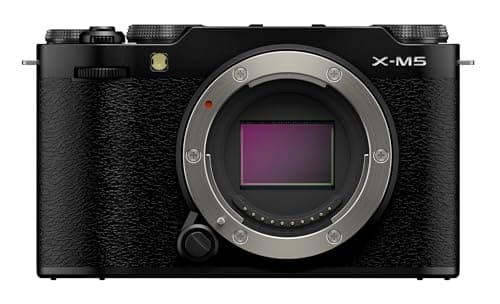
The verdict: buy the X-M5 if you want Fujifilm's colour and genuinely serious video in the smallest, cheapest X-mount body — and buy something else if you need a viewfinder or stabilized handheld footage. The specification is remarkable for the price: a 26.1MP X-Trans CMOS 4 sensor with the X-Processor 5, 6.2K (3:2) recording at up to 360Mbps, DCI and UHD 4K to 59.94p, 10-bit 4:2:2 internally, 20 film simulations on a physical dial, a 3.5mm microphone input and a 3.5mm headphone output, in a 355g body. What it leaves out is the viewfinder and in-body stabilization, and it leaves them out deliberately to hit that size and that price. Every number here is Fujifilm's published specification. We have not tested this camera; see how we pick.
The X-M5 is the cheapest way into the Fujifilm X system with a current sensor, and the spec sheet is unusually honest about what kind of camera it is. There is a film simulation dial on the top plate — a physical control for a creative decision, which tells you Fujifilm expects this camera to be used by people who do not want to edit. There is a 9:16 Short Movie Mode, which tells you it expects vertical video. And there is no EVF, which tells you it expects to be held at arm's length or on a tripod rather than against an eye.
The published specification
| Specification | Published figure |
|---|
| Sensor | APS-C X-Trans CMOS 4, 26.1MP effective, primary colour filter |
| Processor | X-Processor 5 |
| Highest video mode | 6.2K (6240 x 4160, 3:2) at 24/25/29.97p, up to 360Mbps |
| 4K | DCI 4K and UHD 4K to 59.94p; DCI 4K to 100Mbps, 2160p to 360Mbps |
| Slow motion | Full HD to 240fps |
| Codec and colour | H.265 / H.264, 10-bit 4:2:2 available |
| Stabilization | Digital, movie mode only — no IBIS |
| Viewfinder | None |
| Screen | 3.5in vari-angle touchscreen, 1.04 million dots, 3:2 |
| Audio | 3.5mm stereo microphone input with selectable directional modes; 3.5mm headphone output |
| Continuous shooting | Up to 30fps with the electronic shutter (cropped) |
| Film simulations | 20 modes, on a dedicated dial |
| Card slot | Single SD, UHS-I |
| Battery | NP-W126S; approx. 330 frames, or about 50 minutes of 4K per charge |
| Weight and size | Approx. 355g with battery and card; 111.9 x 66.6 x 38.0mm |
What stands out, and why
6.2K open gate at 360Mbps is not a normal spec at this price. The 6240 x 4160 mode is the full 3:2 sensor area rather than a 16:9 crop of it, which means one take can be cut into a horizontal video and a vertical one with real resolution left over in both. That is a workflow feature creators pay far more for elsewhere, and the 360Mbps bitrate means the file has enough data in it to survive the crop and the grade.
It also means storage. At 360Mbps you are writing about 162GB per hour, so a 128GB card holds roughly 47 minutes of that mode — the arithmetic is worked out in what size SD card do I need. The single card slot is UHS-I, so the card you buy needs to be able to sustain 45MB/s of writing; speed classes explainedcovers which V-rating that implies.
A headphone jack on a camera this cheap is rare and genuinely useful. It means you can hear what the microphone is actually recording rather than discovering a problem in the edit. Most bodies at this price give you a microphone input and nothing to monitor it with.
20 film simulations on a dial is a real feature, not a gimmick.Fujifilm's simulations are applied in-camera to the JPEG and to the video, and the point is that a competent colour look comes out of the camera with no editing at all. For someone who does not want a grading workflow, that is worth more than most sensor specifications.
The two omissions, stated plainly
No in-body stabilization. The only stabilization is digital, and only in movie mode, which crops the frame to work. Handheld walking footage from this camera will show your footsteps unless you use a wide lens, a stabilized (OIS) lens, or a gimbal — the options are ranked at best gimbals for mirrorless. If handheld stabilized video is the main thing you want, the X-S20 adds IBIS and this body does not.
No viewfinder. You compose on the rear screen, which is fine indoors and on a tripod and genuinely hard in bright sunlight. There is no accessory that fixes this. For stills-first shooters who shoot outdoors, this is the spec that should send you to a body with an EVF — the Sony a6400 or the Nikon Z50 II, both ranked on best mirrorless cameras for beginners.
Two smaller notes worth knowing: the battery is rated at approximately 330 frames or about 50 minutes of 4K, which means a spare battery is not optional for a day of filming; and the card slot is UHS-I rather than UHS-II, which caps the bus speed and is the reason the highest bitrate modes need a card chosen carefully rather than casually.
Who should buy the X-M5
Creators who shoot both horizontal and vertical. The 6.2K open gate mode plus the 9:16 Short Movie Mode make this one of the cheapest bodies that genuinely handles both orientations from one take. If your output is YouTube and shorts, that is the feature.
People who want good colour without editing. The film simulation dial is the whole argument, and it is a strong one. Nothing else at this price produces a finished-looking file straight out of the camera as reliably.
Anyone who needs the smallest real camera. 355g and 38mm deep is genuinely jacket-pocket territory with a pancake lens, and it is noticeably smaller than the X-S20.
Who should buy something else
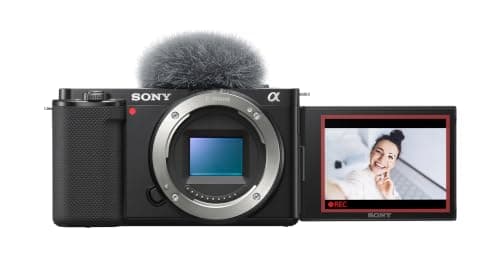
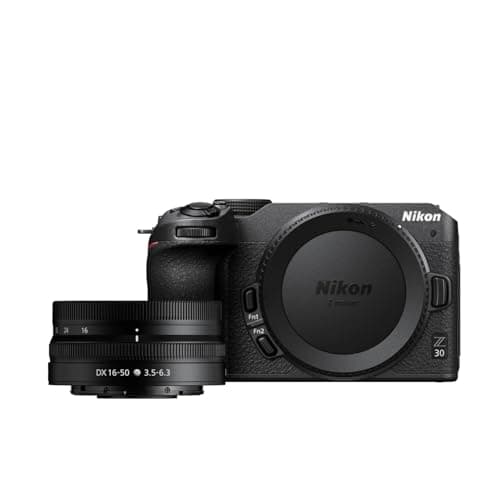
If you want stabilized handheld video: the Sony ZV-E10 or the Nikon Z30.Both are ranked above. Neither has IBIS either — this is a class-wide limitation at this price, and the honest answer for stabilized handheld footage is a wide lens or a gimbal regardless of which of the three you buy. What the ZV-E10 adds is a fully articulating screen plus Sony's tracking autofocus and the deepest cheap-lens catalogue of any mount; the Z30 adds Nikon's grip and a simpler menu.
If you shoot stills outdoors: anything with a viewfinder. Composing on a screen in sunlight is the single most common regret with EVF-less bodies, and it is not something you adapt to.
If you want IBIS in the Fujifilm system: the X-S20. Same colour science, adds IBIS and an EVF, costs more and weighs more. We have not ranked it here because the current listing is a lens kit at a price that is poor value against everything else on this page — check it yourself before deciding.
Lenses to put on it
The X-M5 has no stabilization, so lens choice does more work than usual. A fast wide prime hides handshake best; an OIS zoom is the answer for anything long. Fujifilm's own XC and XF primes are excellent and the third-party options on X-mount are now real — Sigma and Viltrox both build native autofocus X-mount lenses, which is covered in third-party vs brand-name lenses. The full ranking is at best Fujifilm X lenses.
Is the X-M5 good for photography, or just video?
It is a genuinely good stills camera with one caveat. The sensor is the same 26.1MP X-Trans CMOS 4 used across the X range, the processor is current, and the film simulations are a stills feature first. The caveat is composition: no viewfinder means bright-light shooting is awkward, and 30fps burst is only available with the electronic shutter and a crop. For deliberate, screen-composed stills it is excellent; for reactive outdoor shooting an EVF body is better.
Does the X-M5 overheat?
We have not tested it and will not claim a number. What the specification tells you is relevant though: about 50 minutes of 4K per battery charge means battery life, not thermal limits, is what ends most sessions, and the highest-bitrate 6.2K mode is the one worth testing yourself with a long take before you rely on it for an event.
X-M5 or ZV-E10 for YouTube?
The X-M5 for colour and for anything where one take becomes both a video and a short; the ZV-E10 for autofocus, a cheaper and deeper lens catalogue, and a screen that articulates fully rather than vari-angle. Both are ranked on best vlogging cameras for YouTube, and the live prices in the table above are usually the tiebreaker.