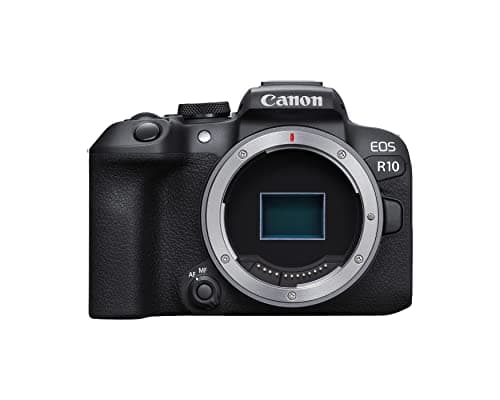
The Canon EOS R10 is the beginner body to buy when your subject will not hold still. Up to 23 frames per second, the same Dual Pixel AF II tracking Canon puts in far pricier cameras, and uncropped 4K30 make it the class pick for kids, pets and sport. If you shoot landscapes, portraits and static scenes, you are paying for speed you will never use.
First, how we work. We have not lab-tested the R10, and we do not pretend to. What follows is compiled from Canon's published specifications and the documented experience of owners, then scored against our rubric. Treat the judgments as informed opinion from documented research, not measurements from a bench we do not own.
Who it's for
The R10 is for the beginner whose photographs keep coming out blurred or half-framed because the subject moved. A parent photographing a toddler who has just discovered running. Someone with a dog who will not sit. A weekend soccer or motorsport spectator. In all of those cases the limiting factor is not sensor size or lens sharpness — it is whether the camera can find the subject, hold focus on it, and fire enough frames that one of them lands at the right instant. The R10 does all three unusually well for the money.
It also suits the buyer who wants a genuine viewfinder and a proper grip. Unlike the creator-first bodies in this price band, the R10 is shaped like a small camera rather than a video cube: it has an electronic viewfinder to put your eye to, a deep handgrip, and twin control dials. If you already know you enjoy the mechanics of photography — changing aperture with your thumb, composing through a finder — this is the entry Canon that respects that.
Who should look past it? Anyone who shoots mostly static subjects in good light. The Canon R50 shares the same sensor and the same autofocus intelligence in a smaller, cheaper body, and for landscapes, portraits and everyday family photos you will not be able to tell the two apart. Buy the R10 for the frame rate or do not buy it at all.
Where it's strong
Burst speed that changes what you can photograph
Canon rates the R10 at up to 15 frames per second with its mechanical shutter and up to 23 with the electronic shutter. Those are numbers that belonged to professional sports bodies a few years ago. In practice the difference is not that you fire more shots — it is that the decisive moment stops being a matter of luck. A jumping dog, a kicked ball, a child mid-laugh: hold the shutter for a second and you have a dozen frames spanning that moment rather than one taken slightly after it.
Dual Pixel AF II subject tracking
Speed is worthless if the frames are soft, which is why the autofocus matters more than the burst rate. The R10 inherits Canon's Dual Pixel AF II with subject detection for people, animals and vehicles. Point it at a face and it will find the eye; point it at a running dog and it will follow the animal rather than snapping to the background. This is the single biggest reason the R10 outperforms its price: the tracking is not a cut-down version of what the expensive Canons have, it is the same idea with fewer processing resources behind it.
Uncropped 4K30, and 4K60 when you want slow motion
The R10 records 4K30 from the full sensor width, oversampled from a 6K readout, so your lenses keep the field of view you paid for and the footage is detailed. There is also a cropped 4K60 mode, which is the one to reach for when you want smooth slow motion of the same moving subjects the stills side is built around. That combination — proper 4K with no crop for normal work, higher frame rates when you need them — is not a given at this price.
An enthusiast's body at a beginner's price
The handling deserves its own paragraph. The R10 has a 2.36-million-dot electronic viewfinder, a fully articulating touchscreen, a mode dial, twin control dials and a multi-controller. That is a lot of physical control for an entry-level camera, and it is what makes the R10 pleasant to keep using after the first year. Cameras that are simple to the point of being limiting get sold; cameras you can grow into get kept.
The honest catches
There is no in-body stabilization
The R10 has no in-body image stabilization (IBIS) — no sensor-shift system to smooth out handheld wobble. For stills at sensible shutter speeds this rarely matters, and for the fast-moving subjects the R10 is built for you are shooting at high shutter speeds anyway. For handheld video it matters a great deal: without IBIS, steadiness comes entirely from a stabilized lens, digital cropping, or a gimbal. If walking-and-talking footage is a big part of your plan, budget for one of those. Our stabilization explainer covers what each type actually fixes.
The native RF-S lens range is still thin
This is the R10's structural weakness and it is shared with every Canon APS-C mirrorless body. Canon's RF-S lenses — the small, affordable ones designed for crop-sensor cameras — are the youngest lineup among the major systems, and Canon has been restrictive about third-party autofocus lenses on RF. That has started to loosen: Sigma now sells licensed RF versions of its 18-50mm f/2.8 zoom and its 16mm, 23mm, 30mm and 56mm f/1.4 primes, all made for APS-C bodies like the R10. You can adapt older EF DSLR lenses with an adapter and open up a large, cheap second-hand catalog, but that adds bulk and cost. Compared with a Sony E-mount shooter browsing Sigma, Tamron and Viltrox primes, an R10 owner has fewer inexpensive native options. How much that matters against Sony's step-up body is laid out in our Canon R10 vs Sony a6700 comparison. Our Canon RF lens guide is an honest account of what is actually available.
You pay a premium over the R50 for speed alone
The R10 and the R50 share a 24MP APS-C sensor and the same autofocus intelligence. What the extra money buys is the faster burst, the bigger grip, the extra dial and the multi-controller. That is a genuinely worthwhile package for an action shooter and close to nothing for anyone else. Be honest about which you are: if you cannot name the moving subject you want to photograph, the R50 is the better buy and the difference goes toward a lens, which will change your photographs far more than a frame rate will.
Rolling shutter at 23fps
The 23fps figure comes from the electronic shutter, which reads the sensor line by line rather than exposing it all at once. On a fast-panning shot or a very quick subject that readout can lean vertical lines and produce the skew photographers call rolling shutter. The 15fps mechanical burst avoids it entirely and is still exceptionally quick, so treat the electronic mode as a tool for specific moments rather than a default.
The verdict
The R10 is one of the clearest value propositions in beginner mirrorless, provided you fit its brief. It takes the autofocus brain from Canon's expensive cameras, adds a burst rate that used to be professional-only, and wraps both in a body with real controls and a real viewfinder. For photographing anything that moves, nothing near this price is more capable.
The caveats are equally clear. No IBIS means handheld video needs help. The native lens range is the thinnest of the big systems. And if your subjects sit still, you are buying an expensive answer to a question you have not asked — the full R50 vs R10 comparison lays out exactly where the money goes. See where it lands against the wider field in our best mirrorless for beginners ranking.