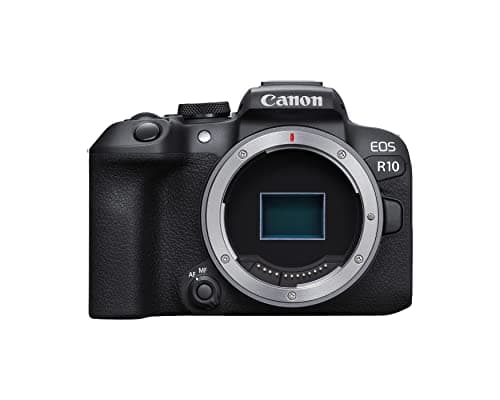
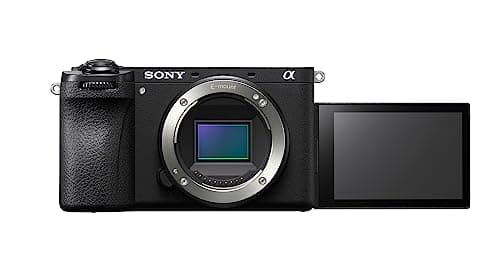
The Sony a6700 is the better camera, and the one to buy if you shoot video, film yourself or want a body you will not outgrow: it has in-body stabilization, the stronger autofocus, oversampled 4K60, a sealed body and at least 60 percent more rated battery life. The Canon R10 is the better buy if you mostly photograph moving subjects, want the faster burst, and would rather put the money you save toward a lens. Both are 24-26MP APS-C cameras with a viewfinder, a fully articulating screen and a single UHS-II card slot, so the everyday experience is closer than the price gap suggests. What separates them is a short list of hardware differences, and the lens system each one ties you to.
The usual disclosure: we have not tested either camera ourselves. Everything below comes from Canon's published specifications and the documented findings of DPReview, Amateur Photographer and PetaPixel, all named and linked in Sources. Where a figure is a reviewer's measurement rather than a manufacturer's claim, we say so.
At a glance
| Spec | Sony a6700 | Canon EOS R10 |
|---|
| Sensor | 26MP APS-C (back-illuminated) | 24MP APS-C |
| In-body stabilization | 5-axis, rated 5 stops | None (digital IS for video only) |
| Subject detection | Human, animal, bird, insect, car/train, airplane | People, animals (dogs, cats, birds), vehicles |
| Top burst | 11fps mechanical or electronic | 15fps mechanical; 23fps electronic |
| RAW buffer | 59 frames at 11fps (Amateur Photographer) | 29 RAW or 157 C-RAW at 15fps, UHS-II card (Canon) |
| 4K video | 4K60 oversampled from 6K; 4K120 with a 1.58x crop | 4K30 oversampled from 6K; 4K60 with a 1.56x crop |
| Viewfinder | 2.36M dots, 0.71x | 2.36M dots, 0.59x |
| Rear screen | 3.0in fully articulating, 1.04M dots | 3.0in fully articulating, 1.04M dots |
| Battery (CIPA, screen / viewfinder) | NP-FZ100: 570 / 550 shots | LP-E17: 350 / 210 shots |
| Card slot | One SD, UHS-II | One SD, UHS-II |
| Audio | Mic input and headphone jack | Mic input, no headphone jack |
| USB | USB-C, 10Gbps, USB Power Delivery | USB 2.0 speed |
| Weather sealing | Sealing at the body's joins | None |
| Weight with battery and card | 493g (17.4oz) | About 429g (15.1oz) |
| Listing we link | Body only | Body only |
R10 figures are from Canon's specification sheet and DPReview's review; a6700 figures are from DPReview's review unless marked. Both buy buttons on this page go to body-only listings, so neither includes a lens.
The eight differences that matter
1. Stabilization: the a6700 has it, the R10 does not
This is the biggest hardware gap. Canon's specification sheet states plainly that the R10 has no in-body image stabilization; for video it offers Movie digital IS, an electronic form of stabilization. The a6700 has 5-axis in-body stabilization rated at 5 stops. In practice, IBIS lets you hand-hold stills at slower shutter speeds in dim rooms and smooths casual walking video, whatever lens you mount. On the R10, steadiness has to come from a stabilized (IS) lens or a gimbal. If you photograph fast subjects at fast shutter speeds, you will rarely miss it. If you film handheld, you will notice it on the first day.
2. Autofocus: both track animals, the a6700 recognizes more
The R10 detects people, animals (dogs, cats and birds) and vehicles such as racing cars and motorbikes. DPReview found its stills tracking accurate and reliable, its animal detection less dependable than its people detection (especially with birds in profile), and its tracking in video unreliable, which it listed as a con in its 2023 review. The a6700's system, driven by a dedicated AI processing unit, recognizes humans, animals, birds, insects, cars and trains, and airplanes, with focus points covering 93 percent of the frame, and DPReview rated its autofocus best in class. Amateur Photographer adds one caveat: you have to choose the subject type in advance, and the camera cannot look for humans and animals at the same time. On balance the a6700 is the safer bet, and in video it is not close.
3. Speed: the R10 fires faster, the a6700 keeps going longer
On burst rate the R10 wins outright: 15fps with the mechanical shutter and 23fps with the electronic one, against 11fps for the a6700 either way. The buffer tells the other half of the story. Canon lists 29 RAW frames at 15fps on a UHS-II card, and DPReview found the RAW buffer full in under two seconds; switching to Canon's compressed C-RAW raises the figure to 157. Amateur Photographer lists 59 RAW frames for the a6700 at 11fps, and PetaPixel reported it could hold 11fps in RAW for roughly five seconds. One nuance from Amateur Photographer: the a6700's full 11fps mode does not show a live view between frames, while its 8fps mode does and holds 390 compressed RAW frames. For a toddler or a dog, the R10's short, fast bursts are ideal. For long sequences such as birds in flight or a whole play, the a6700's stamina matters more.
4. Video: the a6700 is the stronger video camera
Both shoot sharp, oversampled 4K from a 6K readout, but at different frame rates. The R10 does that at up to 30fps; its 4K60 mode crops the frame by 1.56x, which makes wide shots harder in a small room. The a6700 oversamples 4K at up to 60fps from nearly the full sensor width, and crops by 1.58x only for 4K120 slow motion. It also records 10-bit S-Log3 for people who color-grade, has a headphone jack for monitoring sound (the R10 has a mic input but no headphone jack), and offloads files over a much faster USB-C port. DPReview flagged significant rolling shutter in the R10's full-width 4K and measured the a6700's at 15.8ms, so neither is ideal for fast pans.
On heat, PetaPixel ran the a6700 with its temperature limit set to High and recorded 46 minutes of 4K24 and about 26 minutes of 4K60 before it shut down, and over two hours of 1080p without a warning. Canon's R10 specification sheet documents a temperature warning system, but we did not find an independent run-time test of the R10 to set against PetaPixel's figures, so we will not guess at one.
5. Battery: not close
The a6700 uses Sony's large NP-FZ100 battery, rated for 570 shots on the screen and 550 through the viewfinder. The R10 uses Canon's small LP-E17, rated for 350 on the screen and just 210 through the viewfinder. If you shoot with your eye to the camera, the a6700 is rated for more than two and a half times as many shots per charge. CIPA figures come from a standardized test rather than real life: PetaPixel estimated real-world a6700 use at roughly double its rating, while DPReview put the R10 at roughly 200 to 400 shots depending on how you use it. Budget for at least one spare LP-E17 if you buy the R10.
6. Handling, viewfinder and build
Both viewfinders have 2.36 million dots, but the a6700's magnification is 0.71x against the R10's 0.59x, so the Sony shows you a noticeably larger image. Both rear screens are 3-inch, fully articulating and identical in resolution. The R10 is the lighter body, at about 429g with battery and card by Canon's figures against 493g for the a6700. Build is where the Sony pulls ahead: DPReview describes environmental sealing at all the a6700's joins and lists no weather sealing on the R10. Controls are a closer call. DPReview praised the R10's twin dials as a notable addition for the price, while it listed the a6700's lack of an AF joystick among its cons.
7. Lenses: the difference you live with longest
This is the choice that outlasts the camera. The R10 takes Canon's RF-S and full-frame RF lenses, and Canon's EF-EOS R adapter opens up the large back catalog of EF and EF-S DSLR lenses. DPReview listed the lack of RF-S lenses as a con in its 2023 review. That gap has narrowed: in April 2024 Sigma announced six APS-C lenses for the RF mount, made under license from Canon, covering the 18-50mm f/2.8 and 10-18mm f/2.8 zooms and 16mm, 23mm, 30mm and 56mm f/1.4 primes, and Tamron launched a licensed RF-mount APS-C lens at the same time. None of Sigma's six is a telephoto, though. Our best Canon RF lenses guide is an honest map of what is available.
Sony's E mount is the deeper catalog today. Amateur Photographer points to a good range of APS-C lenses from Sony, Sigma and Tamron, and full-frame E-mount lenses fit the a6700 too. That depth is why Sony remains the easiest system to grow cheaply; our best budget Sony E lenses page shows where to start.
8. Price: the R10 leaves room for a lens
When we checked for this page, the R10 body cost roughly two-thirds as much as the a6700 body, and both listings we link are body only. That gap is about the price of a good lens, which is the strongest argument for the Canon: an R10 with a sharp prime or a telephoto will often take better pictures than an a6700 with no budget left for glass. Prices on both move with sales, so check the live figures in the picks below before you decide.
Who should buy which
- You shoot video, film yourself or walk and talk:the Sony a6700. In-body stabilization, 4K60 without the R10's crop, a headphone jack and more dependable video autofocus are exactly what the R10 lacks.
- You photograph kids, pets or outdoor sport and want the most frames per second for the money: the Canon R10, shooting short bursts in C-RAW.
- You want to photograph wildlife:the a6700 if the budget allows, for its dedicated bird mode, deeper buffer, stabilization and sealing. The R10 is the cheaper route, and Canon's 1.6x crop adds a little reach. Our best cameras for wildlife ranking puts both in context, telephoto lenses included.
- You shoot outdoors in drizzle and dust: the a6700, the only one of the two with weather sealing.
- You want the most lens choice as you grow: the a6700, for the depth of the Sony E-mount catalog.
- You are on a firm budget: the R10, and spend the difference on a lens.
Considering a cheaper sibling instead?
Each of these cameras has a cheaper stablemate that is often the better beginner buy. If you like the R10 but do not need its burst speed, our Canon R50 vs R10 comparison shows what you give up for a smaller, cheaper body. If the a6700 appeals but the price does not, the Sony a6400 vs a6700 comparison explains what the older body still does well. For each camera on its own terms, read the Sony a6700 review and the Canon R10 review.
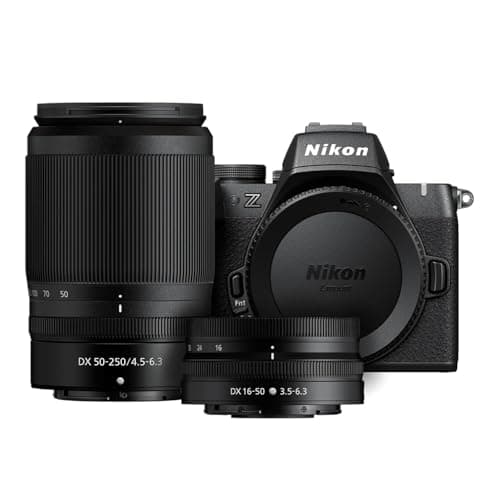
If neither fits: the Nikon Z50 II
The Nikon Z50 II is the third pick for anyone who wants the R10's action focus with more in the box. Nikon lists a 20.9MP sensor, its EXPEED 7 processor, 11fps with the mechanical shutter and 30fps electronically, with pre-release capture that keeps up to a second of frames from before you fully press the shutter. DPReview lists birds, dogs and cats among its nine detectable subject types, and Nikon quotes 4K60 video, 4K oversampled from 5.6K and a viewfinder that reaches 1,000 nits of brightness. The catches: like the R10 it has no in-body stabilization, DPReview found its tracking less dependable than Nikon's pro models, and its CIPA rating of 230 shots through the viewfinder is only a little better than the R10's.
What makes it worth a look is the box. The listing we link is Nikon's two-lens kit, with the NIKKOR Z DX 16-50mm VR standard zoom and the 50-250mm VR telephoto, and when we checked it cost a little less than the a6700 body alone. If you want to photograph sport or wildlife without buying a lens separately, that makes it a strong alternative to both. Our Nikon Z50 II review covers it in full.
The bottom line
The a6700 is the more complete camera; the R10 wins on burst speed, weight and price. If you will use its stabilization, video tools, battery and lens catalog, it is worth the extra, and it is the body you are least likely to outgrow. The R10 is a genuinely quick, capable stills camera that leaves money for a lens, and for a beginner photographing moving subjects in good light that trade-off can be the smarter one. Decide which of those two descriptions sounds like you, and the choice makes itself.