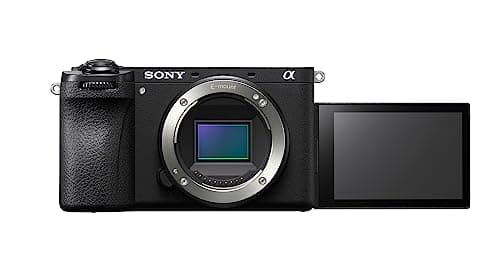
The Sony a6700 is the APS-C body to buy when you have outgrown a beginner camera and know exactly which limitation you are trying to escape. In-body stabilization, AI-driven subject recognition and oversampled 4K60 are all genuine upgrades. For a first camera, they are expensive answers to problems you have not met yet.
The usual disclosure: we have not lab-tested the a6700. This is compiled from Sony's published specifications and documented owner experience, scored against our rubric. Informed opinion, not measurements.
Who it's for
The a6700 is for the second-camera buyer. Somebody who has shot an a6100, an a6400 or a ZV-E10 for a year or two, has a couple of lenses, and has hit a specific wall: handheld video that will not hold still, autofocus that loses a bird or a dog, or 4K that tops out at 30 frames per second when they want slow motion. Each of those is exactly what the a6700 fixes.
It also suits the hybrid shooter who wants one body to do stills and serious video without moving to full frame. The 26MP sensor is the newest in Sony's crop lineup, the video side records oversampled 4K with proper log profiles, and the fully articulating screen finally makes it usable for filming yourself — something older a6000-series bodies were poor at.
Who should look past it? Almost every first-time buyer. The Sony a6400shares the mount, the sensor size and much of the autofocus reputation for substantially less, and the money saved buys a lens that will improve your photographs more than any of the a6700's headline features will. Our a6400 vs a6700 comparison is the page to read if that is the decision in front of you.
Where it's strong
In-body stabilization, at last
This is the headline upgrade for the a6000 line. Five-axis in-body image stabilization shifts the sensor to counteract hand movement, which does two things: it lets you hand-hold stills at slower shutter speeds in dim light, and it smooths out handheld video enough that a lot of casual walking footage becomes usable without a gimbal. Every earlier a6000-series body relied entirely on stabilized lenses. If handheld video is why you are upgrading, this alone may justify it.
AI-based subject recognition
Sony's newer autofocus adds a dedicated processing unit trained to recognize subjects — human pose as well as eyes, plus animals, birds, insects, cars and aircraft. In practice it means the camera keeps hold of a subject that turns away, ducks behind something, or is too small in frame for eye detection to work. Sony's autofocus was already the class benchmark; this is the version that stops losing the hard cases.
Oversampled 4K60 and real video tools
The a6700 records 4K up to 60 frames per second, oversampled from a higher-resolution readout, along with S-Log3 and S-Cinetone profiles for people who grade their footage. It also gets the fully articulating screen that the a6400 lacked. For a hybrid creator this is the moment the crop-sensor Sony line stopped being a stills camera that also filmed.
The E-mount lens catalog
The reason to buy into Sony has always been the glass, and it still is. Sony E-mount has the deepest affordable third-party lens catalog of any mirrorless system — Sigma, Tamron and Viltrox all build for it, and the used market is large. Whatever you want to shoot, there is a lens for it at more than one price. That depth is one reason the a6700 wins our Canon R10 vs Sony a6700 head-to-head. See our budget Sony E lens guide for the practical starting points.
The honest catches
The price puts it against full frame
This is the central tension. The a6700 is priced where entry-level full-frame bodies live, and a bigger sensor gathers more light. We do not think that makes the a6700 a bad buy — crop-sensor lenses are smaller, cheaper and lighter, and for video the crop is often an advantage — but you should make that choice deliberately rather than by accident. Our APS-C vs full frame guide and do I need full frame lay out the trade.
It is more camera than a beginner will use
Log profiles, subject-recognition sub-menus, custom button assignments — the a6700 has the depth an enthusiast wants and the density a newcomer finds discouraging. A first camera should invite you to pick it up. If you have never shot manual, this is not where to start; buy a cheaper body and a good prime, learn on those, and upgrade when you can name the feature you are missing.
Single card slot, and pack a spare battery
There is one UHS-II SD slot rather than two, which matters if you ever shoot paid work where a redundant backup is expected. Battery life is respectable for the class but the body is small, so a spare is a sensible purchase rather than an optional one. Neither is a flaw at this price — both are worth knowing before you assume the a6700 is a professional body in miniature.
Rolling shutter still exists
The sensor readout is faster than the older a6000-series chips but it is not a stacked sensor, so quick pans and fast lateral movement can still show skew in video. For talking heads, travel footage and most creator work you will not see it. For whip pans and motorsport, it is a real limitation of the class rather than of this camera specifically.
The verdict
The a6700 is the best APS-C camera Sony makes and a genuinely satisfying hybrid body. IBIS and the newer autofocus are not marketing — they remove two specific, everyday frustrations — and 4K60 with proper profiles gives the video side room to grow.
But it earns its price only from someone who can name what they are upgrading from. If you are buying your first interchangeable-lens camera, the honest recommendation is to spend less on the body and more on lenses: start with the beginner ranking, and come back to the a6700 when a specific limitation is costing you shots.
What 10-bit S-Log3 buys you
It is the specification that most clearly separates this body from the cheaper Sony crop cameras, and it is also the one most often bought and never used. Whether it is worth paying for depends entirely on whether you grade, which we work through in do you need 10-bit video.