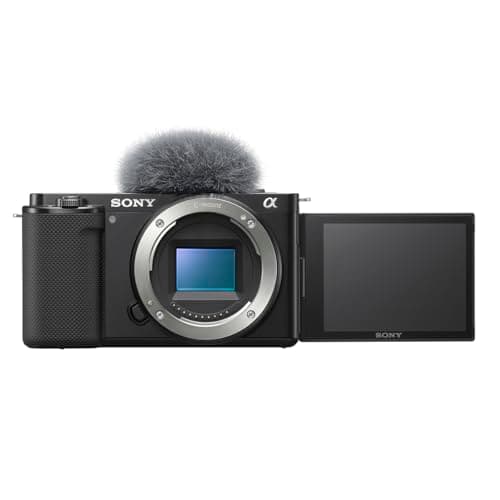
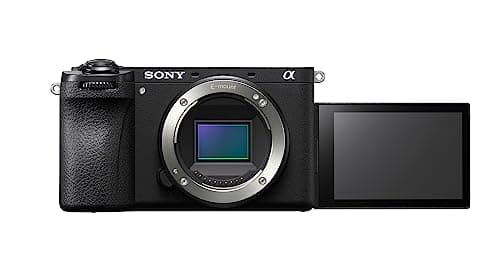
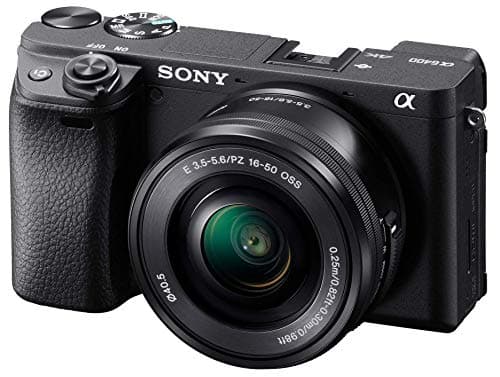
Buy the Sony a6400 if you mostly take photos: it has the electronic viewfinder the ZV-E10 lacks, a tougher magnesium-alloy body, and the a6400 listing we link includes a 16-50mm kit lens for roughly what the ZV-E10 costs as a bare body. Buy the ZV-E10 if you mostly film yourself: its screen swings out to the side, its three-capsule microphone comes with a windscreen, and it has the headphone jack and plug-in USB streaming the a6400 does not. Underneath, the two are closer than their names suggest. Both pair a 24.2-megapixel APS-C sensor with Sony's BIONZ X processor, both use the E-mount and the same battery, and both shoot 4K the same way. The decision comes down to which way the camera faces while you use it.
The usual note on method: we have not tested either camera. Everything below comes from Sony's published specifications, help guides and launch announcements, plus the measurements and findings DPReview published in its full reviews of both bodies, all linked in Sources. Prices were checked on September 18, 2026; the live figures sit in the table below this breakdown.
At a glance
| Spec | Sony ZV-E10 | Sony a6400 |
|---|
| Announced | July 2021 | January 2019 |
| Sensor and processor | 24.2MP APS-C Exmor CMOS, BIONZ X | 24.2MP APS-C Exmor CMOS, BIONZ X |
| Viewfinder | None | 0.39-type OLED, 2,359,296 dots |
| Rear screen | 3.0-type touchscreen, side-opening vari-angle | 3.0-type touchscreen, tilts up 180 degrees |
| Built-in microphone | Directional three-capsule, windscreen supplied | Stereo |
| Headphone jack | Yes (3.5 mm) | No |
| Eye AF while recording video | Yes | No, per Sony's help guide |
| 4K crop (DPReview) | None at 24p, 1.23x at 30p | None at 24p, 1.2x at 30p |
| 4K rolling shutter (DPReview) | 33ms at 24p, 27ms at 30p | 40ms at 24p, 31ms at 30p |
| In-body stabilization | None; electronic Active mode for video | None |
| Body | No dust or moisture claim from Sony | Magnesium alloy; weather-sealing claimed by Sony |
| Built-in flash | None | Built-in, guide number 6 |
| USB | USB-C, streams as a standard webcam | Micro USB (USB 2.0) |
| Battery and CIPA rating (DPReview) | NP-FW50, 440 shots | NP-FW50, 410 shots |
| Weight with battery and card | 343 g | 403 g |
| The listing we link | Body only | Kit with 16-50mm zoom |
The differences that actually matter
1. The viewfinder: the one thing you cannot add later
The a6400 has a 0.39-type OLED electronic viewfinder with 2,359,296 dots. The ZV-E10 has no viewfinder at all. For photography this is the biggest single difference between the two, and it is why the a6400 is the better photo camera. A rear screen washes out in bright sun, and holding a camera at arm's length is less steady than bracing it against your face. If you shoot travel, street, hiking or kids outdoors, you will use the viewfinder every day. If you mostly point the camera at yourself, you will almost never miss it. Everything else on the ZV-E10 can be improved with an accessory; the missing viewfinder cannot.
2. The screen: side-flip versus a 180-degree tilt
The ZV-E10's screen opens to the side and swivels to face you, and Sony built it that way on purpose: the launch announcement says the side-opening design lets you mount an external microphone on top and still see the screen. The a6400's screen tilts up 180 degrees to face forward, which works for a quick selfie, but DPReview found that "any hotshoe-mounted microphone will block almost all of the screen." That is the crux of the vlogging question. For stills the tilt screen is perfectly good, and it keeps the screen in line with the lens for waist-level and overhead shots. One small catch on the ZV-E10: DPReview noted that a cable in its headphone jack gets in the way of the screen as it swings out.
3. Audio: the ZV-E10's clearest win
The ZV-E10 has a directional three-capsule microphone and ships with a furry windscreen for it; DPReview listed the onboard mic as one of the camera's strengths. The a6400 has an ordinary stereo mic. Both have a 3.5 mm microphone input, but only the ZV-E10 has a headphone jack, so only the ZV-E10 lets you hear what you are recording while you record it. If you plan to add an external mic anyway, the gap narrows on sound quality, but on the a6400 that mic sits right over the flipped-up screen, which takes you straight back to difference two.
4. Autofocus: a tie for photos, the ZV-E10 for video
For stills, both cameras have Sony's Real-time Tracking and Real-time Eye AF. The a6400 launched with 425 phase-detection points and what Sony called the world's fastest autofocus acquisition, at 0.02 seconds, and DPReview described its autofocus as an "industry-leading implementation." DPReview called the ZV-E10's tracking "class-leading" too. The real difference is in video. The a6400 help guide states that Eye AF is unavailable during movie shooting, while the ZV-E10 launched with Real-time Eye AF for video. The ZV-E10 also adds two creator shortcuts: Product Showcase, which shifts focus from your face to an object you hold up to the lens, and a Background Defocus button that opens the aperture to blur the background with one press. DPReview noted the exposure flutters if you toggle that button mid-recording, so set it before you roll.
5. 4K video, rolling shutter and heat
Both cameras record 4K from a full readout of the sensor, and both handle frame rates the same way: 24p uses the full sensor width, and 30p adds a crop, which DPReview put at 1.2x on the a6400 and 1.23x on the ZV-E10. Both also show rolling shutter, the wobbly "jello" look on fast pans. DPReview measured the ZV-E10's readout at 33ms in 4K/24p and 27ms in 4K/30p, against 40ms and 31ms for the a6400, so the ZV-E10 is slightly quicker, but DPReview flagged heavy rolling shutter on both. On heat, Sony's ZV-E10 guide says the camera shuts itself down after roughly 20 to 30 minutes of continuous 4K at 77°F with its heat-shutdown setting on Standard, or about 30 minutes with that setting on High. DPReview reported that Sony removed the a6400's recording-time limit and that it ran noticeably cooler than earlier Sony models. For talking-head clips and B-roll neither is a problem; for long, unbroken event recording, plan for breaks.
6. Stabilization: neither has it in the body
Neither camera has in-body image stabilization. The ZV-E10 adds an electronic Active mode for handheld video, which smooths footage by cropping in further (DPReview reported a 1.44x crop). The a6400 leans on optically stabilized lenses or a gimbal. For stills at normal shutter speeds this rarely matters; for walking shots it matters a lot, and it is the main reason people step up to the a6700 covered below.
7. Build: the a6400 is the tougher camera
Sony's launch announcement describes the a6400's "tough magnesium alloy design" and a shutter rated for approximately 200,000 cycles, and DPReview's review notes Sony claims weather-sealing. Sony makes no dust or moisture claim in the ZV-E10's specifications, and DPReview called its port door "flimsy-feeling." The a6400 also has a small built-in flash with a guide number of 6; the ZV-E10 has none. Both use a mechanical focal-plane shutter with speeds from 1/4000 to 30 seconds and shoot up to 11 frames per second, so on the stills side there is little to separate them.
8. Streaming and ports
The ZV-E10 has a USB-C port and works as a standard UVC/UAC webcam: plug it into a computer and it streams video and audio with no extra software, although DPReview notes the USB stream is 720p. The a6400 has an older Micro USB port and needs Sony's free Imaging Edge Webcam app, which Sony lists as compatible with the a6400 on Windows 11 and on Macs with Apple silicon. Both work; the ZV-E10 is simply less fuss for a permanent desk setup.
9. Size, weight and battery
The ZV-E10 weighs 343 g with battery and card against 403 g for the a6400, and it is a few millimeters narrower and shorter (115.2 × 64.2 mm on the front, versus 120 × 66.9 mm). That 60 g adds up when you hold the camera out at arm's length for a whole vlog. Both run on the same NP-FW50 battery, rated by CIPA at 440 shots for the ZV-E10 and 410 for the a6400, so spares are interchangeable if you ever own both. Neither lasts a long shooting day on one charge; budget for a spare either way.
10. Price and what is in the box
This is where the usual advice has shifted. The ZV-E10 launched as the cheaper camera, but the ZV-E10 we link is body only, so you still need a lens, while the a6400 we link is the kit with Sony's 16-50mm f/3.5-5.6 zoom. When we checked on September 18, 2026, the a6400 kit cost only a little more than the ZV-E10 body on its own. That makes the a6400 the better value for anyone who does not specifically need the ZV-E10's video features. Prices move, so check the live figures in the table below before you decide.
What is the same
Plenty. The sensor resolution, processor, lens mount, battery, shutter speed range and burst rate all match, and the 4K crop pattern is nearly identical, so on paper there is no reason to expect a difference in the photos themselves. Every E-mount lens fits both, which means the lens you buy for one carries straight over if you switch later. And both are older designs: the a6400 was announced in January 2019 and the ZV-E10 in July 2021. Neither has the in-body stabilization, 4K60 or modern menus of Sony's newer bodies. Our full Sony ZV-E10 review and Sony a6400 review cover each one on its own terms.
Who should buy which
Buy the a6400 if photography comes first, if you shoot outdoors in bright light, or if you want a camera you can take into drizzle and dust with more confidence. The viewfinder, the magnesium-alloy body and the kit lens in the listing we link make it the more complete camera for most beginners, and at the price we saw it is the better deal. It still shoots very good 4K; it is just awkward to point at yourself with a microphone on top.
Buy the ZV-E10if you are making videos of yourself: YouTube, TikTok, tutorials, product reviews or live streams. The side-flip screen, the three-capsule mic and windscreen, the headphone jack, Eye AF while recording and plug-in USB streaming are all features the a6400 does not have, and most of them cannot be bolted on later. It is also 60 g lighter, which you notice at arm's length. Just remember it is body only in our listing, so add a lens to the budget; our best budget Sony E-mount lenses ranking covers the cheap options, including wide primes that suit vlogging.
If you want both jobs done well: the Sony a6700
The third pick above is the camera that removes the choice. The a6700 has a 2.36M-dot viewfinder and a fully articulating screen, so it frames stills at your eye and swings out for vlogging. It adds 5-axis in-body stabilization rated at 5.0 stops, oversampled 4K at up to 60p, both microphone and headphone ports, and UVC/UAC streaming up to 4K/30, per DPReview. Its magnesium-alloy body is sealed at the joins, and it uses Sony's larger NP-FZ100 battery, rated at 570 shots. The catch is cost: the a6700 listing we link is body only and costs far more than either camera here, before you add a lens. If that stretch is possible, read our Sony a6400 vs a6700 comparison first, because it lays out exactly what the extra money buys.
If neither Sony quite fits
If you want to look beyond Sony without paying a6700 money, the camera most people weigh next is the Canon EOS R50; our ZV-E10 vs Canon R50 comparison explains that trade, which is mostly about lenses. If the real appeal of the ZV-E10 is making videos with as little gear as possible, a fixed-lens compact may suit you better; see Sony ZV-E10 vs ZV-1 II. And if you are still setting a budget, our guide to how much to spend on a first camera shows what each price bracket actually buys.
The bottom line
These two share a sensor, a mount and a battery, so you are not choosing between better and worse pictures. You are choosing between a camera that faces away from you and one that faces toward you. Stills-first beginners should take the a6400, and at today's pricing they get a lens in the box too. Creators who will spend most of their time on the other side of the lens should take the ZV-E10, and budget for a lens alongside it.