Most beginners should plan to spend about $750 to $1,000 on a first camera, including a kit lens. That is the bracket where you get a viewfinder and a flip-out screen in the same body, subject-detecting autofocus and clean 4K video, which covers most of what a beginner will use for the first few years. You can start for less, with a new vlog-style kit in the $500 to $750 range or a used body under $500, and there are specific reasons to go up to $1,500. Past that, the extra money mostly buys features beginners rarely touch, and it does more for your pictures if you spend it on a lens.
Two things to know about those numbers. First, they are for the whole kit with a lens, because a body on its own cannot take a picture. Second, older rules of thumb are out of date. In July 2025, Digital Camera World reported US price increases across Sony's APS-C line, citing tariffs, and noted that Canon, Nikon, Leica and Sigma had raised US prices that year too. When we checked the live listings on September 18, 2026, none of the new interchangeable-lens beginner kits we track with a verified price came in under $500.
How we worked this out: we have no test lab, and we do not pretend to. The brackets come from the live listings we track, and the features in each one come from the manufacturers' published specifications and from DPReview's reviews of the same bodies, all linked in Sources. We use one real, current camera as the example in each bracket so the claims are concrete rather than generic.
The brackets at a glance
| Budget (kit with a lens) | What you get | What you usually give up | Example body |
|---|
| Under $500 | A used or refurbished body from a generation or two back | A new-camera warranty (unless refurbished), the newest autofocus and video | The used route |
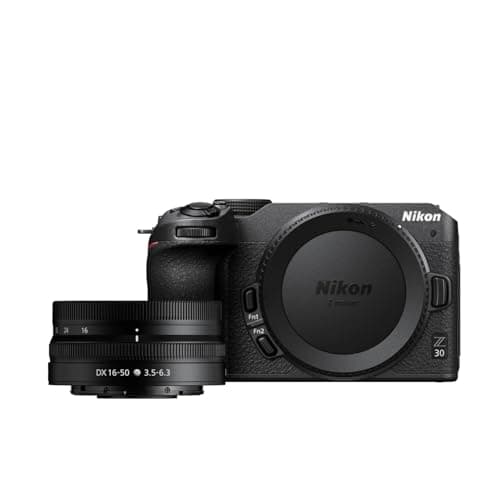
| $500 to $750 | A flip-out screen, 4K30, people and animal detection, a mic input | A viewfinder, a headphone jack, in-body stabilization | Nikon Z30 kit |
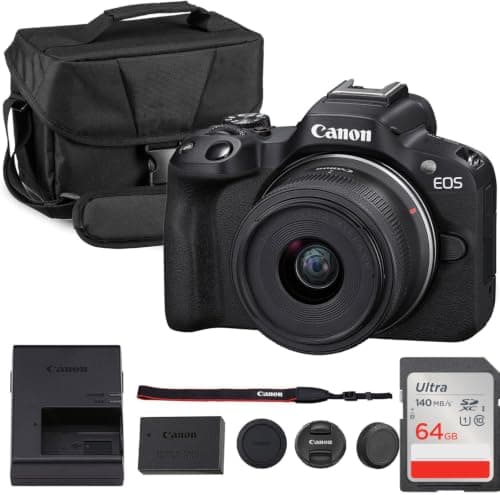
| $750 to $1,000 | A viewfinder and a flip-out screen together, oversampled 4K30, wider subject detection | In-body stabilization, 4K60, battery life | Canon EOS R50 kit |
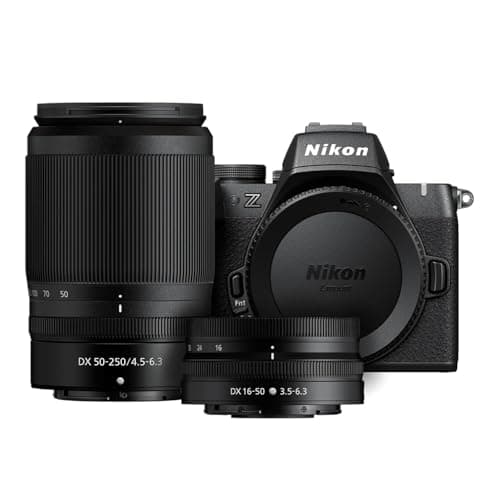
| $1,000 to $1,500 | 4K60, a headphone jack, a faster card slot, more subject types, sometimes a second lens | In-body stabilization | Nikon Z50 II two-lens kit |
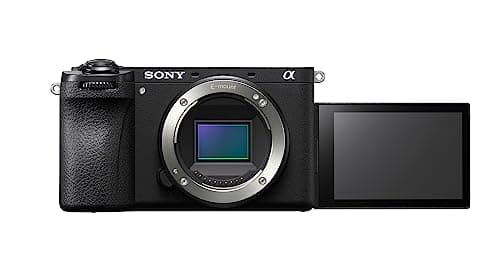
| $1,500 and up | In-body stabilization, oversampled 4K60, a sealed metal body, a much bigger battery | Money you could have spent on lenses | Sony a6700 plus a lens |
What each bracket actually buys
Under $500: the used and refurbished bracket
New interchangeable-lens kits at this price are now mostly a matter of catching a sale. The reliable way to spend under $500 is second-hand or refurbished, where a body a generation or two old often still has good autofocus and takes photos that are hard to tell from the current model's in everyday use. Manufacturer-refurbished gear is the safest version of this: Digital Camera World reported that Canon's US refurbished cameras carry the same one-year warranty as new ones, with the catches that stock is limited for newer models and units ship in a plain white box. Our guide to buying a used camera covers what to check, and our best mirrorless cameras under $500 ranking tracks what is still possible at this line, which is mostly last-generation bodies and sale prices.
$500 to $750: a flip screen and 4K, but no viewfinder
This is where new vlog-style kits live, and the Nikon Z30 is the example. Nikon's specifications list a 20.9-megapixel APS-C sensor, a 3.0-inch vari-angle touchscreen, 4K at up to 30p, subject detection for people and animals, and a 3.5 mm microphone jack. What is missing is telling: there is no viewfinder, Nikon lists no headphone jack, stabilization is electronic and for video only, and the card slot is the slower UHS-I type. For someone who mostly films themselves, none of that hurts much. For someone who mostly takes photos outdoors, composing on a rear screen in bright sun is the price of entry at this level.
$750 to $1,000: the sweet spot
This bracket adds the thing a stills-leaning beginner misses most, a viewfinder, without taking away the flip screen. The Canon EOS R50 is the example: Canon lists a 2.36-million-dot OLED viewfinder alongside a 1.62-million-dot touchscreen that DPReview notes fully articulates, 4K taken from the full sensor width with 6K oversampling, and Dual Pixel CMOS AF II with subject detection for people, animals and vehicles. It does all that at 375 g with battery and card, lighter than the Z30's 406 g despite the added viewfinder. The trade-offs: Canon's specifications list neither in-body stabilization nor 4K60, and the battery is small, with DPReview rating the R50 at 230 shots per charge through the viewfinder. The Sony a6400 kit sits in this bracket too, and if you are weighing Sony's viewfinder body against its vlogging body, our Sony ZV-E10 vs a6400 comparison breaks that choice down.
$1,000 to $1,500: faster video and better connections
Here the gains shift from basics to refinements. The Nikon Z50 II is the example, and in the listing we link it comes as a two-lens kit. DPReview lists subject detection across nine subject types, from people and pets to birds and vehicles, a viewfinder that reaches 1,000 nits of brightness, 4K30 oversampled from 5.6K, a headphone socket and a faster UHS-II card slot. It also adds 4K60 for slow motion, though DPReview notes that mode comes from a cropped region of the sensor. What it still lacks is in-body stabilization; DPReview wrote that "something that counts against all the cameras in this class is the lack of in-body stabilization." Battery life is modest too, at 250 shots per charge on the rear screen.
$1,500 and up: stabilization and a tougher body
Among the bodies we track, in-body stabilization only appears once the whole kit crosses $1,500. The Sony a6700 is the example, and the listing we link is body only, so a lens goes on top. Per DPReview, it has 5-axis in-body stabilization rated at 5.0 stops, 4K60 oversampled from the full sensor width, 4K120 from a 1.58x crop, and AI subject recognition for humans, animals, birds, insects, cars and trains, and airplanes. The magnesium-alloy body is sealed at the joins, the NP-FZ100 battery is rated at 570 shots, and there are microphone and headphone ports plus a UHS-II slot. This is a camera a beginner will not outgrow; it is also more camera than most beginners will use in year one.
Where the returns start to diminish
The thing that barely changes across these brackets is the picture you get in good light. The four example bodies range from 20.9 to 26 megapixels, all on APS-C sensors. DPReview scored the R50 at 84%, and both the Z50 II and the a6700 at 88%, a four-point spread, while an a6700 kit costs roughly double an R50 kit. The biggest practical jump for most beginners is from the first new-camera bracket to the second, because that is where the viewfinder arrives. After that, each step buys something specific: 4K60 for slow motion, stabilization for handheld video and slow shutter speeds in dim rooms, sealing for bad weather. If you cannot name the feature you would use, stop at $750 to $1,000 and put the rest toward a lens.
Spend on the lens, not the body
The kit zoom that comes in the box is a convenient starting point, but it is the weak link. Sony's 16-50mm kit zoom is an f/3.5-5.6 lens and Canon's RF-S 18-45mm is f/4.5-6.3, so at the long end they let in little light. A prime lens at f/1.8 gathers more than three stops more light than f/5.6, roughly ten times as much. That buys faster shutter speeds indoors, lower ISO settings with less visible grain, and the soft, blurred backgrounds that make a photo look like it came from a real camera. No step up in APS-C body gives you all of that. Lenses also move with you: every lens you buy for one body fits the next body on the same mount. Our best 50mm lensesranking is the place to start. As a rule, if the choice is the next bracket's body with a kit lens or this bracket's body plus a fast prime, the prime wins for photos, unless the pricier body adds a feature you know you need, like stabilization for walking video.
Previous-generation bodies are the quiet bargain
Cameras are not phones; a body that is several years old is not obsolete. Sony announced the a6400 in January 2019 with Real-time Eye AF and Real-time Tracking, and it is still sold new today. Older bodies usually give up newer processors and video modes rather than image quality, and those are features a beginner is least likely to miss. Between a stripped-down new body and a well-equipped older one at the same price, the older one often gives you more camera.
The costs that are not on the price tag
The number on the listing is rarely the number you spend. Several popular bodies are sold body only in the listings we link, including the Sony ZV-E10, the Sony a6700 and the Canon EOS R10, so a lens is a real line item, not an extra. A fast memory card rated for 4K is non-negotiable if you shoot video, and a spare battery is close to essential when a camera like the R50 is rated for a couple of hundred shots per charge. Our breakdown of what a beginner camera kit really costs does the full accessory math, so we will not repeat it here; the short version is to set a total budget first and let the body take only part of it.
Here are the four bodies we used as examples, one per new-camera bracket. The Canon R50 comes first because it sits in the bracket we recommend to most beginners; the Nikon Z30, Nikon Z50 II and Sony a6700 follow in order of budget, from the cheapest to the most expensive. Each sits in its bracket by its live price on September 18, 2026; prices move with sales, so if one drifts across a line, the live price on its buy button is the number to trust.
How to set your own number
- Name what you will shoot most. Photos of people and places, video of yourself, kids and pets in motion, or a mix. This decides whether you need a viewfinder, a side-flip screen or burst speed, and those features sit in different brackets. If you are unsure, our guide to what camera to buy matches bodies to use cases.
- Pick the lowest bracket that has what you named. A vlogger can stop at $500 to $750. A stills shooter who wants a viewfinder should plan on $750 to $1,000. Only move higher for a specific feature, such as stabilization for handheld video.
- Add the kit costs, then check the total. Lens if the body is sold alone, a card, a spare battery, and a microphone if you film yourself. If the total breaks your budget, drop a bracket on the body rather than skipping the lens or the battery.
When spending more is worth it
There are real reasons to go past $1,000, and they are specific. If you plan to film while walking, in-body stabilization can spare you a gimbal for casual handheld shots. If you want slow-motion 4K, you need a body with 4K60. If you shoot kids' sports or birds, stronger subject detection and faster burst rates matter more than anything else on the spec sheet. And if you shoot in rain and dust, a sealed body is worth paying for. Our best mirrorless cameras under $1,000 ranking covers the bodies that stretch furthest before you cross that line.
When spending less is the smarter move
If you are not sure the hobby will stick, spend less. A cheaper body is a smaller loss if it ends up in a drawer, and it will still be more camera than your skills need for the first year. If your phone already covers your everyday shots and you mainly want background blur and better low-light pictures, the cheapest body you can pair with a fast prime will do more for you than a pricier body with a kit zoom. Our best budget mirrorless cameras ranking lists the cheapest body worth owning in each system, with the corners each one cuts.
Buying a first camera as a gift
The same logic holds, with one tweak: buy the kit, not the body. A gift that arrives with a lens, a card and a charged battery gets used the same day, while a bare body sits in its box until someone buys the rest. If the budget only stretches to the $500 to $750 bracket, that is fine; a first camera that gets used teaches more than a better one that does not.