Skip to content
Focal & Frame

Creator · Vlogging Cameras

Sony ZV-E10 vs ZV-1 II

One takes lenses and has a much bigger sensor. The other fits in a coat pocket and never needs a decision. The right answer depends on one honest question about yourself.

By Stephen V.Updated How we research
#ad

We earn a commission when you buy through our Amazon links, at no extra cost to you. It never decides our rankings — we say so when the cheaper pick is the better buy. How this works.

Buy the Sony ZV-E10 if you want the better image and a system to grow into: a much larger APS-C sensor, interchangeable lenses, and the cheapest lens catalog in mirrorless. Buy the ZV-1 II if you want a camera that lives in a coat pocket, covers wide-to-normal with a built-in zoom, and never asks you to choose anything. Both are Sony creator cameras with flip-out screens, background-defocus buttons and the same friendly autofocus lineage. The difference is structural, not incremental.

The four things that actually differ

1. Sensor size — the difference you will see

The ZV-E10 has an APS-C sensor. The ZV-1 II has a 1-inch sensor. APS-C is roughly two and a half times the surface area, and sensor area is essentially how much light the camera can collect. In good daylight both look good. In a normally lit living room, a cafe in the evening, or anywhere the lights are low, the ZV-E10 holds detail and stays cleaner while the ZV-1 II gets grainy. It also blurs backgrounds more easily, which is most of what people mean when they say footage looks "cinematic."

2. Lenses versus no lenses

The ZV-E10 takes Sony E-mount lenses, which is both its biggest advantage and its biggest catch. Advantage: you can buy a fast prime for low light and background blur, a wide zoom for cramped rooms, or a telephoto for reach, and third-party makers sell all of them cheaply — see our budget Sony E lens guide. Catch: the body alone is not the whole cost, and choosing lenses is a job you now have. The ZV-1 II's built-in 18-50mm-equivalent zoom covers arm's-length selfie framing through to a flattering talking-head crop, and that is the end of the discussion.

3. Size, and whether it comes with you

The ZV-1 II genuinely fits in a jacket pocket. The ZV-E10 with a lens on it does not — it needs a small bag. This sounds trivial and is not: the camera that is with you takes the shot. If you know from experience that you leave bulky things at home, weight that heavily, because a slightly worse image you actually captured beats a better one you did not.

4. Price, and where it lands

Sony's pricing here is counter-intuitive and worth stating plainly: the compact ZV-1 II is not automatically the cheaper camera. Check the live prices above before you assume the pocket option saves money. When the two are close, the ZV-E10 is the better technical buy — a bigger sensor and a lens mount for the same or less is not a difficult call. When the ZV-1 II is clearly cheaper, the question becomes whether you value the image or the pocket more.

Where they are the same

Both have a fully articulating screen that faces forward, a dedicated background-defocus button, Sony's product-showcase mode for holding an item up to the lens, and a 3.5mm microphone input. Neither has a viewfinder. Neither has in-body stabilization, so walking footage on either wants a stabilized lens or a gimbal. Both crop their 4K to some degree, so neither is ideal for filming yourself in a very small room without a wide lens.

The short answer

Quick picks

#ProductBest forScorePrice
01
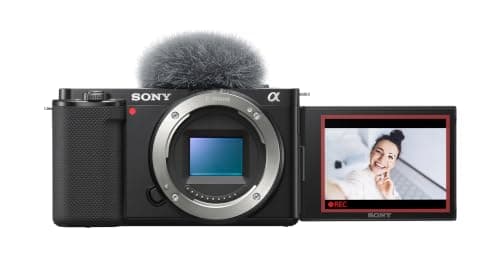
Sony Sony ZV-E10
Sony ZV-E10

The default first vlog camera: a fully articulating screen, class-leading eye autofocus, and both a mic input and a headphone jack — rare at this price.

Video-first beginners who'll add lenses
8.4
$579.00Amazon
02
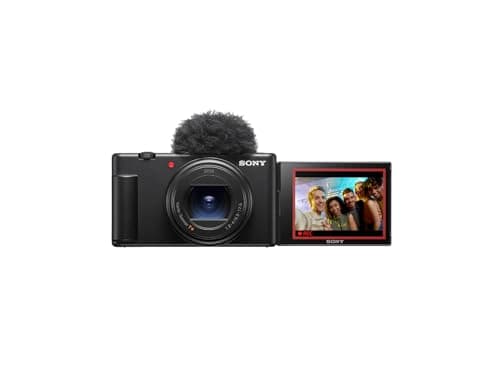
Sony Sony ZV-1 II
Sony ZV-1 II

A pocket all-in-one with a wide-to-normal zoom — no lenses to buy, just switch on and talk.

Grab-and-go vlogging without lenses
7.2
$948.00Amazon

#ad · Live prices from the Amazon Product API, as of Sep 4, 2026. Where we have no verified live price, we show none — we would rather leave a gap than print a number that has rotted.

In detail

The picks, in full

01
Sony Sony ZV-E10

Video-first beginners who'll add lenses

Sony ZV-E10

24MP APS-C4K30 (with crop)Fully articulating screenMic in + headphone out
8.4/10

The default first vlog camera: a fully articulating screen, class-leading eye autofocus, and both a mic input and a headphone jack — rare at this price.

Video quality
7
Autofocus
9
Screen & handling
8
Audio & inputs
9
Value
9

Pros

  • It has both a microphone input and a headphone jack, so you can record and monitor good audio — most rivals at this price give you one or neither
  • Sony's real-time eye AF is the best in the class and keeps your face locked while you move around
  • The E-mount has the deepest catalog of cheap wide primes to grow into, from Sony, Sigma and Viltrox

Cons

  • 4K30 is taken from a cropped region and shows noticeable rolling shutter (jello) on fast pans
  • No in-body stabilization, plus a small grip and battery, so it wants a gimbal or a wide lens for walking shots

Don't buy this if…

you walk and talk a lot without a gimbal. There's no in-body stabilization and the digital Active mode crops in hard — the DJI Osmo Pocket 3's built-in gimbal is far steadier for run-and-gun.

$579.00View on Amazon

$698.0017% off

Price as of Sep 4, 2026. Prices change — Amazon's is the one that counts.

#ad · we may earn a commission from this link to Sony ZV-E10

02
Sony Sony ZV-1 II

Grab-and-go vlogging without lenses

Sony ZV-1 II

20MP 1-inch sensor18-50mm equiv. zoom4K30Flip-out screen
7.2/10

A pocket all-in-one with a wide-to-normal zoom — no lenses to buy, just switch on and talk.

Video quality
7
Autofocus
8
Screen & handling
8
Audio & inputs
6
Value
7

Pros

  • The 18-50mm-equivalent zoom is wide enough for arm's-length selfie framing and long enough for a flattering talking-head, with nothing to swap
  • Pockets easily and includes a capable 3-capsule directional mic built in, plus a flip-out screen
  • Sony's autofocus and a background-defocus button carry over from the bigger ZV bodies

Cons

  • The 1-inch sensor gathers less light than the APS-C bodies, so it's noisier in dim rooms
  • There's a mic input but no headphone jack, and no in-body stabilization for walking shots

Don't buy this if…

you shoot a lot in low light or want the shallow, cinematic background blur of a big sensor. A 1-inch compact can't match an APS-C body with a fast prime there.

$948.00View on Amazon

$1,049.9910% off

Price as of Sep 4, 2026. Prices change — Amazon's is the one that counts.

#ad · we may earn a commission from this link to Sony ZV-1 II

Who should buy which

Buy the ZV-E10 if you film indoors, want visible background blur, or expect to still be using this camera in three years. The APS-C sensor is the better starting point and E-mount is the cheapest system to expand into — a wide vlogging lens or a fast prime later transforms it in a way no setting on the ZV-1 II can.

Buy the ZV-1 II if the camera needs to be in your pocket, if you travel light, or if the idea of researching lenses makes you want to close the tab. The built-in zoom covers the two framings vloggers actually use, the whole thing weighs almost nothing, and there is nothing to forget at home.

The bottom line

This is a genuine fork, not a better-and-worse. The ZV-E10 is the camera you choose when image quality and growth matter most; the ZV-1 II is the camera you choose when convenience does. The mistake is buying the ZV-E10 and never buying a lens for it, at which point you own a bigger camera producing similar results from a kit zoom — if that sounds like you, take the compact and be happy.

If neither is quite right, our best vlogging cameras for beginners ranking puts both against Canon, Nikon and DJI rivals, and Osmo Pocket 3 vs ZV-1F covers the cheaper pocket options.

How we picked

We do not run a testing lab

We compiled the manufacturers' published specifications and manuals, did the cost math, and scored each product against a published rubric. The scores are judgments from that documented research — they are notmeasurements we took, because we do not have a lab and we are not going to pretend we do. Where a number came from someone else's testing, we name and link them in Sources.

Questions

Frequently asked

Is the Sony ZV-E10 better than the ZV-1 II?
Technically yes: the ZV-E10's APS-C sensor is around two and a half times the area of the ZV-1 II's 1-inch sensor, so it is cleaner in low light and blurs backgrounds more easily, and it takes interchangeable lenses. The ZV-1 II wins on size and simplicity. Check the live prices above — they are closer than most people expect. See our full ZV-E10 review.
Do I need to buy a lens with the Sony ZV-E10?
You need at least one. It is often sold with a 16-50mm kit zoom, which is a perfectly fine starting point — shoot it first and learn which focal lengths you reach for. The upgrade that changes the most is a fast prime for low light and background blur; our budget Sony E lens guide ranks the options.
Which is better for travel vlogging?
The ZV-1 II, in most cases — it fits in a pocket, its built-in zoom covers the framings you need, and there is nothing to swap on the move. The ZV-E10 produces the better image but needs a bag and lens decisions. See our travel vlogging camera ranking.
Do either of them have in-body stabilization?
No. Neither has in-body image stabilization, so handheld walking footage on either will show your steps unless you use a stabilized lens, the digital stabilization crop, or a gimbal. For seated and tripod-based filming — most creator work — it makes no difference.

Keep reading

Receipts

Sources

We do not run a testing lab, and we do not pretend to. Specs come from manufacturer sheets and manuals; where a figure came from someone else's measurement, we name and link them. Where we could not verify something, we say so on the page rather than quietly leaving it out. Read our full method.