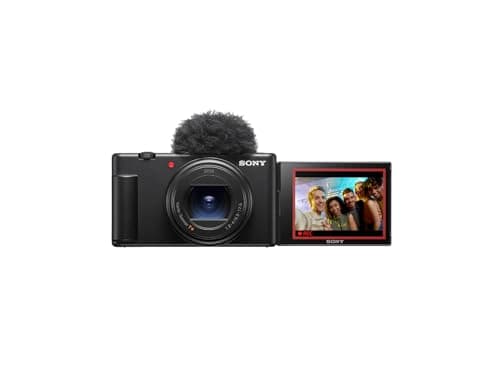
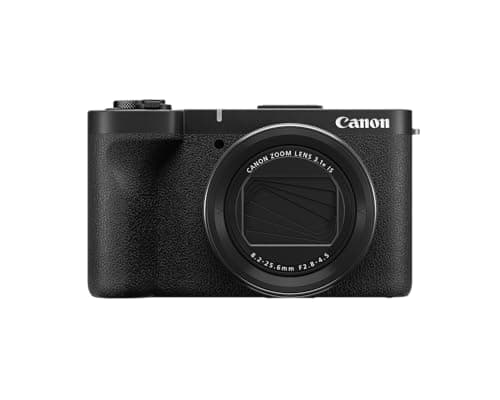
The Canon PowerShot V1 is the better camera of the two for most creators: its 1.4-inch sensor is physically larger than the ZV-1 II's 1-inch chip, its zoom starts wider at 16mm equivalent against 18mm, and it has a 3-stop neutral density filter built into the body — which is the single most useful feature on a fixed-lens camera used outdoors. Choose the Sony ZV-1 II if you want the genuinely smaller, lighter camera, or if the price gap at the moment you buy favours it — check the live prices above, because these two move around.
Both cameras exist to answer the same question: what do you buy if you want much better video than a phone but you do not want to learn a lens system? Both have a zoom built in, both have a screen that flips round to face you, both have a microphone input, and both are small enough to actually carry. Neither has in-body stabilization, so both lean on lens-based and digital stabilization for walking shots — if steady walking footage is the point, the third pick on this page solves it in a way neither of these can.
The honest headline is that Canon arrived late to this category and used the extra time to out-spec Sony on the things that matter in a fixed-lens camera. The honest caveat is that the V1 is a bigger object. Sony's ZV-1 line is genuinely pocketable in a way the Canon is not quite, and for some people that is the entire decision.
At a glance
| Spec | Canon PowerShot V1 | Sony ZV-1 II |
|---|
| Sensor | 1.4-inch, 22.3MP stills | 20MP 1-inch |
| Lens (35mm equivalent) | 16-50mm stills / 17-52mm video | 18-50mm |
| Built-in ND filter | Yes, 3-stop | No |
| Video | 5.7K-oversampled 4K30; 4K60 with a crop | 4K30 |
| Screen | Flip-out, faces forward | Flip-out, faces forward |
| In-body stabilization | No - optical plus digital IS | No |
| Microphone input | Yes | Yes |
| Headphone output | Yes, headphone terminal listed | No |
| Autofocus | Canon Dual Pixel | Sony hybrid AF with background defocus |
| Size and weight | The larger, heavier body | The genuinely pocketable one |
Every figure above is a manufacturer-published specification, named and linked in Sources, plus the measured findings of reviewers we name rather than numbers of our own — we do not run a lab, as our methodology states plainly. Prices are live and carry their own date.
The sensor difference, in plain terms
A 1.4-inch sensor is not dramatically bigger than a 1-inch one — this is not the gulf between a compact and an APS-C body — but it is a real, measurable step in the right direction, and it moves two things. Low light gets a little cleaner, because a bigger sensor of similar resolution collects more light per pixel. And background blur gets a little easier to achieve at the same framing, because depth of field narrows as the capture format grows. Neither difference will make you gasp. Both are the direction you want to be moving in, and the Canon gets them for less money at the moment of writing.
What is worth being clear about: if shallow, cinematic background blur is your main goal, neither of these is the right camera. An APS-C body with a fast prime blurs backgrounds in a way no one-inch-class compact can approach, and it costs roughly the same by the time you have bought a lens. Our under-$1,000 ranking is where that path starts. These two cameras are for people who have decided that carrying one object with no lens decisions is worth more than maximum image quality — a completely reasonable decision, and the reason this category exists.
Why the built-in ND filter matters more than it sounds
It is the V1's best feature and it is easy to skip over. Natural-looking video motion needs a shutter speed around double your frame rate, so roughly 1/60s at 30fps. On a bright day, 1/60s at a wide aperture on a camera with no ND is badly overexposed, and your only outs are closing the aperture down — which removes the background separation you were after — or raising the shutter speed, which makes motion look stuttery and cheap. A camera with a built-in 3-stop ND filter just solves this with a menu toggle. On the ZV-1 II, your options are a screw-on ND filter if the lens takes one, or accepting the compromise. Our filters explained guide covers why this is the one filter video shooters genuinely need.
The wide end: 16mm against 18mm
Two millimetres of equivalent focal length sounds trivial and is not, because at the wide end every millimetre buys a disproportionate amount of angle. Held at arm's length, 16mm fits your head and shoulders plus a readable amount of background; 18mm is tighter and makes a walk-and-talk feel more cramped and more sensitive to how long your arm is. If selfie-framed vlogging is the main job, the Canon's extra width is a daily, noticeable advantage. If you mostly shoot the world in front of you rather than yourself, it matters much less.
Where the Sony still wins
Size. The ZV-1 II is the camera that goes in a jacket pocket. The V1 is the camera that goes in a bag. That is a real, everyday difference and it is the main argument for Sony. Sony's creator features. The background-defocus button and product-showcase mode are genuinely useful shortcuts for solo creators who do not want to think about aperture, and the built-in 3-capsule directional microphone is good for a camera of this size. Lineage. The ZV-1 line is several generations deep, so accessories, tutorials and community answers are abundant, which is worth something when you are learning.
And one practical Canon caveat from reviewers we cite rather than tested ourselves: the V1's 4K60 mode comes with a 1.4x crop, so the camera you framed at 16mm equivalent becomes noticeably tighter the moment you switch to 60fps. If you shoot 60fps as a default for slow motion, factor that in — 4K30 is the uncropped mode.
The third option neither of them beats
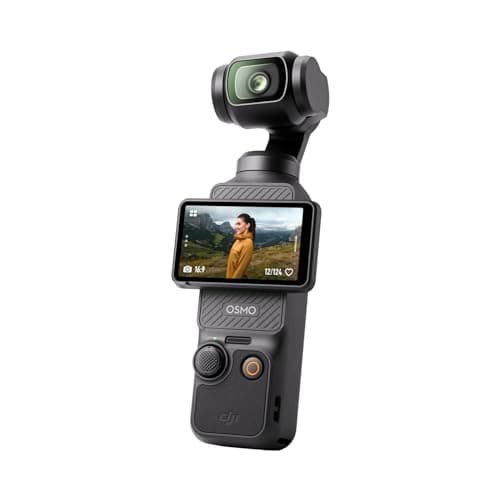
If what you actually want is smooth walking footage, buy neither. The DJI Osmo Pocket 3 is ranked third here because it has a real mechanical 3-axis gimbal inside it, and no amount of digital or optical stabilization in a conventional compact comes close. It is usually the cheapest of the three as well. What you give up is the zoom, the microphone input flexibility, and the ability to use it as a stills camera in any serious way. We compare it directly against Sony's cheapest option in Osmo Pocket 3 vs ZV-1F, and the full picture is in best compact vlogging cameras.
If you are weighing the two Sony compacts against each other rather than against Canon, our ZV-1 II vs ZV-1F comparison is the page for that, and the PowerShot V1 review goes deeper on the Canon alone.