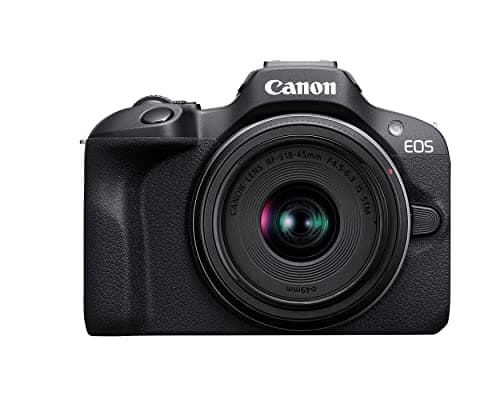
The Canon EOS R100 is the cheapest way into a real interchangeable-lens camera, and it is honest about what it gives up to get there. If your goal is the lowest possible price of entry and you shoot mostly stills in good light, it is a genuine on-ramp — but the fixed, non-touch screen and cropped, slow-focusing 4K are real corners cut, not marketing quibbles.
First, how we work. We have not lab-tested the R100, and we do not pretend to. What follows is compiled from Canon's published specifications and the reported experience of owners, then scored against our rubric. Treat the judgments as informed opinion from documented research, not measurements from a bench we do not own.
Who it's for
The R100 is for the person who wants to step up from a phone to a proper camera for the least money possible, and who mostly takes photos. A parent who wants nicer pictures of the kids, a student on a strict budget, a traveler who wants a dedicated camera without a big outlay — these are the buyers the R100 serves well. It is small, light and about as simple as an interchangeable-lens camera gets, so it is approachable for someone who has never touched a mode dial.
It also suits the buyer who already knows they want into the Canon system on a budget and plans to upgrade the body later while keeping the lens. Because it uses the same RF mount as Canon's pricier mirrorless cameras, a lens you buy for the R100 today moves straight onto an R50 or beyond if you trade up. For that buyer the R100 is a low-cost foot in the door rather than a destination — and there is nothing wrong with treating it that way.
Who should look past it? Anyone who wants to film themselves, shoot serious video, or have room to grow within a single body. The compromises that make the R100 cheap are exactly the ones a creator bumps into first, and for a little more money the Canon R50 removes most of them. If your budget can stretch, we almost always suggest it does.
Where it's fine
Stills in good light
The R100 uses a 24MP APS-C sensor in the same class as Canon's pricier crop-sensor bodies, and in good light it takes genuinely lovely photos. Detail is abundant, color is the pleasant, reliable Canon rendition that flatters skin tones, and there is plenty of resolution to crop into a distant subject. For the daylight photography most beginners actually do — family gatherings, holidays, days out — the pictures that come off an R100 are a huge leap over a phone, and in many situations indistinguishable from what a far pricier Canon would produce with the same lens.
A real viewfinder
Unlike some cheap creator bodies, the R100 keeps a built-in electronic viewfinder. That is a bigger deal than it sounds at this price: it lets you compose with the camera to your eye, which is far easier in bright sun and steadier for stills than holding a camera at arm's length. For a stills-first beginner learning to frame a shot, having a viewfinder to look through is a real and lasting advantage over screen-only rivals.
Small, light and simple
The R100 is one of the smallest and lightest ways into the Canon system, and its simplicity is a feature for the right buyer. Point it, let the automatic modes do their work, and it quietly gets the shot. There is a guided interface to help a newcomer learn what the settings do, and the whole camera is unintimidating in a way that encourages you to carry it and use it — which is the single most important thing a first camera can do.
Genuinely beginner-proof automatic modes
The R100 leans on Canon's long experience making cameras that get out of a beginner's way. Its scene-intelligent automatic mode reads the situation and sets exposure sensibly, so a first-timer can lift the camera, half-press to focus and come away with a well-judged photo without understanding a single setting. As confidence grows there is a full set of manual controls waiting underneath, so the camera does not become a dead end the week you learn what aperture does. For the buyer who wants results today and a gentle path to learning tomorrow, that balance is exactly right — and it is easy to forget how much that matters when you are choosing your very first camera.
The kit lens is a fine place to start
The R100 is usually sold with a compact RF-S kit zoom, and for a beginner that is a perfectly good first lens. It is small, light and versatile enough to cover everyday scenes from a room interior to a portrait, and it keeps the whole package cheap. You will outgrow it eventually — a fast prime opens up low light and blurred backgrounds it cannot match — but there is no need to buy another lens on day one. Learn what focal lengths you reach for with the kit zoom first, then add glass with intent rather than guessing.
The Canon RF mount and a path onward
Buying an R100 buys you into Canon's RF system, which matters if you ever upgrade. The lens is where most people's money ends up over the years, and an RF or RF-S lens bought for the R100 fits Canon's pricier bodies too. A fast prime is the single best upgrade you can make — our best Canon RF lenses guidecovers the options that lift the R100's photos well beyond kit-lens results.
The honest catches
The screen is fixed — and not a touchscreen
This is the R100's defining compromise. The rear screen does not tilt or flip out, so it cannot face you for filming yourself and cannot swing to an awkward high or low angle. Worse for a modern beginner, it is not a touchscreen at all, which means you cannot tap to set your focus point or navigate menus with a swipe the way you can on nearly every rival. You drive everything with buttons, which feels dated the moment you have used a smartphone. If you want to vlog or shoot at creative angles, this alone rules the R100 out.
4K is cropped and focuses slowly
The R100 does list 4K, but with two heavy asterisks. It is recorded from a cropped region of the sensor, so your lenses lose their wide field of view and everything zooms in, and it drops to slower contrast-detect autofocus rather than the smooth, sticky Dual Pixel tracking Canon is known for. Smooth eye tracking is limited to 1080p. In practice the R100 is best thought of as a stills camera that can shoot casual 1080p video, not a 4K creator tool. If video matters at all, this is the corner that will frustrate you.
The RF-S lens range is thin
Canon's native RF-S lenses — the small, affordable ones designed for crop-sensor bodies like this — are the youngest lineup of the big four systems, so the cheap native options are a short list. You can adapt older EF lenses with an adapter, which opens up a lot of inexpensive glass, but that adds bulk and a little cost. It is not a dealbreaker, but it means the R100's upgrade path is narrower and sometimes clunkier than a Sony shooter's.
A stripped-back feature set
To hit its price the R100 also trims the smaller conveniences enthusiasts take for granted: the burst speed is modest, the autofocus system is simpler than its pricier siblings', and there is no in-body stabilization, so handheld video leans entirely on a stabilized lens. None of this stops it taking excellent daylight stills — but it is the honest ledger of what "cheapest way in" actually means, and it is worth reading before you buy.
The verdict
The R100 does exactly one job and does it well: it gets you into a real camera system, with a real sensor and a real viewfinder, for the least money Canon asks. If you shoot mostly stills in good light and want the lowest price of entry, it delivers photos that will delight anyone stepping up from a phone. Just go in clear-eyed about the trade: the fixed non-touch screen, the cropped and slow-focusing 4K, and the thin native lens range are the price of that low price.
For many buyers, the smarter move is to stretch a little. The Canon R50 adds a flip-out touchscreen, uncropped 4K and far better autofocus for not a great deal more, and it is the camera we recommend to most beginners. If your budget genuinely will not move, the R100 is an honest, capable little stills camera — and you can see how it stacks up against other value bodies in our best under $500 ranking and best budget mirrorless guide.
Is the R50 worth the step up?
The R100 exists to be the cheapest door into the RF mount, and the question almost everyone asks next is whether the extra for an R50 buys enough: a touchscreen that articulates, uncropped 4K and a far better autofocus implementation. We set the two side by side in Canon R50 vs R100.