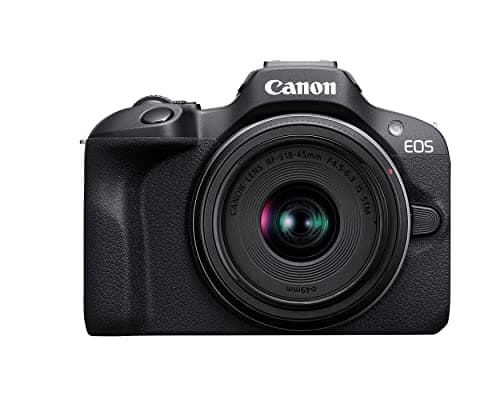
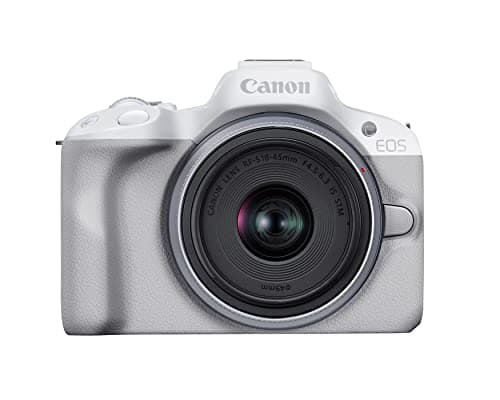
Buy the Canon EOS R50. It adds a flip-out touchscreen, uncropped 4K30 and Canon's proper Dual Pixel autofocus for a modest step up in price, and those three things are exactly what a beginner runs into first. The R100 only makes sense when the budget genuinely will not move and you shoot stills in good light. Both cameras use a 24MP APS-C sensor and the same RF mount, so the lenses you buy fit either — and either can be upgraded later without replacing your glass.
The four things that actually differ
1. The screen: this is the decision
The R50 has a fully articulating touchscreen that flips out and around to face you. The R100 has a fixed screen that does not tilt, does not flip, and — the part people miss — is not a touchscreen at all. That means no tapping to place your focus point, no swiping through menus, and no way to see yourself while filming. If you have used a smartphone, the R100's screen feels like a decade-old device. For anyone who films themselves, shoots at high or low angles, or simply expects to tap where they want the camera to focus, this single difference settles the comparison.
2. 4K video: uncropped versus cropped and slow to focus
Both list 4K, and the listings mean different things. The R50 records 4K30 from the full sensor width, oversampled from 6K, with Dual Pixel autofocus running. The R100 takes its 4K from a cropped region of the sensor — so every lens zooms in and a small room becomes impossible to frame — and it falls back to slower contrast-detect focus, with smooth eye tracking limited to 1080p. Treat the R100 as a stills camera that shoots casual 1080p.
3. Autofocus: the same brand name, different results
The R50 uses Dual Pixel CMOS AF II with subject detection for people, animals and vehicles — the same intelligence Canon puts in its far pricier bodies. The R100's system is older and simpler, and it is noticeably less confident on moving subjects and in video. In still photography of a static scene, you will not see a difference. Photographing a child, a pet or anything that moves, you will.
4. Price and what the gap actually buys
The R100 is the cheaper camera, and if it is the difference between owning a real camera and owning none, that matters. But the gap between them is usually smaller than the cost of a single decent lens — and unlike a lens, the R100's compromises cannot be fixed later. Our honest advice for anyone who can flex the budget: buy the R50 body and put the rest toward a fast RF prime, which will change your photos more than either body will.
Where they are the same
It is worth being clear about what you are notgiving up with the R100. Both have a 24MP APS-C sensor of the same class, so daylight image quality is very close. Both have an electronic viewfinder, which is not a given at this price and is a real advantage over screen-only creator bodies. Both use the Canon RF mount, so lenses carry across, and both can adapt EF DSLR lenses with Canon's adapter. And neither has in-body stabilization, so handheld video on either leans on a stabilized lens or a gimbal.
Who should buy which
Buy the Canon EOS R50 if you will ever point a camera at yourself, if you shoot anything that moves, or if you want 4K you can actually use. That covers the large majority of people shopping in this bracket, and it is the camera we recommend to most beginners entering the Canon system.
Buy the Canon EOS R100 if the lowest possible price of entry is the binding constraint, you shoot stills in good light, and you are content composing through the viewfinder with buttons rather than a touchscreen. It is an honest, capable little stills camera — it just asks you to accept a fixed non-touch screen and 1080p-in-practice video in exchange for its price.
The bottom line
These are not two rungs on the same ladder so much as two different propositions. The R50 is a small modern camera with modern conveniences. The R100 is the cheapest ticket into Canon's RF system, with the conveniences removed. Because the sensor and mount are shared, the thing you are really choosing is how much friction you are willing to live with — and friction is what makes a first camera sit in a drawer.
If neither quite fits, widen the search: our best mirrorless cameras for beginners ranking puts both against Sony, Nikon and Fujifilm rivals, and the best under $500 list covers the value end specifically.