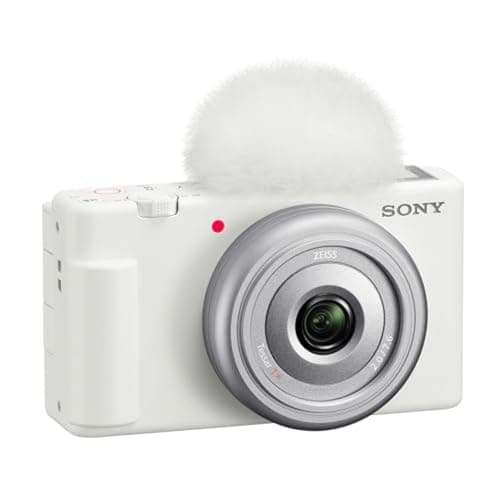
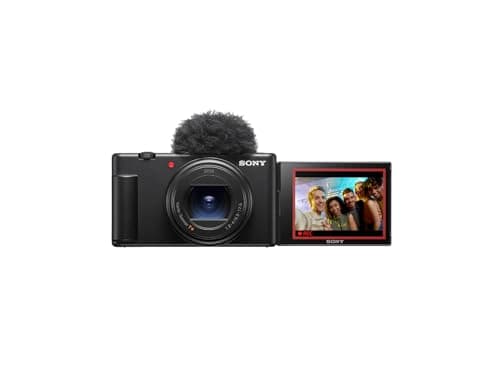
The Sony ZV-1 II is the right pocket camera for one specific person: someone who wants to film themselves, does not want to own lenses, and shoots mostly in daylight. Its 18-50mm-equivalent ZEISS zoom is wide enough that your arm fits in the frame — the single biggest improvement over the original ZV-1 — it has a 3-stop neutral density filter built into the body for bright sun, and it weighs 292g. The catches are concrete and we will not bury them: Sony rates the battery at 45 minutes of 4K recording and DPReview measured roughly 30-35 minutes in practice, there is no headphone jack, stabilization is electronic and video-only with about a 1.33x crop, and the 1-inch sensor is the limiting factor the moment the light drops.
The usual disclosure: we have not run a ZV-1 II through a lab. This review is compiled from Sony's own announcement specifications and from DPReview's tested findings and measurements — both named and linked in Sources — then scored against our rubric. Informed judgment from documented research, not bench measurements of our own. Any price on this page comes from our live price check, and there is a note about that price further down, because today it is not where you might expect it.
Who it's for
The ZV-1 II is for the creator who wants the camera to be the whole decision. There is no mount, no lens to choose, nothing to carry besides the camera, and that is a genuine feature rather than a limitation — the most common failure mode for a first camera is that it stays home. At 292g this one goes in a jacket pocket, and the screen flips out to the side so a top-mounted microphone does not block it.
Specifically, it suits talking-head video, travel vlogs, day-in-the-life clips and product demonstrations shot in decent light. Sony built the vlogging toolkit directly into the body: a Product Showcase setting that shifts focus from your face to an object you hold up, a Bokeh Switch that drops the background out of focus with one press, and a Cinematic Vlog setting that records at 2.35:1 and 24fps with a set of looks and moods. None of that is essential, and all of it removes a menu dive from the moment you are actually filming.
Who should look past it? Anyone whose phone is already good and who is not frustrated by it — DPReview's reviewer said as much, declining to recommend the camera to people with a capable phone, and we agree. Anyone who films indoors or at night should buy a larger sensor, which in practice means an APS-C body and one bright lens. And anyone who wants to monitor their own audio should look at the Canon PowerShot V1, which has a headphone jack and a bigger sensor in a bigger, pricier package.
Where it's strong
The lens, which is the whole reason this camera replaced the ZV-1
Sony fits a ZEISS Vario-Sonnar T* zoom covering 18-50mm in full-frame equivalent terms, at f/1.8 wide open and f/4 at the long end. For selfie filming the wide end is what matters: at 18mm equivalent you can hold the camera at arm's length and still have your head, shoulders and some of the room in frame, which the original ZV-1's 24mm equivalent could not manage without a grip. The 50mm end is the flattering end for a talking head on a tripod, so one zoom covers both of the shots a solo creator actually takes.
The trade is that f/4 at the long end is not a bright lens, and the aperture closes as you zoom. In daylight this is irrelevant. Indoors it means you shoot at the wide end or you raise the ISO, and the sensor has limited patience for that — which is the honest shape of this camera's compromise.
A 3-stop ND filter built into the body
This is the feature owners come to appreciate and buyers overlook. Sony builds a three-stop neutral density filter into the camera, which lets you hold a natural shutter speed in bright sun instead of being forced to 1/2000 and the brittle, stuttery motion that comes with it. On a compact camera you usually cannot screw a filter to the front, so building it in is the only way to solve the problem. Our ND filter guide explains why the 180-degree shutter rule makes this matter for video; the ZV-1 II just has the answer inside it.
Autofocus, and a surprisingly serious burst mode
The autofocus is the part no rival at this size does better. DPReview called it "very zippy and reliable" with face and eye tracking, with one documented weakness: it can lose focus when the subject is briefly backlit. Alongside that, the camera shoots 24 frames per second in JPEG and raw with a buffer DPReview measured at up to 800 JPEGs — numbers that belong on an action camera rather than a vlogging compact, and useful if you photograph children or pets between clips.
Clean, well-behaved 4K
It records 4K at up to 30p and 1080 at up to 120p for slow motion, and DPReview rated its rolling shutter "very good" — which is not a given in this class and is the difference between a usable pan and a frame full of leaning verticals. Sony also includes its Picture Profiles, so S-Log2, S-Log3 and HLG are available for grading. The camera scored 83% overall at DPReview, with a 9.5 for performance.
Where it falls short
The battery, which is the real limit on a shooting day
Sony's CIPA rating is 290 stills or 45 minutes of 4K recording, and DPReview's tester got about 30-35 minutes of video in practice and called the battery "terrible." Plan around it rather than hoping: the camera charges and runs over USB-C, so a power bank in a pocket turns a 35-minute camera into an all-day one, and that is how we would use it. If you need to film long, unattended takes — interviews, ceremonies, lectures — this is the wrong camera and an APS-C body with a bigger cell is the right one.
The audio ceiling, and the missing headphone jack
Sony fits an intelligent three-capsule microphone that switches between front and all-directions pickup automatically, or lets you choose front, rear or all-directions manually. It is better than a phone and it is still a built-in microphone: DPReview found it struggles indoors and in noise, and described out-of-camera tracks as flat and tinny. There is a 3.5mm microphone input and a Multi Interface Shoe, so the fix is available and cheap — but there is no headphone jack, which means you cannot verify while recording that the fix is working.
Our honest recommendation is to budget for a microphone with the camera, not after it. A small wireless kit is the single biggest quality upgrade available to a vlogger — best wireless microphones ranks them, and lavalier vs shotgun explains which shape fits this kind of filming.
Stabilization is electronic, video-only, and costs you framing
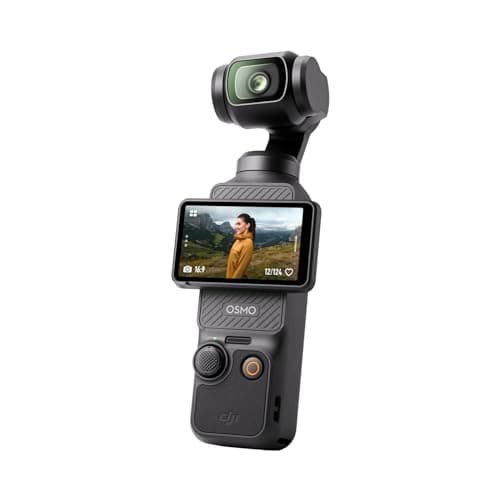
There is no in-body or optical stabilization for stills at all, and for video the stabilization is electronic with roughly a 1.33x crop, per DPReview's testing. The reviewer found it works reasonably well for steady walking but becomes jerky on corners and pans. That crop also eats into the wide end you bought the camera for: switch stabilization on and your 18mm equivalent is no longer 18mm. If smooth walking footage is the point of your channel, the DJI Osmo Pocket 3 and its mechanical gimbal are a different league, which is why we rank it on this page as the alternative.
A 1-inch sensor, and 8-bit Log
Sony publishes an ISO range of 125-12,800 for the 1.0-type stacked Exmor RS sensor. The sensor measures 13.2 x 8.8mm — a fraction of the area of the APS-C chips in Sony's own ZV-E10 — so noise arrives earlier and background blur is harder to come by. The Bokeh Switch is a clever workaround, not physics. Log recording is 8-bit, and DPReview noted that S-Log3 in particular degrades quickly under grading; if you want serious color work out of a small camera, 10-bit video explains what the extra depth buys. Two smaller documented quirks: daylight white balance can run blue, and the electronic shutter will not go slower than 1/4 second.
The price we are reading today
Sony launched the ZV-1 II at an estimated $900 in June 2023. The live listing our price check reads sits above that launch figure, which materially weakens its case — a camera that costs more than it did at launch is competing against an APS-C body with a kit lens rather than against other compacts. Check the number in the price table before you decide, and if it has not come down, read the alternatives below as the stronger buys.
How it compares with the obvious alternatives
Sony ZV-1F— the cheaper sibling, and the comparison most people actually need. It has the same 1-inch sensor class and the same flip screen, but a fixed 20mm equivalent lens instead of a zoom and a slower contrast-detect autofocus system. If you only ever shoot one framing — yourself, at arm's length — it does that job for noticeably less money. The full head-to-head is at ZV-1 II vs ZV-1F.
Canon PowerShot V1 — a bigger 1.4-inch sensor, a wider 16-50mm equivalent zoom, a built-in ND filter of its own, a headphone jack and a cooling fan, in a heavier body that will not pocket. It is the better camera and the less convenient one. See Canon V1 vs ZV-1 II.
DJI Osmo Pocket 3 — a mechanical 3-axis gimbal, a 1-inch sensor and a rotating screen in something smaller than the Sony. For walking footage it is not close: the gimbal does what no electronic stabilization can. What you give up is the zoom, the mic input flexibility and conventional camera handling. Compared directly at Osmo Pocket 3 vs ZV-1F.
Sony ZV-E10 — the same vlogging toolkit on an APS-C body with interchangeable lenses, usually for similar money. Bigger sensor, better low light, real background blur, a headphone jack — at the cost of carrying lenses and deciding which one to buy. If you are even slightly tempted by that trade, read best vlogging cameras for beginners before you buy a compact.
What to buy with it
Three accessories turn this camera into a kit, and the order matters. First, a microphone: the built-in capsules are the weakest part of the package and a small wireless set or an on-camera shotgun fixes it for a fraction of the camera's price — best microphones for vlogging ranks both shapes. Second, a power bank and a USB-C cable, because the camera runs while charging and that is the honest answer to a 45-minute rating. Third, a small tripod: a tabletop or flexible tripod is what makes the 50mm end usable for a seated talking head, and it costs very little.
On cards, you need far less than the marketing suggests. The camera's 4K modes sit comfortably inside a V30 card's guaranteed write floor, so the sensible buy is capacity rather than speed class — see SanDisk Extreme vs Extreme PRO for why the cheaper of the two usual suspects is normally the right one, and what size SD card do I need for how much 4K each capacity holds.
Our verdict, and the honest version of the recommendation
Scored against our rubric the ZV-1 II earns its place: the lens is the right lens for selfie video, the autofocus is best in class at this size, the ND filter solves a real daylight problem, and the rolling shutter is well controlled. It is a camera we are comfortable recommending to someone who films themselves outdoors and wants one small object to carry.
It is not the camera to buy if you film indoors, if you need to monitor audio, if you need long unattended takes, or if your phone already satisfies you. And at a listing above its launch price, the gap between it and an APS-C body with a kit lens narrows to the point where the bigger camera is the better value for anyone willing to carry it. That is a price question rather than a camera question, so check the live figure above and decide on the number in front of you.