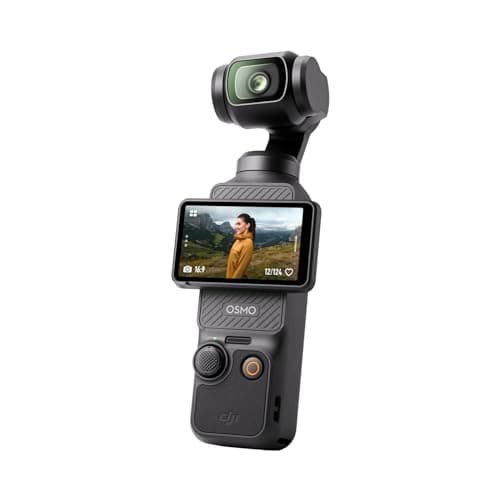
The DJI Osmo Pocket 3 is the best camera in the world for one specific thing: walking while filming. A genuine mechanical 3-axis gimbal sits between your hand and a 1-inch sensor, so footage comes out glass-smooth with nothing done in editing. Ask it to do anything else — low light, shallow background blur, a different focal length — and it is comfortably beaten by a cheaper interchangeable-lens camera.
Our usual disclosure: we have not lab-tested the Pocket 3. This is compiled from DJI's published specifications and documented owner experience, scored against our rubric. Informed judgment from research, not bench measurements.
Who it's for
The Pocket 3 is for the creator who moves. Travel vloggers walking through a market, food creators following a dish from counter to table, anyone whose footage is mostly made on their feet. Most cameras solve motion with in-body stabilization that crops the image, or with a separate gimbal you have to balance and carry. The Pocket 3 has the stabilizer built in and switched on, permanently, in something the size of a chunky marker pen.
It also suits the creator who wants to stop thinking about gear. There is no lens to choose, nothing to balance, and the screen rotates to tell the camera whether you want horizontal or vertical — which, for anyone posting to both YouTube and short-form, removes a genuinely annoying step. Turn it on, point it, walk.
Who should look past it? Anyone whose main output is a seated talking head, an interview, or anything shot in a dim room. There the fixed lens and the small sensor both work against you, and an APS-C body with a fast prime — see our best cameras for YouTube — produces a visibly better image for similar money.
Where it's strong
The gimbal is not a gimmick
This is the whole product. A mechanical 3-axis gimbal physically counteracts your hand and body movement with motors before the light reaches the sensor. Digital stabilization can only crop and warp footage after the fact; in-body stabilization can only move the sensor a few millimeters. A real gimbal cancels the twist and tilt of your hand as you walk, and it does it without cropping your frame or costing you resolution. The one thing no 3-axis gimbal removes is the up-and-down bob of your steps; that part is technique, which our do you need a gimbal? guide covers.
A 1-inch sensor, which is a lot for this size
The sensor is far larger than a phone's and large enough to hold up in good light and reasonable indoor light. Combined with 4K at up to 120 frames per second for slow motion and 10-bit color capture, the footage has genuine editing latitude. This is not a toy camera with a stabilizer attached; it is a competent small camera with an unusually good stabilizer attached.
The rotating screen and the framing it enables
The screen rotates between landscape and portrait, and the camera follows. For a creator publishing to both long-form and vertical short-form, that is a real time-saver — you shoot each in its native orientation rather than cropping a wide frame into a tall one and losing resolution. It also flips to face you, so filming yourself is trivially easy.
It pairs cleanly with wireless audio
Audio is where cheap video usually falls down, and the Pocket 3 connects directly to DJI's wireless microphone transmitters without a receiver cluttering the setup. If you film outdoors or at any distance from the camera, that combination punches well above its size. Our best wireless microphones guide covers the options and what each one is actually for.
The honest catches
The lens is fixed, and moderately wide
You cannot change the focal length. That is fine for arm's-length selfie framing and for wide establishing shots, but you cannot step back optically for a flattering, compressed headshot, and you cannot reach a distant subject. Compared with a body that takes a 50mm prime or a telephoto zoom, the Pocket 3 is a single-perspective camera. Whether that is a limitation or a simplification depends entirely on what you shoot.
Low light is where the small sensor shows
A 1-inch sensor is much bigger than a phone's and much smaller than APS-C. In a dim restaurant or an evening street, the Pocket 3's footage gets grainier and loses detail in a way an APS-C body with a fast lens does not. It is perfectly usable; it is just visibly behind. If most of your filming happens indoors after dark, this is the wrong camera.
Battery life is short, because physics
A pocket-sized body holds a pocket-sized battery, and it is driving three gimbal motors continuously. Expect to charge partway through a full day of shooting and to carry a power bank on a long one. That is not a defect — it is the unavoidable cost of the form factor — but plan for it rather than discovering it at hour three.
Availability and the single-supplier risk
DJI's availability in the US has been uncertain at times, and there is no true equivalent from another brand: nobody else makes a pocket camera with a mechanical gimbal inside it. If the Pocket 3 is hard to buy the week you shop, the honest alternative is a different approach entirely — a compact like the Sony ZV-1 II or the bigger-sensor Canon PowerShot V1, or an APS-C body paired with a separate budget gimbal. We flag this on every DJI recommendation on the site.
The verdict
The Pocket 3 is a specialist, and specialists are worth owning when the specialty is what you do. If a meaningful share of your footage is filmed while walking, nothing else at any price gets you this result this easily — a real gimbal in a pocket, no balancing, no crop, no editing plugin.
If your work is mostly seated, indoors, or needs different focal lengths, the same money buys a more capable general camera. Plenty of creators end up owning both and reaching for the Pocket 3 only when they leave the desk. See where it ranks against the rest of the field in our best compact vlogging cameras and best travel vlogging cameras rankings.