Buy a wireless lavalier if your subject moves, if the camera is more than about a metre away, or if you ever record two people. Buy a shotgun if you sit in one place, close to the camera, in a quiet room — it is simpler, there is nothing to charge or pair, and nothing clipped to your shirt. For most creators the lav wins, which is why the Rode Wireless GO III is the first pick below. If you are a seated talking-head channel, the Rode VideoMic GO II does the job for less money and less faff.
The thing almost every comparison of these two gets wrong is framing it as a sound-quality question. It is not. A good shotgun capsule is a better microphone than a good lavalier capsule — it is bigger, it is better isolated, and it has more low-frequency body. But none of that survives being three metres from a mouth in a room with hard walls, and a cheap lav clipped 15cm from the same mouth will beat it comfortably. Distance beats quality. Every other consideration on this page is downstream of that one sentence.
Why distance decides it
Two things happen as a microphone moves away from a voice. The direct sound gets quieter — fast, because sound falls off with distance. Meanwhile the reflected sound bouncing off your walls, ceiling, desk and window does not get quieter at anything like the same rate, because it is arriving from everywhere. So the ratio of voice to room gets worse the further back you go, and that ratio is what people hear as "echoey", "hollow", or "like it was recorded in a bathroom". Room reflection is the one audio problem you genuinely cannot fix in editing, and the only reliable cure is to get the capsule closer.
A lavalier solves this by definition: it is clipped a hand's width below the chin and stays there no matter where the camera is or where you walk. A shotgun solves it only if you can get it close, which in practice means mounted on the camera for a tight framing, or on a boom pole or stand just out of the top of frame. A shotgun in a hot shoe on a camera two metres away, framing a wide shot of a desk, is the most common bad-audio setup in amateur video, and no amount of money spent on the shotgun fixes it.
What a shotgun is actually good at
Shotguns are not a worse product, they are a different tool, and there are jobs where they are clearly the right one. They sound more natural on a voice than a chest-mounted lav, because a lav sitting on a sternum picks up chest resonance and misses some of the brightness that comes off the mouth. They need no batteries to charge, no pairing, and no transmitter hidden in someone's clothing — point the camera, hit record. They pick up a whole scene plausibly rather than just one person, which matters for b-roll, ambience, music, and anything where the sound of the place is part of the story. And there is nothing visible on the subject, which some people care about a great deal.
What a lavalier is actually good at
Everything to do with movement and distance. Walking vlogs, kitchen and workshop videos where you turn away from the camera, pieces to camera shot wide, interviews where the camera is on a tripod across a table, anything outdoors where you are not standing still. Wireless lav systems also give you the thing a shotgun fundamentally cannot: two independent channels, so you can mic an interviewer and a guest cleanly and balance them separately afterwards. If you ever record a conversation, that single capability settles the argument.
So which should you buy first?
If you can only buy one microphone ever, buy the wireless lav. Not because it sounds better, but because it is the one that works in the most situations and the one that is hardest to use badly. A shotgun used wrong sounds like a bad room; a lav used wrong sounds like a slightly muffled person, which is a much more forgiving failure mode. Our picks below are ranked on exactly that basis — the two lav systems first, then the two shotguns that make sense if you have decided you are a seated, close-to-camera creator.
The two shapes, and the four picks
The first table is the decision; the second is what to buy once you have made it. Every spec is manufacturer-published and linked in Sources — we have not tested any of these.
| Consideration | Wireless lavalier | On-camera shotgun |
|---|
| Distance from the mouth | Always close — clipped to the chest wherever you go | As far away as the camera is |
| Two people | Yes, two transmitters and two separate tracks | One mic position, compromised between both |
| Setup time | Pair, clip, check levels | Slide into the hot shoe and record |
| Power | Rechargeable, and you must remember it | Camera plug-in power or one long-life battery |
| Wind outdoors | Sheltered under a lapel | Severe without a furry windshield |
| Characteristic failure | Clothing rustle, and radio dropouts in crowds | Room reverberation when the camera is too far back |
| Visible on the subject | Yes, a clip on the chest | Nothing |
| Pick | Shape | Published specs | Who it is for |
|---|
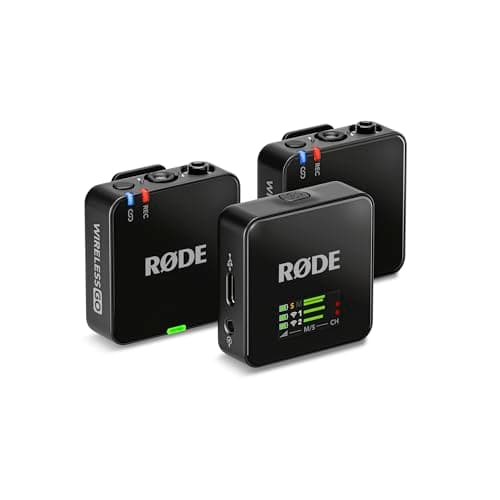
| Rode Wireless GO III | Wireless lavalier | 2 transmitters + 1 receiver, 32-bit float onboard recording, GainAssist automatic level control | Anyone recording something they cannot re-shoot |
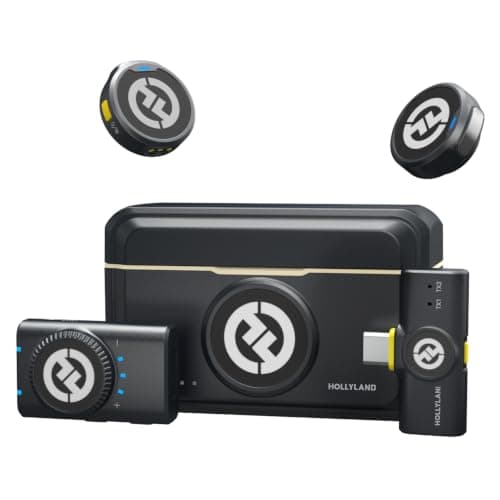
| Hollyland Lark M2 (Camera Kit) | Wireless lavalier | 2 transmitters + camera and USB-C receivers, 48kHz / 24-bit, up to ~300m line of sight, ~9g transmitters | The value route, and anyone filming on a phone too |
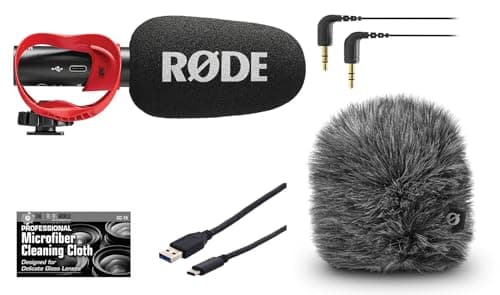
| Rode VideoMic GO II | On-camera shotgun | Supercardioid, 3.5mm TRS + USB-C output, no battery (plug-in power), ultra-compact | Seated creators close to the camera, on a budget |
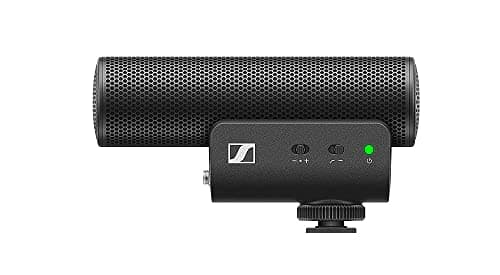
| Sennheiser MKE 400 | On-camera shotgun | Supercardioid, built-in windscreen and shock mount, 3.5mm headphone monitor out, 3-step sensitivity + low-cut filter | Run-and-gun shooting where you want to monitor audio |
Which wins for interviews?
The wireless lav, almost always, and specifically a two-transmitter kit. An interview has two people who talk at different volumes, lean in and out, and sometimes talk over each other. Giving each of them their own transmitter means you get two separate tracks you can level independently, and you are no longer choosing a microphone position that is a compromise between two mouths. Both lav kits ranked above include two transmitters, which is why they appear here rather than the single-transmitter alternatives.
The professional version of the shotgun answer is a mic on a boom just above the frame line, angled down at the speaker, which sounds superb — but it needs a stand or a second pair of hands and it only ever covers one person at a time. For a solo creator interviewing someone across a table, two lavs is the setup that actually works.
The in-between options nobody mentions
A wireless lav used as a desk mic. Clip a transmitter to a small stand 20cm from your mouth, just out of frame, and you have a close microphone with no cable and no transmitter visible on your shirt. It is a genuinely good use of a kit you already own.
A shotgun off the camera. A shotgun does not have to live in a hot shoe. On a cheap stand or a tripod with a flexible arm, pointed down at your face from just above the top of frame, it is close to the mouth and sounds dramatically better than the same mic on the camera. Most people never try this.
Both at once. A lav on the subject and a shotgun capturing the room gives you a clean voice track plus natural ambience to mix underneath it. This is how most documentary work is recorded, and on a camera with one microphone input it means recording the second source separately and syncing in the edit.
The practical differences worth knowing before you buy
Wind.A shotgun on a camera outdoors needs a furry windshield, not just the foam one — wind noise on a shotgun's long interference tube is severe. A lav under a lapel is naturally sheltered, which is a real outdoor advantage. Clothing rustle.The lav's own failure mode: a transmitter rubbing on a collar, a zip or a scarf produces a noise nothing removes. Clip high, clear of anything that can touch it. Charging. Every wireless lav is a battery you have to remember; most shotguns run from the camera or a single AAA for months. Radio. Wireless kits drop out in crowded radio environments — conferences, trade shows, city centres. A wired shotgun never does.
Your camera's input matters too. Both shapes need a 3.5mm microphone jack on the body, and the cheapest cameras cut it. Several of the bodies in our under-$500 ranking have one and one notable pick does not, which is worth checking before you buy a microphone rather than after.
Where to go next
Once you have decided on a shape, the full rankings go deeper than this page can: the best wireless microphones covers six lav kits scored against each other, and best shotgun microphones does the same for on-camera shotguns. If you are specifically choosing between the two cheapest wireless kits, DJI Mic Mini vs Hollyland Lark M2 is the head-to-head.