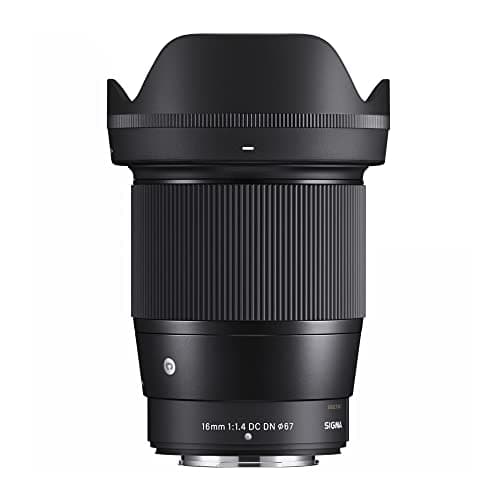
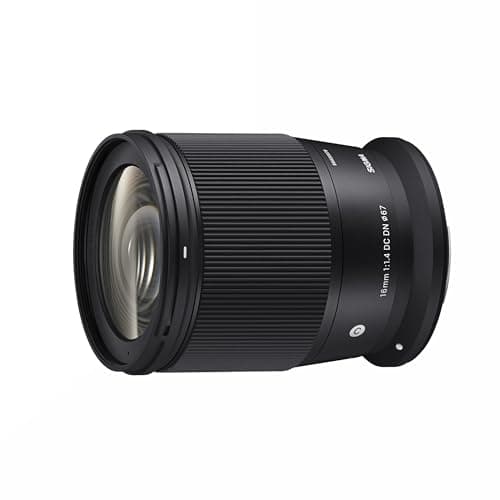
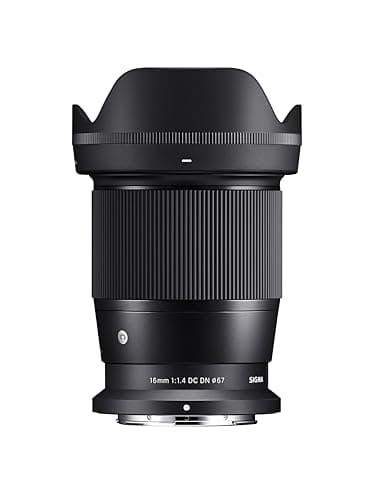
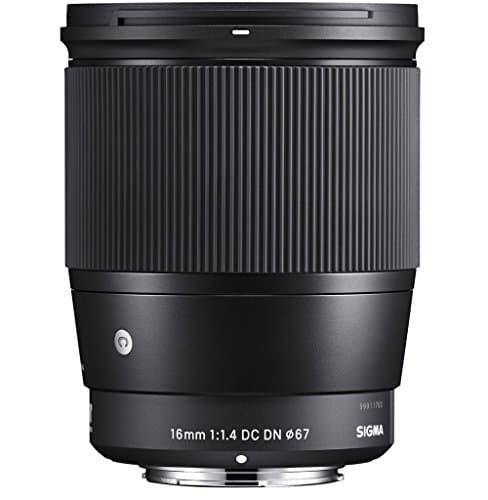
The Sigma 16mm F1.4 DC DN is the cheapest way to put a genuinely fast wide-angle lens on a crop-sensor mirrorless camera. It frames like a 24mm on full frame, opens about three stops wider than the wide end of a kit zoom, and is sharp enough in the middle at f/1.4 that labs rate it against lenses costing far more. It also weighs more than some of the cameras it is designed for, its corners do not catch up with its center until f/2.8, and uncorrected it bends straight lines by nearly 3 percent.
The usual disclosure: we have not lab-tested this lens. Everything below is Sigma's published specification sheet, the measurements and findings of reviewers who did test it — named and linked in Sources — and our own read on who it suits, scored against our rubric. Informed opinion, not measurements of our own.
This page exists because the lens sits near the top of four of our roundups — it is rank 2 on best wide-angle lenses and rank 2 on best low-light lenses — and a ranking blurb is not enough room to be honest about a lens whose strengths and weaknesses are this unevenly spread across the frame. It is also the natural second question after our Sigma 30mm f/1.4 review: the two lenses cost similar money, share a family name, and suit completely different people.
Who it's for
This is a lens for somebody who keeps backing into a wall. You are shooting a room, a kitchen, a cafe table, a cramped studio or a street at night, and the widest end of your kit zoom still cannot fit the scene — and when you make it fit, the shot is dark. A fixed 16mm on APS-C gives an 83.2-degree angle of view, which Sigma publishes identically for Sony E, Nikon Z and Fujifilm X. That is roughly what a 24mm shows on a full-frame camera: wide enough for interiors, environmental portraits, landscapes and group shots, and the classic focal length for walking around a city.
It is also the third-party lens creators reach for most, and for one specific reason. Hold a camera at arm's length with a 16mm on the front and you are in frame with the room behind you, which is why it appears on our best vlogging lenses list. And because it opens to f/1.4 it will shoot a night sky, which the slow wide zooms it competes with cannot.
Who should look elsewhere? Anyone shooting full frame — this lens covers only the APS-C image circle and a full-frame body will crop to it automatically. Anyone whose complaint is that backgrounds will not blur in portraits, because a wide angle works against you there and the portrait primes are the right answer. And anyone who has not yet worn out their kit zoom: if you cannot say which focal lengths you actually use, read our kit lens vs prime guide before spending anything.
What it actually fixes
f/1.4 at a focal length where f/1.4 is rare
Fast normal primes are everywhere and cheap. Fast wide primes are neither. Most APS-C kit zooms start at f/3.5 at their widest setting, so f/1.4 is roughly three stops brighter — around eight times the light. In a dim room that is the difference between ISO 6400 and ISO 800, and at night it is the difference between a usable handheld frame and a smeared one. Because the field of view is wide, you can also hold slower shutter speeds than you could with a longer lens before camera shake shows, which stacks with the aperture advantage.
The aperture matters for a second reason specific to wides. Depth of field at 16mm is naturally deep, so at f/5.6 almost everything in the frame is acceptably sharp. At f/1.4 you can actually separate a subject a couple of feet away from the room behind them — not the creamy wash a portrait lens gives, but enough to make a photo look deliberate rather than snapshot-flat.
Center sharpness that punches above the price
OpticalLimits, testing the Sony E version in the lab, found center quality "very good" wide open at f/1.4, with a steep drop toward the edges that recovers as you stop down: borders improve at f/2, corners fully recover by f/2.8, and peak performance arrives at f/4. Photography Blog reached the same conclusion by a different route, calling it acceptably sharp wide open at least in the center and awarding four stars out of five. Lateral chromatic aberration is genuinely low — OpticalLimits measured an average CA pixel width under 0.5px at f/1.4, better than many lenses at several times the money — and found autofocus "quite fast and essentially noiseless".
Serious glass for a Contemporary-line lens
Sigma publishes a 16-element, 13-group construction including three FLD elements, two SLD elements and two molded glass aspherical elements. For context, the 30mm f/1.4 uses nine elements in seven groups. That complexity is where the size and the price go, and it is also why the lens holds contrast in difficult light. The diaphragm has nine rounded blades, the minimum focusing distance is 25cm for a 1:9.9 maximum magnification, and Sigma specifies a dust- and splash-resistant mount on every version except the discontinued Canon EF-M one. OpticalLimits rated build quality 7.5 out of 10 and price-to-performance 9.5 out of 10; Photography Blog singled out the brass mount and the circular hood in the box.
The honest catches
The corners are soft wide open, and that matters here
On a normal or portrait lens, soft corners at maximum aperture are a footnote — the subject is in the middle. On a wide-angle lens they are the review. Landscapes put detail in the corners. Interiors put the walls there. Astrophotography puts stars there, and stars are the least forgiving test subject in existence. OpticalLimits described the corners wide open as "downright soft" and found that stopping to f/2 helps a great deal, with sharp results across the frame from f/2.8. Photography Blog put it the same way: you need f/2.8 for acceptable edges.
In practice the lens has two personalities. At f/1.4 to f/2 it is a low-light and subject-separation lens, best used with the important thing near the middle. From f/2.8 to f/5.6 it is a landscape and architecture lens. It is not, at f/1.4, a corner-to-corner astro lens, whatever the aperture number suggests.
Heavy distortion and vignetting before correction
OpticalLimits measured about 2.8 percent barrel distortion in the uncorrected file and more than 1.8EV of vignetting at f/1.4. Those are big numbers. They are also, in normal use, mostly invisible: with auto-correction active the same lab measured distortion at under 0.2 percent and light falloff at 0.7EV. Modern bodies apply a profile to JPEGs and video automatically, Adobe ships one for raw, and Sigma's RF version supports in-camera aberration correction directly.
The catch is that correction is not free. Fixing 2.8 percent of barrel distortion means stretching the edges of the frame, which costs a little corner resolution on top of corners that were already the weak point. If you shoot raw with corrections switched off — in some non-Adobe converters that is the default — you will see curved doorframes and dark corners together.
It is heavier than the cameras it is sold for
This is the practical complaint, and the one most likely to matter to you. Sigma lists weights from 395g on Micro Four Thirds to 420g on Nikon Z; OpticalLimits measured 405g for the Sony E version, at 72.2 x 92.3mm. A Fujifilm X-M5 body weighs 355g with its battery. A Nikon Z30 is in the same territory. So on the small, cheap bodies this lens is most often recommended for, the lens is the heavier half of the camera, and the whole thing hangs forward off the mount.
That is survivable on a strap or a tripod and genuinely tiring at arm's length. If your use case is holding the camera out in front of you to talk to it, a lighter wide — the Sony E 11mm f/1.8 is the obvious one — will be more comfortable even though it is more than a stop slower. If your use case is a camera round your neck in a city, the weight is a fair trade for f/1.4.
The filter thread is the expensive size
67mm. Sigma's 30mm and 56mm DC DN primes both take 52mm filters, which are among the cheapest you can buy; 67mm glass costs noticeably more and will not swap with them. Budget for that if you want a polarizer or a variable ND for video. It is a small thing that quietly adds to the cost of ownership.
No stabilization, on bodies that usually have none either
There is no optical stabilization in any mount version. The bodies this lens is most often paired with — the Sony ZV-E10 and a6400, the Canon R50, R10 and R100, the Nikon Z30 — have no in-body stabilization either. For stills, f/1.4 and a wide field of view buy back most of what you lose. For handheld walking video you are relying on the camera's digital stabilization, which crops into the frame and so undoes part of why you bought a wide lens, or on a gimbal. Our stabilization explainer covers which system does what.
16mm or 30mm — which Sigma first?
This is the question we get asked instead of either review, so here is the straight answer. Buy the 30mmfirst if you photograph people. It frames like a 45mm, which is close to what your eye sees, it is well under half the weight at 265g, it takes cheap 52mm filters, and it is better behaved in the corners. Buy the 16mm first if you photograph places — rooms, streets, landscapes, skies — or if you film yourself at arm's length, where the 30mm is simply too tight to include anything except your face.
If you genuinely cannot choose, the 30mm is the safer first prime and the cheaper mistake. The 16mm is the more specialized tool, and specialized tools make better second purchases than first ones. For how the two sit against everything else on the mount, see best budget Sony E lenses.
Mount by mount
Sigma lists seven mounts for this lens: Sony E, Canon RF, Canon EF-M, Nikon Z, Fujifilm X, Micro Four Thirds and L-mount. They are not equally good buys, and three of them we do not rank at all.
Sony E — the default
The E-mount version has been on sale since 2018 and it is the one with the deepest stock, the most competition around it and, usually, the lowest price. If you shoot a ZV-E10, an a6100, an a6400 or an a6700 this is the wide prime to buy, and it slots into a real upgrade path rather than being a dead end — Sigma, Tamron and Viltrox all compete for affordable APS-C E-mount glass.
Fujifilm X — the one X owners can actually get
Worth calling out, because Sigma's X-mount availability in the US is patchy. The 16mm is the DC DN prime that stays in stock: at our last check the X-mount 30mm listing showed no buyable offer at all while the 16mm did. Given what Fujifilm charges for its own fast wides, this is the affordable route to a 24mm-equivalent f/1.4 on an X body. See best Fujifilm X lenses for the full picture.
Canon RF — the newest, and the priciest
Sigma put the 16mm on sale for RF on 23 January 2025 at a $489 list price, after the 30mm and 56mm arrived that December. It matters on this mount because Canon builds no fast RF-S prime at all — every APS-C-native RF lens Canon makes is a variable-aperture zoom. Sigma says it developed an AF drive and communication-speed algorithm specifically for RF, and the lens supports Servo AF and in-camera aberration correction on cameras that offer them. Our Canon RF lens guide puts it in context.
Nikon Z — real, but thin on stock
Sigma brought the 16mm, 30mm and 56mm to Z mount in late April 2023, with the 16mm listed at $499 — the highest of the three. DPReview reported at the time that the trio was aimed at the Z30, Z50 and Zfc, giving DX owners 24, 45 and 85mm equivalents they could not otherwise buy. It is also the heaviest version, at Sigma's listed 420g. US stock runs thin; our best Nikon Z lenses guide covers what else is available.
Canon EF-M, Micro Four Thirds and L-mount — not ranked
The EF-M version is a fine lens on an M50 or M6 Mark II, but Canon has moved its entire mirrorless effort to RF and EF-M has no future, so do not buy into that system now on the strength of a lens. The Micro Four Thirds version is the lightest at 395g, but the smaller sensor changes the framing: Sigma lists a 68.1-degree angle of view there against 83.2 on APS-C, so it behaves like a 32mm-equivalent normal lens rather than a wide. The L-mount version covers the APS-C crop area of Sigma, Panasonic and Leica bodies. All three are real products with the same optics; none of the three audiences is who this site writes for.
What to buy alongside it
Three things. A 67mm filter if you shoot outdoors — a polarizer is the one effect you cannot recreate in editing, and our CPL guide covers sizes and prices. Something with more reach, because a fixed 16mm will eventually frustrate you: keep your kit zoom, or add the Sigma 18-50mm F2.8. And if you shoot handheld video on a body without in-body stabilization, the stabilization the lens does not provide — a gimbal for moving shots, or a tripod for locked-off ones.
The verdict
The Sigma 16mm F1.4 DC DN has been on sale since 2018, Sigma has kept adding mounts to it as recently as 2025, and nothing has arrived to replace it. It is the affordable fast wide for crop-sensor cameras, and for interiors, street at night, environmental portraits and arm's-length video it does a job no kit zoom can do at any ISO.
The two things that would make you complain are both real. The corners are soft until f/2.8, which is the wrong weakness for a wide-angle lens to have. And at around 405g it unbalances the small bodies it is most often recommended for. Neither changes the recommendation; both change how you use it.
Buy it if you shoot places rather than faces, if your photos are dark indoors, or if you film yourself and want the room in the shot. Skip it if you shoot full frame, if you want the lightest possible lens for vlogging, or if corner-to-corner sharpness wide open is what you are paying for — that is a far more expensive lens.