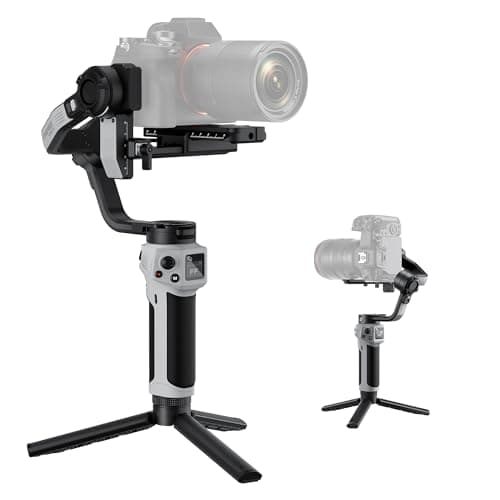
The Zhiyun Weebill 3E is the gimbal to buy if your camera and lens are heavier than DJI's small gimbal can take, or if you want most of what a gimbal does for meaningfully less money. Zhiyun rates it to a 3kg payload — half again the RS 4 Mini's 2kg — and up to 16 hours per charge, in a body that folds to roughly the footprint of a sheet of A4 paper. The trade-offs are all in the setup: the axes do not lock and unlock themselves, the sling handle that makes it comfortable is sold separately, and it needs rebalancing more often than you would like.
The usual disclosure: we have not run this gimbal through a lab. What follows is Zhiyun's published specifications, the documented findings of reviewers who used one — named and linked in Sources — and our own read on who it suits, scored against our rubric. Informed opinion, not measurements of our own.
A note on the name. Zhiyun sells this under its CINEPEER label, so the box and most retail listings read "ZHIYUN CINEPEER Weebill 3E". It is the same product people mean when they say Weebill 3E; CINEPEER is Zhiyun's value line, not a different manufacturer. Worth knowing before you worry that you are looking at a clone.
Who it's for
This gimbal is for one of two people. The first has a rig that is too heavy for the small DJI: a mid-size mirrorless body with a fast zoom, or a full-frame body with a short prime, anywhere in the 1.5-3kg range. Digital Camera World ran theirs with a Sony A7C and a 105mm lens, a combined 2.284kg, and the gimbal handled it. The second person simply does not want to spend DJI money, and is willing to do a little more work by hand in exchange.
It is also the hedge. DJI's availability in the US has wobbled more than once, and this whole hub is built so that no reader is left with a single dead link — every DJI pick we make has a Zhiyun or Hohem alternative beside it. The Weebill 3E is that alternative at the small-gimbal end, which is why it appears on six other pages in this hub, most prominently at rank 2 on best gimbals for mirrorless.
Who should look elsewhere? Anyone whose camera already has in-body stabilization and who mostly shoots static or slow-moving footage may not need a gimbal at all — our do you need a gimbal guide is the honest version of that question, and it is the cheapest page on this site. Anyone whose rig is genuinely light and who values speed of setup above everything should read our DJI RS 4 Mini review instead. And anyone carrying a cinema camera or a long telephoto needs the full-size class, covered in best gimbals for heavier cameras.
What you actually get for the money
3kg of payload in a 1kg gimbal
This is the headline, and it is the reason the Weebill 3E exists. Zhiyun rates the payload at 3kg; Digital Camera World's spec table lists the gimbal itself at 1,010g, and ProVideo Coalition reported 990g for the Lite version and 1,050g for the Standard at launch. Carrying three times your own weight is unusual in this size class, and it buys something specific: headroom. A gimbal running near its limit strains, drifts and drains its battery faster. One running at two-thirds of its rating just works.
Put concrete numbers on it. A Sony a6700 with the Sigma 18-50mm F2.8 is well under 1kg together. A full-frame body with a 24-70mm f/2.8 is closer to 1.8kg. The first is comfortable on any gimbal in this class; the second is at or past the RS 4 Mini's 2kg rating once you add a cage, a microphone or a filter. That is the gap the Weebill 3E fills. Our RS 4 Mini vs RS 4 comparison walks through how quickly a rig gains weight.
A 16-hour rating, and one USB-C port that does the talking
Zhiyun rates the built-in battery at up to 16 hours per charge, which both Digital Camera World and Fstoppers quote. Like every manufacturer runtime figure that is a best case rather than a promise, but it is the longest rating in this class and comfortably longer than DJI's 13 hours for the RS 4 Mini. For a day of run-and-gun work it means you stop thinking about the gimbal's battery and worry about the camera's instead, which is the right order.
There is a 0.96-inch OLED screen for modes and parameters, and a single USB-C port that handles camera control, so you can start and stop recording from the gimbal rather than reaching for the body. Bluetooth shutter control works too. Fstoppers lists the stabilization modes as Pan Follow, Lock, Follow, POV, Vortex and Go, which is the full spread — Vortex being the continuous barrel roll, and Go being the fast-response mode for running shots.
Vertical shooting without an adapter
Switching to portrait orientation is built in rather than bolted on, which matters if you shoot for Reels, Shorts or TikTok alongside landscape footage. You do have to rebalance after the switch — see below — but you do not have to buy a bracket or take the camera off the plate. If vertical is most of what you shoot, our best cameras for TikTok covers the bodies built around it.
The price is the point
ProVideo Coalition recorded a $249 recommended price at launch on 12 June 2024, and Zhiyun's own store has since shown it below that. Digital Camera World quoted $199 at Amazon when they reviewed it. We do not print a number here that we have not pulled live — the price on the buy row above comes from our price pipeline and is stamped with the date it was checked. What is stable is the relationship: this gimbal consistently costs less than the comparable DJI while carrying more.
The honest catches
You lock and unlock the axes yourself
This is the single biggest practical difference between the Weebill 3E and DJI's current small gimbal, and it is the one that decides whether a gimbal gets used. The RS 4 Mini locks and releases all three axes automatically when you fold and unfold it. On the Weebill 3E you do it by hand, every time. Digital Camera World called this out directly and also found the tilt axis "quite stiff" while rebalancing.
Thirty seconds of fiddling does not sound like much. In practice it is the friction that determines whether the gimbal comes out of the bag for a two-minute shot, and we have said as much in every gimbal ranking on this site. If you know yourself to be the kind of person who skips the setup, pay the DJI premium.
Rebalancing is a recurring chore, not a one-time setup
Digital Camera World's stated con is that it "needs to be rebalanced when using long lens", and that changing focal length or switching between landscape and portrait both send you back to the balancing step. Any gimbal needs rebalancing when the rig changes; a zoom lens that physically extends makes it worse, because the center of gravity moves as you zoom. If you work with one prime, this barely registers. If you swap lenses on a shoot, budget for it.
The handle that makes it comfortable is sold separately
The box contains the gimbal, a mini tripod and a USB-C cable. Zhiyun's MasterMove sling handle — the accessory that lets you carry the rig low, sling-style, instead of holding it straight out in front of you — is not included, and Digital Camera World priced it at $139 and described it as essential. Their reviewer, running the A7C and 105mm combination, found that "maneuvering this weight with one hand put a lot of strain on my wrist", and that two-handed support using the mini tripod as a second grip improved things.
Take that seriously when you compare prices. A Weebill 3E plus the sling handle is no longer the budget option; a Weebill 3E on its own, used two-handed with the tripod as a front grip, genuinely is. Zhiyun claims Sling Mode 2.5 with the wrist rest and adjustable grip reduces fatigue by over 40 percent, which is a manufacturer figure, not a measurement anyone independent has published.
Features the previous generation had, and this one does not
Digital Camera World notes two deletions relative to the model it replaces: there is no built-in fill light and no built-in microphone, and the port count is down from two USB-C to one. None of those is a reason to avoid the gimbal — a gimbal-mounted LED is a weak light and a gimbal-mounted mic is a compromised mic — but they are the places the cost came out. If you need light or sound, buy them properly: our video lighting guide and wireless microphone roundup cover what actually works.
The app and ecosystem are a step behind
Zhiyun's ZY Play app is functional and supports the intelligent shooting modes, but DJI's app, accessory range and follow-focus system are more polished, and DJI has more third-party support. Fstoppers, while recommending the gimbal overall as "a robust and versatile tool that offers excellent performance and value for money", still flagged a learning curve for beginners and the fact that getting the most out of it means buying accessories separately. That is the honest shape of this product: more capability per dollar, less polish per dollar.
Weebill 3E vs DJI RS 4 Mini — the decision in one table's worth of prose
These two are the real alternatives to each other, and the choice comes down to three numbers and one habit. Payload: 3kg for the Zhiyun against DJI's 2kg tested rating. Weight: roughly 1,010g against DJI's 890g. Battery rating: 16 hours against 13. On every one of those the Zhiyun wins except weight, and it usually costs less.
The habit is the tiebreaker. DJI's automatic axis locks remove the step that makes people leave a gimbal at home, and the app and accessory ecosystem around it are better. If you are buying your first gimbal and you suspect the setup friction will beat you, that is worth real money and the RS 4 Miniis the right buy. If you have used a gimbal before, or your rig is heavier than 2kg, or you would rather not have your whole kit depend on one manufacturer's import situation, buy this one. Our Zhiyun vs DJI comparison goes brand by brand.
What to buy alongside it
Three things, in order of how much difference they make. First, a second grip: either Zhiyun's MasterMove sling handle, or the habit of using the supplied mini tripod as a front handle, which costs nothing. Second, a spare camera battery, because the gimbal will outlast the camera by hours. Third, if you are stabilizing footage in a dark room, a fast lens rather than a higher ISO — a gimbal fixes shake, not noise, and our Sigma 16mm f/1.4 review covers the wide fast prime most often paired with gimbal work.
The verdict
The Weebill 3E is the most gimbal you can buy for the money in the compact class, and the payload headroom is not a spec-sheet brag — it is the difference between a rig that floats and a rig that strains. The 16-hour rating means the gimbal stops being something you think about. The A4-sized fold means it comes with you.
What you are giving up is convenience, not capability. Manual axis locks, rebalancing when you change lens, and an essential accessory that is not in the box are three small frictions that add up to a gimbal you have to want to use. Experienced hands will take that trade happily for the money saved. Someone buying their first gimbal, with a light camera and no patience for setup, should spend the extra on DJI and actually use it.
Buy it if your rig is over 2kg, if you already know how to balance a gimbal, or if you want the capability without the brand premium. Skip it if setup friction is what stops you shooting, or if your camera has in-body stabilization and you mostly shoot slow.