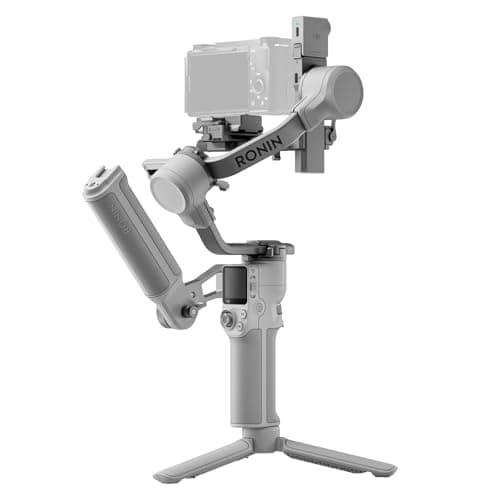
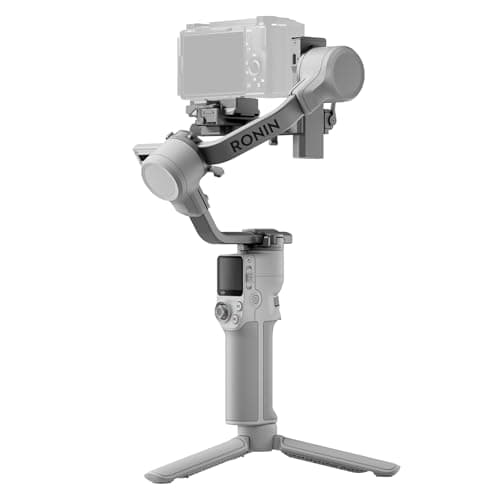
The DJI RS 4 Mini is the gimbal to buy if your camera and lens together weigh under about 2kg. It is light enough to carry all day, its automatic axis locks remove most of the setup friction that makes people abandon gimbals, and the battery outlasts any sensible shooting day. The catches are real and worth knowing: the payload ceiling is a hard limit, the build is largely plastic, and the battery does not come out.
The usual disclosure: we have not run this gimbal through a lab. What follows is DJI's published specification sheet, the documented findings of reviewers who used one — named and linked in Sources — and our own read on who it suits, scored against our rubric. Informed opinion, not measurements.
Who it's for
This is a gimbal for somebody shooting a compact mirrorless body — a Sony a6400 or ZV-E10, a Canon R50 or R10, a Nikon Z30, a Fujifilm X-S20 — with a prime or a small zoom on the front, who wants walking footage that does not look like walking footage. DJI lists a tested payload of 0.4-2kg, and that range is the whole story of this product: it is sized for exactly that class of camera and nothing heavier.
It suits solo creators in particular. Everything about the Mini line is built around one person setting up quickly and carrying the thing themselves, and at a listed 890g without tripod or quick-release plate it is one of the few camera gimbals light enough that you keep bringing it. A gimbal you leave at home stabilizes nothing, which is the argument we make throughout our best gimbals for mirrorless ranking.
Who should look elsewhere? Anyone whose rig is near or over 2kg — a bigger body with a fast zoom gets there faster than people expect — should read best gimbals for DSLRs instead. And anyone whose camera has in-body stabilization and who mostly shoots static or slow shots may not need a gimbal at all; our stabilization explainer is the honest place to check that before spending anything.
Where it's strong
Automatic axis locks — the reason it gets used
DJI put a second-generation automatic axis locking system on all three axes. The arms fold and hold themselves while you mount the camera, which turns balancing from a fiddly two-handed job into something you finish quickly. This sounds like a minor convenience written down and is not one in practice. Balancing friction is the single most common reason a gimbal ends up in a cupboard, and this is the feature that addresses it directly. It is also the main thing you pay for over the previous generation — our RS 3 Mini vs RS 4 Mini comparison works through whether that is worth it at any given price gap.
Weight you can live with
DJI lists the gimbal at approximately 890g excluding the tripod and quick-release plate, folding to 236 × 64 × 316mm. That is genuinely small for a camera gimbal, and it is the spec that decides whether this ends up in your bag on a travel day. It is not weightless — the reviewer at ProVideo Coalition put it at just under two pounds and called it travel-friendly rather than featherlight — but it sits in the category of things you carry without resenting.
A battery you can stop thinking about
The built-in 3100mAh (22.32Wh) pack is rated by DJI at up to 13 hours stationary and takes roughly an hour and 50 minutes to charge on a 30W supply. Real-world runtime with a camera on it and motors working will be shorter than the stationary figure — that is true of every gimbal's headline number — but the reviewers who used one agreed it comfortably covers a full shooting day. This is one spec where you can simply charge it the night before and forget about it.
Vertical shooting without a rebuild
Switching to a portrait orientation used to mean partially rebalancing the rig. The RS 4 Mini uses a third-generation native vertical switching mechanism, and the ProVideo Coalition review reported making the change in under ten seconds. If part of your output is vertical — Reels, Shorts, TikTok — this is the feature that keeps you from shooting everything horizontal and cropping later, which always costs resolution and framing.
The tracking module, honestly assessed
DJI sells an RS Intelligent Tracking Module: a 19g unit that attaches magnetically and adds subject tracking and palm-gesture control to any camera on the gimbal, with tracking working to about 10 meters. It ships in the Combo kit and is sold separately otherwise. For somebody filming themselves with nobody behind the camera it is the single most useful accessory DJI makes for this gimbal. For everybody else it is optional, and we have ranked the two kits below in that order deliberately.
The honest catches
The 2kg payload is a ceiling, not a target
DJI's tested payload is 0.4-2kg, and the ProVideo Coalition review was blunt that the 4.4 lb limit confines this to mirrorless bodies with mid-range lenses — where the full-size RS 4 Pro handles roughly ten pounds. Payload ratings are not aspirational: run a gimbal at its limit and the motors fight, battery life drops and stabilization degrades. Weigh your heaviest realistic combination before you buy, and if it lands anywhere near 2kg, buy up. Our RS 4 Mini vs RS 4 comparison is exactly that decision.
It is mostly plastic
The same review noted that the Mini "features a lot of plastic, whereas the RS 4 Pro feels sturdier with more robust metal in its critical use spots." That is the cost of 890g and this price bracket, and it is a fair trade for most buyers — but if you work in rough conditions or expect gear to be knocked about, it is a real difference in class rather than a matter of taste.
The battery does not come out
The pack is built in. You cannot carry a charged spare and swap it — if you run flat on location, you are tethered to a power bank or waiting. With 13 hours of rated stationary runtime this will rarely bite, but it is a genuine design limitation rather than an oversight, and it is worth knowing before a long shoot day away from power.
Tracking is not an operator
The Intelligent Tracking Module impressed the reviewer who used it, but with caveats he stated plainly: it reacts more slowly than an experienced human operator, and it lost high-contrast subjects during his testing. Treat it as a capable second pair of hands for a solo creator, not as a camera operator you no longer have to pay. If somebody else is holding the camera anyway, skip the Combo.
It is not a phone gimbal
It will hold a phone, and the same reviewer recommended buying a dedicated phone gimbal instead. That is our read too: the RS 4 Mini's design, weight and price all exist to serve a camera. If your shooting is phone-first, this is the wrong purchase.
The DJI availability question
We keep a standing note on this hub because it is honest and because it affects buying decisions: DJI's US availability has wobbled, so we deliberately pair every DJI pick with a Zhiyun or Hohem alternative. The RS 4 Mini is on sale in the US now and we have verified the listings below, but if you would rather not depend on DJI at all, our Zhiyun vs DJI comparison and best budget gimbals cover the alternatives.
The verdict
The RS 4 Mini is the gimbal we recommend most often to mirrorless creators, and the reason is not on the spec sheet. It is that the automatic locks and the low weight remove the two excuses — setup is a hassle, it is too heavy to bring — that stop people using the gimbal they already own. Stabilization quality at this level is largely a solved problem; what differs between products is whether you actually reach for it.
Buy the standard kit unless you film yourself alone, in which case the Combo's tracking module earns its premium. Buy something bigger if your rig is near 2kg. And check your camera's in-body stabilization first — for slow, static work it may already be enough.
Standard or Combo — how to decide
The two listings above are the same gimbal. The Combo adds the RS Intelligent Tracking Module and a briefcase handle; nothing about the stabilizer itself changes. The decision is therefore simple and not about the gimbal at all: does anybody hold the camera for you?
If the answer is no — you film yourself, you shoot alone, you want the camera to follow you around a room while your hands are busy — the module is the most useful thing DJI sells for this gimbal, and buying it in the box is usually cheaper than adding it later. Compare the two live prices above against each other before you decide; the premium moves, and when it is close to the module's standalone price the Combo is the cheaper route to the same two objects.
If somebody else operates the camera, or your shots are planned and framed in advance, buy the standard kit. The module will sit in the case, and the money is better spent on a lens that improves every shot instead.
Weigh your rig first — this is the step people skip
DJI's tested payload is 0.4-2kg, and both ends matter. Too heavy and the motors struggle; surprisingly, far too light can also make balancing awkward. Add up your body, your heaviest lens, and anything permanently attached — a cage, a microphone, a small monitor — and compare that to 2kg with honest margin. If you are within a couple of hundred grams of the ceiling, step up to the full-size RS 4 or look at the higher-payload options in best gimbals for DSLRs.
What you give up against the full-size RS 4
Payload headroom and build materials, mostly. The full-size gimbals take heavier rigs and use more metal in the parts that get handled, and they are correspondingly heavier and more expensive. What you do not give up is stabilization quality for the cameras the Mini is rated for — within its payload band it does the same job. That is why we rank it first for mirrorless and not at all for heavier setups.
Before you buy any gimbal
Two honest checks. First, does your camera have in-body stabilization? If it does and your shots are mostly static, a tripod with a fluid head will give a better result for less money — see image stabilization explained. Second, can you name the moving shot you want? "Smoother video" is usually solved by a lens or a tripod. A gimbal is for walking, following and orbiting shots specifically, and it is worth buying when you can describe the shot you are missing.