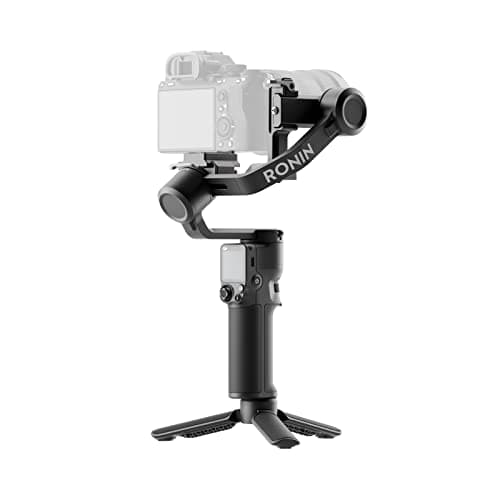
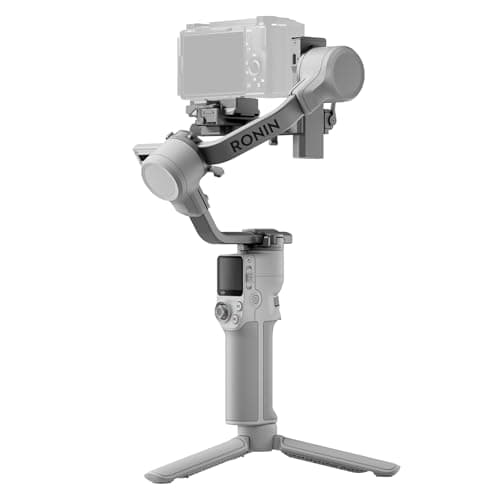
Buy the DJI RS 4 Mini if the price gap is modest — its second-generation automatic axis locks cut the balancing friction that makes beginners abandon gimbals, and that is worth paying for. Buy the RS 3 Mini when it is discounted meaningfully: it stabilizes footage just as well, weighs slightly less, and keeps DJI's app. Both are 3-axis gimbals rated to roughly the same payload, aimed at the same buyer: someone with a compact mirrorless body who wants smooth walking footage without carrying a full-size rig.
The four things that actually differ
1. Automatic axis locks — the real upgrade
This is where the RS 4 Mini earns its price. Its second-generation automatic axis locks fold the arms for you and hold them while you mount the camera, which turns balancing from a fiddly two-handed job into something you do in under a minute. On the RS 3 Mini you lock each axis manually. That sounds trivial written down and is not in practice: balancing friction is the single most common reason a gimbal ends up in a cupboard. If you know yourself to be impatient with setup, pay for the locks.
2. Weight, and which one you carry
Counter-intuitively, the older gimbal is the lighter one — the RS 3 Mini is around 795g against roughly 890g for the RS 4 Mini. That is not a big difference on paper and it is noticeable at the end of a long day held out in front of you. Both are among the lightest camera gimbals you can buy, which is the whole reason the Mini line exists.
3. Payload: effectively the same
Both are rated to roughly 2kg. That is comfortable for a compact mirrorless body with a prime or a small zoom, and tight for a heavier body with a large zoom. The payload rule does not bend for either: weigh your camera with its heaviest lens and make sure it is comfortably under the rating, with headroom. Running any gimbal near its ceiling strains the motors, drains the battery and produces shakier footage. If your rig is close to 2kg, neither of these is the right gimbal — step up to a Weebill 3E or an RS 4.
4. Battery and app polish
The RS 4 Mini runs longer on a charge and gets DJI's newest firmware attention first. The RS 3 Mini still gets a full shoot day out of its battery and keeps the same polished app, follow-focus support and native vertical shooting mode. This is a difference of degree rather than of kind — nobody buys the newer Mini for the battery.
What has not changed
Both are genuine 3-axis mechanical stabilizers, and both produce the same result: walking footage that looks like it was shot on a dolly. The stabilization itself is not the upgrade. Both work with DJI's app ecosystem, both support vertical shooting for short-form video, and both use the same quick-release plate system. The RS 3 Mini is not a cut-down product — it is last year's product.
Who should buy which
Buy the RS 4 Mini if the two are close in price, if you will be mounting and dismounting the camera often, or if you have tried a gimbal before and given up on the balancing. The automatic locks are the difference between a tool you use and a tool you own.
Buy the RS 3 Mini when it is genuinely discounted. You are getting the same stabilization, a slightly lighter body and the same app for less money, and you can spend the difference on something that improves the footage more — a wireless microphone or a better lens.
The question before both of them
Do you need a gimbal at all? If your camera has in-body stabilization and you shoot mostly static or slow footage, the answer may be no. A modern IBIS body with a stabilized lens handles locked-off shots, gentle pans and careful handheld work on its own. A gimbal earns its keep for genuine motion — walking, running, tracking, reveals and orbits. We would rather you kept the money than bought a stabilizer that sits still. Our stabilization guide covers which system fixes what.
And the DJI availability note
As on every DJI recommendation here: DJI's US availability has been uncertain at times. If neither Mini is easy to buy the week you shop, the Zhiyun and Hohem alternatives in our budget gimbal ranking do the same job, and the Weebill 3E in particular is a genuine equal rather than a consolation prize.