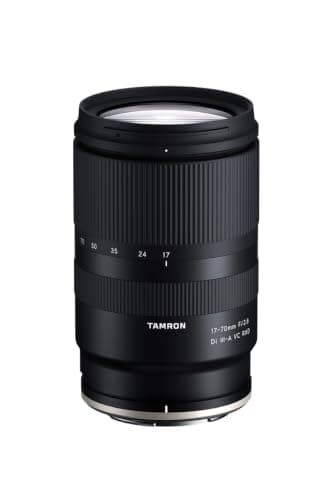
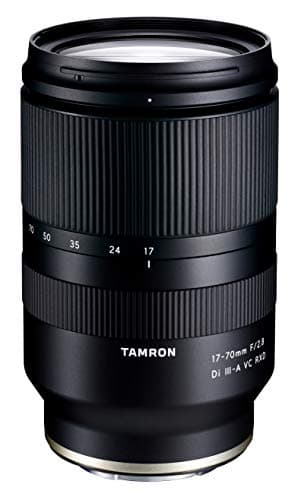
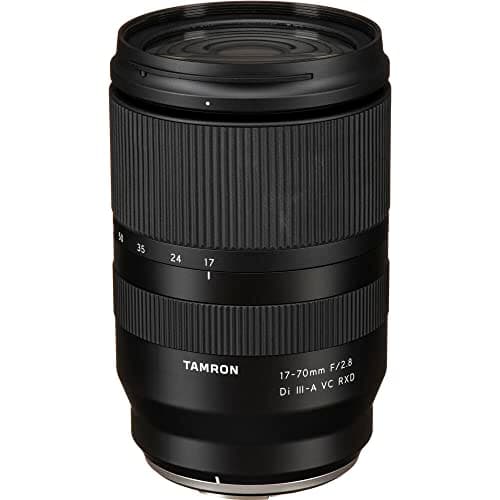
The Tamron 17-70mm F2.8 Di III-A VC RXD is the only APS-C lens that genuinely replaces a kit zoom and a short telephoto at the same time. It holds f/2.8 from a 25.5mm-equivalent wide angle out to a 105mm-equivalent short telephoto, it has its own stabilization, and LensTip measured very good center resolution at every focal length they tested — rising to 81 lpmm at 70mm against a 39-41 lpmm decency level on the 42.4-megapixel sensor they use. Nothing else on APS-C does all three. The price of that is weight: at 525-540g depending on mount it is roughly double what a compact f/2.8 zoom like the Sigma 18-50mm F2.8 asks you to carry.
As of July 2026 it exists on four mounts. Sony E came first in 2021, Fujifilm X followed in 2022, and Tamron put the Nikon Z and Canon RF versions on sale on July 2, 2026. That matters more than it sounds: on Nikon Z DX and Canon RF-S there is no first-party constant-f/2.8 standard zoom at all, so for a Z50 II or an R10 owner this is not a better option than the native one — it is the only one.
The usual disclosure: we have not lab-tested this lens. Every measurement below is LensTip's, from their multi-part test, and every specification is Tamron's own published figure — both linked in Sources. Our scores are judgments against our rubric, not measurements of our own. Prices are read live and stamped with the date; we never quote a number in prose.
Who it is for
This lens is for the person who has worked out that changing lenses is the reason they miss shots. A 17-70mm range covers an interior, a street, a full-length portrait and a head-and-shoulders portrait without the lens ever leaving the camera, and it does all of it at the same aperture, so the exposure does not drift as you zoom and the background blur does not evaporate the moment you reach for reach.
Three buyers in particular. The event and family shooter, because a birthday party or a wedding reception is exactly the situation where a prime is the wrong tool and a kit zoom is too dark. The traveler who carries one lens, as long as they are honest that this is a heavy one lens. And the Nikon Z DX or Canon RF-S owner, because both systems ship kit zooms that start at f/3.5 and end at f/6.3, and neither brand sells a fast standard zoom for its crop bodies. Our best Nikon Z lenses and best Canon RF lenses pages both describe those gaps in detail.
It is not for the gimbal shooter or the person optimizing for size. More than half a kilogram on the front of a small mirrorless body is a different camera to hold, and a 2kg-payload gimbal will feel it — our guide to choosing a gimbal walks through the payload arithmetic with this exact lens as the worked example. If that is you, read Sigma 18-50mm vs Tamron 17-70mm before anything else on this page — it is the same decision, framed as a choice.
The specification, as published
| Spec | Tamron 17-70mm F/2.8 Di III-A VC RXD (B070) |
|---|
| Format | APS-C only |
| Mounts | Sony E, Fujifilm X, Nikon Z, Canon RF |
| Aperture | f/2.8 constant to f/22, 9 rounded blades |
| Angle of view | 80°37' to 23°17' (E, Z, X); 77°0' to 21°52' (Canon RF) |
| Optics | 16 elements in 12 groups, with 2 LD and 3 aspherical elements |
| Stabilization | VC; LensTip measured about 3.7 EV at 70mm |
| Autofocus | RXD stepping motor, internal focus, focus-by-wire (no distance scale) |
| Minimum focus | 0.19m (7.5in) at 17mm; 0.39m (15.4in) at 70mm |
| Maximum magnification | 1:4.8 at 17mm; 1:5.2 at 70mm |
| Filter thread | 67mm, non-rotating |
| Maximum diameter | 74.6mm |
| Length | 119.3mm (E), 121.3mm (Z), 119.6mm (X), 117.3mm (RF) |
| Weight | 525g (E), 540g (Z), 530g (X and RF) |
| Weather resistance | Moisture-resistant construction, fluorine coating on the front element |
| In the box | Both caps and a petal-shaped hood |
Two notes on that table. The 0.19m close focus at the wide end is unusually short for a standard zoom — at 1:4.8 you can fill most of the frame with a dinner plate, which is a genuinely useful second job for a lens like this. And the angle-of-view row is the one Canon buyers should read twice: Tamron publishes a narrower figure for the RF version because Canon's APS-C sensors crop at 1.6x rather than 1.5x. The lens is identical; the sensor behind it is smaller, so you get about 27-112mm equivalent instead of 25.5-105mm. Crop factor explained covers why that happens.
What the lab found: sharpness
LensTip tested the lens on a 42.4-megapixel sensor used in APS-C mode, which is a harsher test than any camera this site covers — it puts roughly 18 megapixels inside the crop, so a lens that holds up there has margin on a 24-megapixel APS-C body. Their decency level for that sensor is 39-41 lpmm.
In the center, the lens clears it everywhere and improves as it gets longer. Wide open at f/2.8 LensTip recorded above 60 lpmm at 17mm, almost 64 lpmm at 30mm, slightly above 64 lpmm at 50mm and above 66 lpmm at 70mm. Stopped down to each focal length's optimum those rise to above 65, almost 69, almost 74 and 81 lpmm respectively. The practical reading: you can shoot this lens wide open at any focal length and the middle of the frame will be sharp, which is the entire point of buying a constant f/2.8.
The edges are the familiar zoom compromise, and they are best where it matters most. From 17mm to 30mm LensTip measured clearly above 50 lpmm from maximum aperture, rising to well over 60 lpmm stopped down — strong results for the focal lengths you use for interiors and landscapes, where corner detail is actually looked at. At 50mm the edge sits near 46 lpmm at f/2.8, 59 lpmm at f/4 and almost 64 lpmm at f/5.6; at 70mm it is near 45 lpmm wide open with a peak below 60 lpmm. In other words: at the long end, wide open, the corners are merely acceptable. For a portrait that is irrelevant, because the corners are background. For a flat copy of a document it is not, and you would stop down to f/5.6.
LensTip's own summary calls the results uneven across the range but free of weak spots, and credits the design with putting its best edge performance at the shortest focal lengths. That is the right trade for this lens.
Distortion: strong at both ends, and worth knowing about
This is a wide-range zoom and it distorts like one. LensTip measured -3.33% barrel distortion at 17mm, with a moustache component that makes it slightly awkward to correct by hand, then it swings to pincushion: +0.81% at 24mm, +2.50% at 35mm, +2.88% at 50mm and +2.71% at 70mm. Every modern camera and raw converter applies Tamron's correction profile automatically, and in JPEG you will never see any of it. If you shoot raw in software that does not load the profile, straight lines near the edge of the frame will bend, and at 17mm they will bend in a wave rather than a simple curve.
The three honest flaws
Vignetting is the first, and LensTip calls it strong — worst at both ends of the zoom range. Corners of an uncorrected raw file are visibly darker than the center. Profile correction fixes it in a click and costs a little corner noise; in JPEG the camera has already done it. It is the standard price of a wide range and a constant aperture in a barrel this size, and it is the flaw you are least likely to notice in real photographs.
Spherical aberration is the second, and it is the more interesting one. LensTip describes its correction as not a strong point of this lens. In practice that shows up as a slight softness and a glow around high-contrast edges wide open, and as focus shift — the plane of focus moving very slightly as you stop down. On a mirrorless camera that focuses through the taking aperture, focus shift is mostly handled for you. It is still the reason the lens looks meaningfully crisper at f/4 than at f/2.8 in a way the raw resolution numbers alone do not fully explain.
Flare resistance is the third, and it is the one that will actually change a photograph. LensTip says performance against bright light is weaker than it should be. Shoot into a low sun or a streetlight without the supplied hood and you should expect veiling haze and visible ghosts. The hood is in the box; use it. This is the flaw worth weighing if you shoot backlit portraits or late-afternoon travel work, because unlike vignetting it cannot be corrected afterwards.
A fourth thing is not a flaw but a characteristic: the zoom barrel extends 29mm as you go from 17mm to 70mm, so the lens grows in use, and the front element sits 56mm across behind a 67mm thread. If you are buying filters for it, buy 67mm — and our lens filters explained page covers which ones are worth owning.
Stabilization: what 3.7 EV actually buys you
Tamron's VC is the quiet reason this lens outsells its rivals on mounts where cheap bodies have no in-body stabilization. LensTip measured the maximum gap between stabilized and unstabilized blur rates at about 3.7 EV at 70mm, and noted that makers typically claim around 4 EV for a lens of this class — so the measurement broadly supports the marketing, which is not always the case.
In plain terms, 3.7 EV is roughly three and a half stops: a handheld shot that would have needed 1/100s to come out sharp will come out sharp at something nearer 1/10s. That is the difference between a usable indoor photograph at ISO 1600 and a noisy one at ISO 12800. It does nothing for a moving subject — stabilization steadies the camera, not the person in front of it — and it does not remove footstep bounce in video, which is what a gimbal is for. What it does do is make a 525g lens usable handheld on a Z30, an R10 or an X-M5, none of which have in-body stabilization at all. Our image stabilization explainer separates the four kinds properly.
Which mount to buy, and what it competes with
All four versions are the same optical design, so buy the one that fits your camera. The picks above are ordered by the price we can read today, not by preference — the Sony E listing is live but Amazon currently suppresses its price, so its button sends you to the product page to check rather than quoting a number we cannot verify. What differs between the mounts is the competition.
On Sony E, this lens has real rivals and the decision is genuinely close. The Sigma 18-50mm F2.8 is far smaller, far lighter, cheaper, and gives up the long end and the stabilization. We built a whole page on that choice: Sigma 18-50mm vs Tamron 17-70mm. The short version is that the Sigma is the better lens to carry and the Tamron is the better lens to arrive with. Best budget Sony E lenses ranks the rest of the mount.
On Fujifilm X, Fujifilm's own constant-f/2.8 zooms stop at 55mm, so the Tamron is the only way to get f/2.8 past that without changing lenses. The XF 18-55mm f/2.8-4 remains the better lens for someone who wants an X body to stay small and dial-driven. See best Fujifilm X lenses.
On Nikon Z and Canon RF, there is no competition, which is the whole story. Neither brand makes a fast standard zoom for its crop bodies; both ship variable-aperture kit zooms. If you own a Z50 II, a Z30, an R10, an R50 or an R100 and you want a constant f/2.8 without adapting older glass, this is it. On Canon, remember the 1.6x crop takes the wide end to about 27mm equivalent — less wide than the same lens on the other three mounts.
Does it suit landscape work?
Well, with one caveat. The 17mm wide end is a 25.5mm equivalent on Sony, Nikon and Fujifilm — wider than a kit zoom, but not the sweeping ultra-wide most people picture for landscape. What it does give you is the whole trip in one lens with no lens changes in wind or spray, and moisture-resistant construction to go with it. Pair it with a sealed body — our best cameras for landscape ranking explains why sealing only works end to end — and carry a genuine ultra-wide alongside it if the big view is the reason you went out.
Is it worth it over a kit lens?
Yes, and by more than the aperture number suggests. A typical f/3.5-6.3 kit zoom is two and a third stops darker at its long end than this lens is, which at the same shutter speed means five times the ISO. Add VC on top and the gap in what you can shoot handheld indoors is enormous. The honest counterweight is that the kit lens weighs a third of this and costs a fraction, and that a cheap fast prime buys you more light again for less money and less weight — which is the argument we make in kit lens vs prime.
The verdict
LensTip's summary calls the price very reasonable for a lens with these unique specifications, and says it delivers very good image quality across the frame at every focal length — while listing strong vignetting, noticeable spherical aberration and weak performance against bright light as its faults. We would put it this way: the Tamron 17-70mm is not the sharpest, smallest or cheapest APS-C zoom, and it is the most useful one. The range and the constant aperture together remove a decision you would otherwise make twenty times a day.
Buy it if you are tired of changing lenses, if you shoot events or family or travel, or if you own a Nikon Z DX or Canon RF-S body and want f/2.8 at all. Do not buy it if you are building the lightest possible kit, if your gimbal is rated near 2kg, or if you mostly shoot one focal length — in that last case a prime from best 35mm primes or best 50mm lenses will give you more light and better corners for less money.