Skip to content
Focal & Frame

Kit · Accessories

The Best Alternatives to the Rode Wireless GO

The Wireless GO invented the pocket-sized clip-on wireless kit. Here is what to buy instead when you want a charging case, a smaller clip, a safety net for your levels - or simply a better price.

By Stephen V.Updated How we research
#ad

We earn a commission when you buy through our Amazon links, at no extra cost to you. It never decides our rankings — we say so when the cheaper pick is the better buy. How this works.

Rode Rode Wireless GO III

Our #1 pick

Rode Wireless GO III

The audio-quality step up. Two transmitters with 32-bit float onboard recording and automatic level control — the most bulletproof recording of the whole GO line.

Don't buy it if you want the smallest, cheapest kit or a charging case in the box. The DJI Mic Mini and Hollyland Lark M2 pack smaller for less, and the DJI Mic 3 bundles a charging case.

#ad · Live Amazon price as of November 22, 2026. No verified price → we show none.

The best alternative to the Rode Wireless GO is the Rode Wireless GO III - the same brand, the same clip-on shape and the same workflow, with 32-bit float onboard recording and GainAssist automatic level control added. It is also, at the time of writing, usually the cheaper of the two. That last point is the whole reason this page exists. Our budget pick is the DJI Mic Mini, the least expensive kit here and still a genuine two-transmitter setup. Prices come from the live price layer with an "as of" date; where there is no verified purchasable offer, we show no price.

First, what the Wireless GO is known for, because it earned its reputation honestly. Rode invented this category: a transmitter the size of a matchbox with a microphone built into it, a receiver that slides into a camera's hot shoe, and no cables, no lavalier and no setup to get wrong. The second-generation kit put two transmitters in the box with one receiver, so you could mic yourself and a guest with a single purchase, added onboard backup recording so a radio dropout did not cost you the take, and worked over roughly 200m of line of sight with both 3.5mm and USB-C outputs. Every kit on this page is a descendant of that design, including the ones from other companies.

People look for an alternative for four reasons, and each has a different answer. The original kit is now a generation behind, so its features are the oldest here. Rode's own Amazon listing for it has gone, which leaves remaining seller stock at seller prices - frequently above the newer Wireless GO III that replaced it. The transmitters are larger than what is now available. And there is no 32-bit float recording, which is the single feature that makes beginner audio hard to ruin. The picks below are ordered by how many of those four they solve.

The short answer

Quick picks

#ProductBest forScorePrice
01
Rode Rode Wireless GO III
Rode Wireless GO III

The audio-quality step up. Two transmitters with 32-bit float onboard recording and automatic level control — the most bulletproof recording of the whole GO line.

The best all-round creator mic
8.8
$165.90Amazon
02
DJI DJI Mic 3
DJI Mic 3

The most forgiving wireless kit, a generation on. Two transmitters, a receiver and a charging case, with dual-file 32-bit float recording and gain that sets itself.

Beginners who want levels handled for them
9.2
$259.00Amazon
03
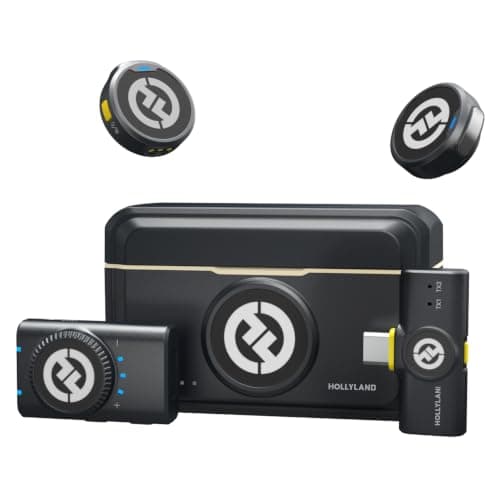
Hollyland Hollyland Lark M2 (Camera Kit)
Hollyland Lark M2 (Camera Kit)

The value wireless kit. Two of the smallest clip-on transmitters going, plus both a camera receiver and a USB-C receiver in one box, for well under the flagship money.

The best value wireless lav
8.6
$70.40Amazon
04
DJI DJI Mic Mini (2 TX + 1 RX)
DJI Mic Mini (2 TX + 1 RX)

The most pocketable two-person kit. Ultralight transmitters you forget you are wearing, a camera receiver, and DJI's easy pairing — the cheapest way into a proper wireless setup.

The most compact budget kit
8.2
$59.00Amazon
05
DJI DJI Mic 2
DJI Mic 2

The last-generation DJI kit, still widely sold. Two transmitters, a receiver and a charging case, with 32-bit float onboard recording and genuinely good background-sound reduction.

The last-generation DJI, still sold
8.8
$199.00Amazon

#ad · Live prices from the Amazon Product API, as of November 22, 2026. Where we have no verified live price, we show none — we would rather leave a gap than print a number that has rotted.

In detail

The picks, in full

01
Rode Rode Wireless GO III

The best all-round creator mic

Rode Wireless GO III

2 transmitters + 1 receiver32-bit float onboard recordingGainAssist automatic level controlLarge internal recording backup per TX
8.8/10

The audio-quality step up. Two transmitters with 32-bit float onboard recording and automatic level control — the most bulletproof recording of the whole GO line.

Sound quality
10
Ease of use
9
Build
9
Versatility
9
Value
7

Pros

  • 32-bit float onboard recording makes clipped or too-quiet audio recoverable in the edit — a genuine safety net
  • GainAssist rides your levels automatically, so beginners rarely clip a loud moment or lose a quiet one
  • Hours of internal backup recording on each transmitter means a dropout never costs you the take

Cons

  • Pricier than the value picks, and the standard box does not include a charging case
  • The transmitters are a touch larger than the tiny Hollyland and DJI Mic Mini clips

Don't buy this if…

…you want the smallest, cheapest kit or a charging case in the box. The DJI Mic Mini and Hollyland Lark M2 pack smaller for less, and the DJI Mic 3 bundles a charging case.

$165.90View on Amazon

Price as of November 22, 2026. Prices change — Amazon's is the one that counts.

#ad · we may earn a commission from this link to Rode Wireless GO III

02
DJI DJI Mic 3

Beginners who want levels handled for them

DJI Mic 3

2 transmitters + 1 receiver + charging caseDual-file 32-bit float internal recordingAdaptive gain + two-level noise cancelingUp to 400m range (line of sight)
9.2/10

The most forgiving wireless kit, a generation on. Two transmitters, a receiver and a charging case, with dual-file 32-bit float recording and gain that sets itself.

Sound quality
10
Ease of use
10
Build
8
Versatility
10
Value
8

Pros

  • Dual-file 32-bit float recording keeps two internal safety copies per transmitter, so a clipped or too-quiet moment is recoverable twice over
  • Adaptive gain control rides your levels for you — the single biggest cause of ruined beginner audio, handled in the box
  • Scales further than anything else here: up to four transmitters and eight receivers, so a two-person kit can grow into a multi-camera setup

Cons

  • Not compatible with Mic 2 transmitters or receivers, so Mic 2 owners cannot mix the two generations
  • The 16g transmitters clip and hold well, but the magnet can drag on very light fabric
  • The transmitters have no 3.5mm input, so you cannot plug in a separate lavalier mic to hide under clothing — the built-in mic on the visible unit is the only option

Don't buy this if…

…you want the cheapest route to clean wireless sound. The DJI Mic Mini and Hollyland Lark M2 cost a fraction of this and still sound excellent — what you pay for here is the safety net, not the microphone.

$259.00View on Amazon

$329.0021% off

Price as of November 22, 2026. Prices change — Amazon's is the one that counts.

#ad · we may earn a commission from this link to DJI Mic 3

03
Hollyland Hollyland Lark M2 (Camera Kit)

The best value wireless lav

Hollyland Lark M2 (Camera Kit)

2 transmitters + camera & USB-C receivers48kHz / 24-bit audioUp to ~300m range (line of sight)~9g magnetic-clip transmitters
8.6/10

The value wireless kit. Two of the smallest clip-on transmitters going, plus both a camera receiver and a USB-C receiver in one box, for well under the flagship money.

Sound quality
8
Ease of use
9
Build
7
Versatility
9
Value
10

Pros

  • The transmitters are among the tiniest and lightest here, so they hide on a collar and clip on magnetically in a second
  • The camera kit includes both a camera receiver and a USB-C receiver, so one purchase covers your mirrorless body and a phone or laptop
  • Long battery life and effective background-sound reduction that punch well above the price

Cons

  • There is no 32-bit float, so you still set sensible levels before you roll rather than rescuing them later
  • The companion app and accessory range are less mature than DJI's or Rode's

Don't buy this if…

…you want a 32-bit-float safety net or the deepest first-party lavalier and mount range. The DJI Mic 3 handles levels for you, and the Rode systems have the widest accessory catalog.

$70.40View on Amazon

$88.0020% off

Price as of November 22, 2026. Prices change — Amazon's is the one that counts.

#ad · we may earn a commission from this link to Hollyland Lark M2 (Camera Kit)

04
DJI DJI Mic Mini (2 TX + 1 RX)

The most compact budget kit

DJI Mic Mini (2 TX + 1 RX)

2 transmitters + 1 camera receiverUltralight ~10g transmittersUp to ~400m range (line of sight)Two-level background-sound reduction
8.2/10

The most pocketable two-person kit. Ultralight transmitters you forget you are wearing, a camera receiver, and DJI's easy pairing — the cheapest way into a proper wireless setup.

Sound quality
8
Ease of use
9
Build
7
Versatility
8
Value
9

Pros

  • Among the lightest transmitters here, so they disappear on a collar and stay comfortable all day
  • A genuine two-transmitter camera kit at a budget price — you can mic yourself and a guest
  • DJI's quick pairing and background-sound reduction carry over from the flagship

Cons

  • No 32-bit float, unlike the DJI Mic 3, so levels matter more when you record
  • Shorter feature list and a lighter-duty build than the flagship

Don't buy this if…

…you want 32-bit float or a charging case included. Step up to the DJI Mic 3, which adds both.

$59.00View on Amazon

$79.0025% off

Price as of November 22, 2026. Prices change — Amazon's is the one that counts.

#ad · we may earn a commission from this link to DJI Mic Mini (2 TX + 1 RX)

05
DJI DJI Mic 2

The last-generation DJI, still sold

DJI Mic 2

2 transmitters + 1 receiver + charging case32-bit float onboard recordingSmart background-sound reductionUp to ~250m range (line of sight)
8.8/10

The last-generation DJI kit, still widely sold. Two transmitters, a receiver and a charging case, with 32-bit float onboard recording and genuinely good background-sound reduction.

Sound quality
9
Ease of use
10
Build
8
Versatility
9
Value
8

Pros

  • 32-bit float internal recording means clipping is effectively a non-issue — you can rescue levels that would be ruined on other systems
  • The charging case tops the transmitters back up between shoots, so the kit is always ready to grab and go
  • One-tap background-sound reduction on the transmitter tames air conditioning, traffic and room hum surprisingly well

Cons

  • Magnetic clips are quick but can pull loose on heavy fabrics, and each transmitter weighs 28g, well above the Mic 3's 16g
  • Deepest features and firmware assume you're in DJI's ecosystem; pairing to some older cameras needs the right cable

Don't buy this if…

…you want the current generation. The DJI Mic 3 replaced this kit and adds dual-file 32-bit float recording and automatic gain — buy the Mic 2 only when the discount is real.

$199.00View on Amazon

$269.0026% off

Price as of November 22, 2026. Prices change — Amazon's is the one that counts.

#ad · we may earn a commission from this link to DJI Mic 2

Why we do not list a price for the original

The Wireless GO II is still in our rankings and we still think it is a good microphone. It gets no buy button on this page, and that is a deliberate choice rather than an oversight: Rode's own listing for the kit has gone, so what remains is third-party seller stock, and it regularly prices above the current-generation Wireless GO III. Pointing you at a more expensive way to get fewer features would be the opposite of useful. If you find the GO II genuinely discounted somewhere, it is a fine mic - just check it against the GO III's live price first, which is on this page.

How we ranked the five alternatives

  1. Recording safety. 32-bit float onboard recording means a clipped or too-quiet take is recoverable in the edit instead of lost. Combined with automatic gain, it removes the most common way beginners ruin audio. Three of the five picks have it.
  2. How little you notice wearing it. The original GO transmitters are chunky by current standards. Hollyland lists its Lark M2 clips at roughly 9g and DJI lists the Mic Mini transmitters at around 10g - light enough to forget, and small enough not to dominate a shot.
  3. What is actually in the box. Two transmitters or one? A camera receiver, a USB-C receiver, or both? A charging case or not? This is where the real price differences hide.
  4. Price for the same job. Clean two-person wireless audio does not cost what it used to. Two picks here do it for well under half the money, and we say plainly what they give up to manage it.

The five alternatives

KitWhat it fixes vs the Wireless GO32-bit float?What it costs you
Rode Wireless GO IIISame shape and brand, plus float recording and automatic levelsYesNo charging case in the standard box
DJI Mic 3Dual-file float, adaptive gain, charging case, up to 400mYes (two files per transmitter)Most expensive here; no 3.5mm input on the transmitters
Hollyland Lark M2Roughly 9g clips, and both a camera and a USB-C receiver in one boxNoYou set your own levels; less mature app and accessories
DJI Mic MiniThe lowest price for a real two-transmitter kit, at around 10g eachNoNo float safety net, no charging case, lighter-duty build
DJI Mic 2Float recording plus a charging case, at last-generation pricingYes28g transmitters; superseded, so buy only on a real discount

1. Rode Wireless GO III - the obvious answer, and usually the cheaper one

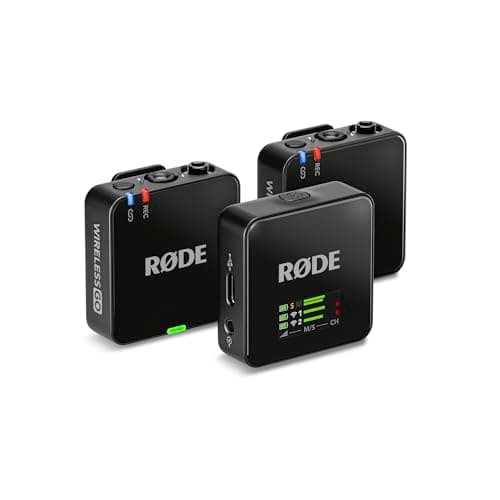
If you liked the idea of the Wireless GO, this is it with the two weaknesses fixed. Rode publishes 32-bit float onboard recording on each transmitter plus GainAssist automatic level control, which between them handle the two things that wreck beginner audio: levels set wrong before you rolled, and a radio dropout mid-take. The internal backup runs for hours per transmitter. The shape, the hot-shoe receiver and the two-transmitter box are unchanged, so nothing you learned on the older kit is wasted.

The honest cons: it costs more than the value picks on this page, and the standard box does not include a charging case - Rode sells the Charge Case+ separately, which it rates at two full recharges and up to 21 hours of use. Its transmitters are also a touch larger than the Hollyland and DJI Mic Mini clips, so it is not the most discreet option on camera. The direct comparison with our other top-tier pick is DJI Mic 3 vs Rode Wireless GO III.

2. DJI Mic 3 - the most forgiving kit you can buy

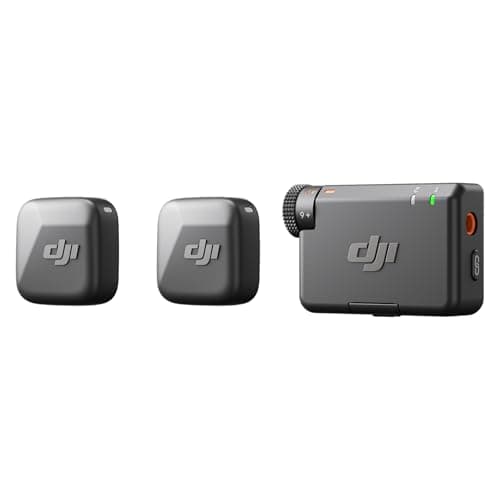
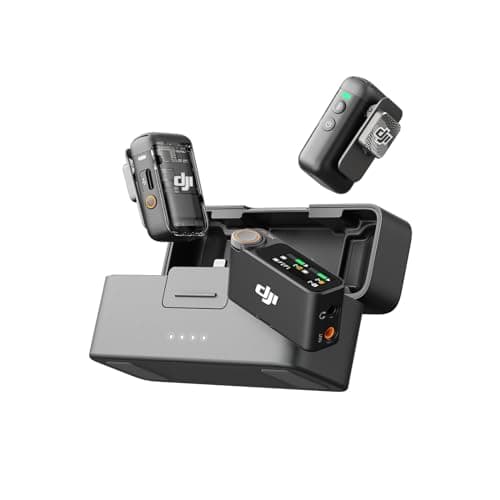
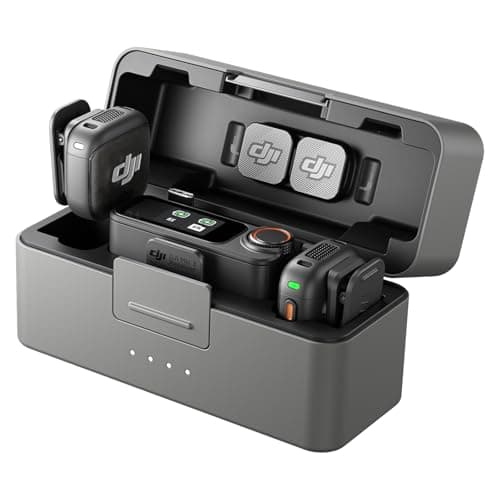
This is the pick if you want the machine to look after you. DJI publishes dual-file 32-bit float recording - two internal safety copies per transmitter - adaptive gain control that rides your levels for you, two-level noise canceling, and a range figure of up to 400m line of sight on transmitters it lists at 16g. The charging case is in the box, and the system scales to four transmitters and eight receivers, so a two-person kit can grow into a multi-camera setup without being replaced.

Three real drawbacks. It is the most expensive kit here. DJI's own FAQ confirms the transmitters have no 3.5mm input, so you cannot hide a separate lavalier under clothing - the visible clip-on is your only microphone. And it is not compatible with Mic 2 transmitters or receivers, so it is a clean break rather than an upgrade path. DJI's US retail availability has also been inconsistent, as PetaPixel documented at the Mic 3 launch, so check stock before you plan around it.

3. Hollyland Lark M2 - the closest thing to the GO for a fraction of the money

If what drew you to the Wireless GO was the size and the simplicity rather than the brand, this is the sharpest answer on the page. The published spec table lists transmitters of roughly 9g with magnetic clips, 48kHz/24-bit audio and around 300m of line-of-sight range, and the camera kit includes both a camera receiver and a USB-C receiver - so one purchase covers your mirrorless body and a phone or a laptop, which the GO never did in a single box. Battery life and background-sound reduction punch far above the price.

What you give up is the safety net. There is no 32-bit float here, so you set sensible levels before you roll rather than rescuing them afterwards, and the companion app and the first-party accessory range are less mature than Rode's or DJI's. For a careful operator that is a non-issue; for someone filming alone and improvising, it is the reason the GO III is ranked first. The head-to-head with our budget pick is DJI Mic Mini vs Hollyland Lark M2.

4. DJI Mic Mini - the budget pick

The cheapest kit on this page and the smallest, and it is still a real two-transmitter kit with a camera receiver rather than a single-person compromise. DJI lists the transmitters at around 10g with up to roughly 400m of line-of-sight range and two-level background-sound reduction carried over from the flagship. On a collar they genuinely disappear, which is the quality the original Wireless GO was praised for and this kit does better.

It has no 32-bit float, so levels matter when you record, there is no charging case, and the build is lighter-duty than the flagship. If you want both of those things, the step up is the Mic 3 above. Our detail page is the DJI Mic Mini review, and the other sub-$100 options are in best camera microphone under $100.

5. DJI Mic 2 - worth it only on a real discount

The last-generation DJI kit is still widely sold, and on paper it answers the Wireless GO well: two transmitters, a receiver and a charging case, 32-bit float onboard recording and genuinely effective background-sound reduction, over roughly 250m of line of sight. If it is sitting meaningfully below the Mic 3, it is a lot of microphone for the money.

The caveats are the same ones that apply to buying any superseded kit. Its transmitters are 28g against the Mic 3's 16g, so they are more noticeable on camera. The magnetic clips are quick but can pull loose on heavy fabric. Firmware and the deepest features assume you are inside DJI's ecosystem, and pairing to some older cameras needs the right cable. Buy it when the discount is real, not by default - the generational comparison is DJI Mic 2 vs DJI Mic 3.

Two cases where we would still buy a Wireless GO

If you already own Rode gear, the accessory catalog is the widest of any of these brands, and a GO-series receiver dropping into a workflow you already know has a value that does not show up on a spec sheet. And if you specifically want to hide a proper lavalier under clothing, the GO transmitters take a 3.5mm input - which the DJI Mic 3 transmitters do not. That is a real, narrow advantage and it is worth naming.

What we would not do is pay a premium for the second-generation kit over the third. The feature gap runs entirely one way, and the price frequently does too. If you want the shotgun-microphone route instead of a clip-on, that is a different decision - lavalier vs shotgun mic covers it, and best shotgun microphones ranks those. The full wireless field, original included, is in best wireless microphones, and the mirror image of this page - what to buy instead of a DJI - is alternatives to the DJI Mic.
How we picked

We do not run a testing lab

We compiled the manufacturers' published specifications and manuals, did the cost math, and scored each product against a published rubric. The scores are judgments from that documented research — they are notmeasurements we took, because we do not have a lab and we are not going to pretend we do. Where a number came from someone else's testing, we name and link them in Sources.

Questions

Frequently asked

What is the best alternative to the Rode Wireless GO?
The Rode Wireless GO III. It keeps the same brand, shape and workflow and adds the two things the older kit lacks: 32-bit float onboard recording and GainAssist automatic level control. It is also usually cheaper than what remains of the second-generation kit's seller stock. The comparison with its closest rival is DJI Mic 3 vs Rode Wireless GO III.
Is there a cheap Rode Wireless GO alternative?
Two, and both are genuine two-transmitter kits rather than single-person compromises. The Hollyland Lark M2 camera kit includes a camera receiver and a USB-C receiver with clips listed at roughly 9g; the DJI Mic Mini is cheaper still at around 10g per transmitter. Neither has 32-bit float recording, so you set your levels before you roll. More at best camera microphone under $100.
Why is the Rode Wireless GO II sometimes more expensive than the GO III?
Because Rode's own Amazon listing for the second-generation kit has gone, so what is left is third-party seller stock at seller prices. When a product's official listing disappears, remaining inventory often drifts upward rather than down. That is why we show no price for it on this page and point at the current generation instead.
Does the Wireless GO have 32-bit float recording?
The second-generation kit records a backup copy onboard but not in 32-bit float, so a clipped take is still a clipped take. The Wireless GO III, the DJI Mic 3 and the DJI Mic 2 all record in 32-bit float, which makes levels recoverable in the edit. It is the main technical reason to look past the older kit - the whole field is ranked in best wireless microphones.
Can I use a separate lavalier with these kits?
With the Rode kits, yes - their transmitters take a 3.5mm input, so you can hide a proper lavalier under clothing and leave the transmitter in a pocket. DJI's Mic 3 transmitters have no 3.5mm input at all, so the visible clip-on is the only microphone. If an invisible mic matters to your shots, that single line decides the purchase.
How current are the prices on this page?
Every price is read from the live price layer and stamped with the date it was read, shown above the rankings. Where a product has no verified purchasable offer - or where its remaining stock prices above its own successor, as with the second-generation Wireless GO - we show no price and say why rather than quoting a stale number.

Keep reading

Receipts

Sources

We do not run a testing lab, and we do not pretend to. Specs come from manufacturer sheets and manuals; where a figure came from someone else's measurement, we name and link them. Where we could not verify something, we say so on the page rather than quietly leaving it out. Read our full method.