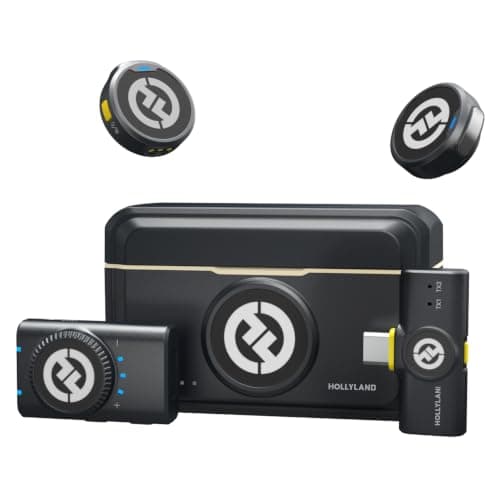
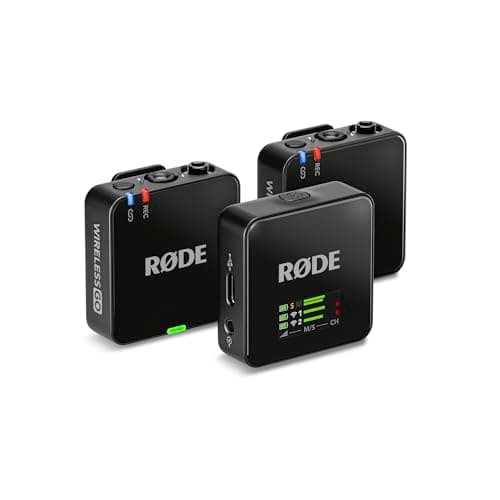
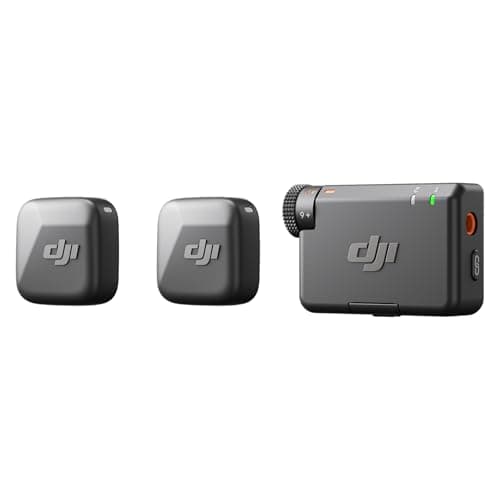
The DJI Mic Mini is the cheapest wireless microphone kit we would tell a beginner to buy. Two transmitters of roughly 10g, a camera receiver, a published range of about 400m in open line of sight and two levels of background-sound reduction — for a price that until recently bought a single wired shotgun. It is the pick for anyone filming people talk who does not need a recording safety net. If you also shoot on a phone, the Hollyland Lark M2 is the better buy because its camera kit includes a USB-C receiver as well. Among these three, the Mic Mini is also the budget pick — the cheapest of the kits ranked below. Prices are read live and date-stamped; where we have no verified price, we show none.
The usual disclosure first: we have not tested this kit in a lab or recorded it against its rivals. Everything below comes from DJI's own published specifications for the Mic Mini, the kit contents DJI lists, and the physics of where a microphone sits — all named and linked in Sources. Informed judgment from documented research, not measurements we took.
What it is, and what makes it different
The Mic Mini is DJI's cut-down wireless kit, sold here as two transmitters plus one camera receiver. The design decision that defines it is weight: DJI publishes a transmitter of about 10g excluding the clip magnet, which is roughly a quarter of what a previous generation of wireless transmitters weighed. That number sounds like trivia and is not. A transmitter light enough to clip to a thin shirt without the fabric sagging is a transmitter that stays on the subject, and a microphone in a pocket records nothing. Weight is the whole product.
The rest of the specification is deliberately conventional. Up to about 400m of range in an open, unobstructed area free of interference — a figure you will never approach indoors, and do not need to. Two-level background-sound reduction, processed in the kit rather than in post. DJI's pairing routine, which is as close to automatic as this category gets. There is no 32-bit float recording, no internal backup recording per transmitter, and no socket on the transmitter for an external lavalier. Those omissions are the price.
The Mic Mini against the two kits worth comparing
| Spec | DJI Mic Mini | Hollyland Lark M2 | Rode Wireless GO III |
|---|
| In the box (kit ranked here) | 2 transmitters + 1 camera receiver | 2 transmitters + camera and USB-C receivers | 2 transmitters + 1 receiver |
| Transmitter weight (published) | About 10g, excluding clip magnet | About 9g | Substantially heavier |
| Published range, line of sight | Up to about 400m | Up to about 300m | Published by Rode per datasheet |
| 32-bit float onboard recording | No | No | Yes, per transmitter |
| External lavalier input on TX | No | No | Yes, locking 3.5mm |
| Noise reduction | Two levels, in-kit | In-kit | GainAssist level control |
Who it is for
Buy the Mic Mini if you film people talking and your filming is repeatable. A piece to camera you can shoot again, an interview where you can set a level and check it on headphones, a two-hander at a table, a walking shot where the camera is further away than an arm. In all of those the Mic Mini does the one thing that matters — microphone on the person, not on the camera — for less than any kit we rank.
Do not buy it if the thing you are recording happens once. A wedding speech, a live performance, a single-take event: those are exactly the cases where 32-bit float recording earns its money, because a voice that spikes into distortion on the radio link can be recovered from a transmitter's own file. The Mic Mini has no such file to fall back on. That is not a flaw so much as the line DJI drew to hit the price, and it is the line you should decide on before you buy.
The three things we would want to know before buying
Does your camera have a 3.5mm microphone input? Most mirrorless bodies do; a few of the cheapest do not, and without one the camera receiver has nowhere to go. Check this before anything else — it decides whether an external microphone is possible at all.
Which kit configuration is on the listing? DJI sells the Mic Mini as a single transmitter with a receiver, as two transmitters with a receiver, with and without a charging case, and in phone-oriented bundles. The cheapest listing is usually the one with half the kit. The ranking here is the two-transmitter camera kit, because the second transmitter is what makes an interview possible and buying it separately later costs more.
Is DJI easy to buy where you are?DJI's US retail availability has been uncertain at times, which matters if you need to replace a lost transmitter in a hurry. We flag this on every DJI pick on the site. If it worries you, the Hollyland is the closest substitute and the alternatives are laid out in alternatives to the DJI Mic.
How to get the best out of it
Three habits, none of them specific to DJI. Leave headroom: aim for the loudest moment to peak around two-thirds up the meter, because digital audio clips hard and unrecoverably at the ceiling, while a quiet recording lifts cleanly afterwards. Clip high: the transmitter wants to be roughly a hand's width below the chin, on a lapel or a collar, not on a waistband. And fit the windshield outdoors every time, even on a day that feels still — wind is the one problem that noise reduction cannot fix after the fact.
Where it sits on this site
The Mic Mini is our top pick in best camera mic under $100 and in best camera accessories under $100, it is ranked in best wireless microphones against the whole field, and it is compared directly with its nearest rival in DJI Mic Mini vs Hollyland Lark M2 and with DJI's own flagship in DJI Mic 3 vs DJI Mic Mini.