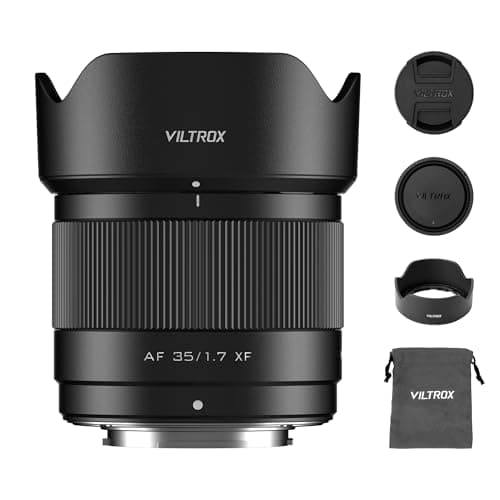
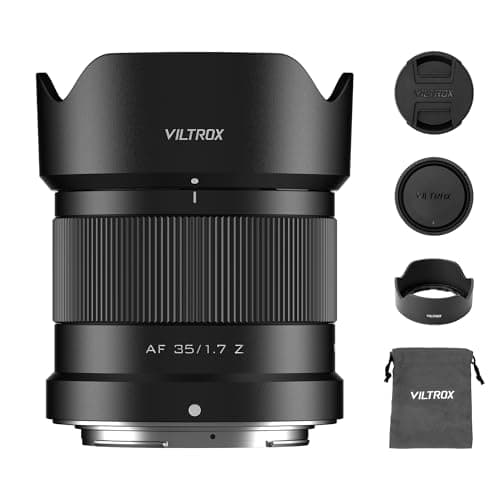
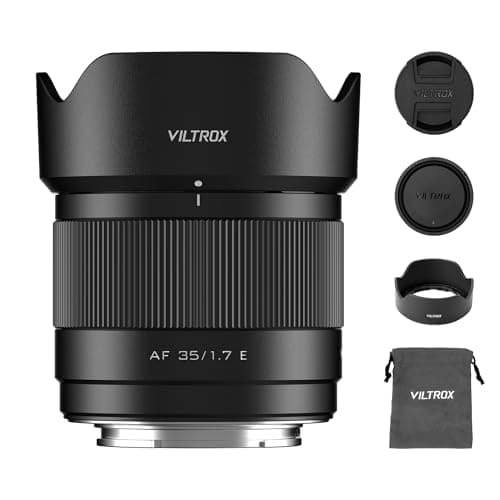
The Viltrox AF 35mm F1.7 Air is the clearest bargain in crop-sensor primes right now. LensTip measured 91.8 lpmm in the center of the frame at f/2.8 on a Fujifilm X-T2 — a figure that sits within a few percent of lenses costing five times as much, against the 44-45 lpmm the site treats as the decency level for that sensor — and recorded zero distortion, negligible lateral chromatic aberration and imperceptible longitudinal chromatic aberration. It weighs 170g and costs less than most kit zooms. The two things it gets wrong are specific: LensTip flags distinct vignetting in RAW files, and autofocus accuracy that "leaves a bit to be desired, especially with the lens attached to older camera bodies."
The spec that matters most, and that plenty of listings get wrong — including, until this page was written, our own ranking blurb for it — is the format. This is an APS-C lens. It does not cover a full-frame sensor. On any of its three mounts it frames like a 53mm normal lens, not like a documentary 35mm. Mount it on a full-frame Sony body and the camera switches to its crop mode and hands you a fraction of its resolution. If you came here looking for a cheap full-frame 35mm, this is not it, and our best 35mm primes ranking lists the ones that are.
The usual disclosure: we have not lab-tested this lens. Every measurement below is LensTip's, published in their multi-part test of the X-mount version and linked in Sources; the specifications are Viltrox's own, cross-checked against the sansmirror lens database. Our scores are judgments against our rubric, not measurements of our own. Prices are read live and stamped with the date.
Who it is for
This is the lens for somebody who owns a crop-sensor camera, a kit zoom, and a growing suspicion that the zoom is the reason their photographs look ordinary. A 53mm-equivalent view is the most natural framing in photography — close to what you see without thinking about it — and at f/1.7 it is roughly two and a half stops brighter than the long end of a typical f/3.5-5.6 kit zoom. That is the difference between a dim indoor photograph at ISO 6400 and a clean one at ISO 1250, and the difference between a background that is merely there and one that falls away behind your subject.
It suits three buyers in particular. The first-prime buyer, because at this price the decision barely needs justifying. The video shooter, because 170g is light enough that a small gimbal does not fight it and LensTip recorded low focus breathing — the lens does not visibly change framing as it focuses, which is the thing that makes cheap primes look cheap on video. And the Nikon Z DX owner, because Nikon's own DX prime range is nearly empty and this is the cheapest genuinely fast lens that fits.
The specification, as published
| Spec | Viltrox AF 35mm F1.7 Air |
|---|
| Format | APS-C only (53mm equivalent on a 1.5x sensor) |
| Mounts | Sony E, Fujifilm X, Nikon Z DX |
| Aperture range | f/1.7 to f/16, 9 rounded blades, no aperture ring |
| Optics | 11 elements in 9 groups (1 aspherical, 1 high-index, 2 ED) |
| Weight | 170g |
| Dimensions | About 64mm diameter x 45.7mm long |
| Filter thread | 52mm, non-rotating |
| Minimum focus | About 0.33m (13in); 1:7.7 maximum magnification |
| Focus | Stepping motor, internal focusing, focus-by-wire (no distance scale) |
| Firmware | USB-C port in the metal mount, user-updatable |
| In the box | Both caps, petal lens hood, soft case |
| Warranty | 5 years |
Two notes on that table. There is no optical stabilization listed anywhere in the specification, so on a body without in-body stabilization — which is most of the beginner APS-C cameras this site covers — you are relying on shutter speed and the f/1.7 aperture. And the sansmirror database lists a micro-USB firmware port while LensTip describes the port in the mount as USB-C; we have reported both rather than pick one, because we have not had the lens in our hands.
What the lab found: sharpness
LensTip tested the X-mount version on a Fujifilm X-T2, analyzing RAW files in Imatest, and the center results are the story. Wide open at f/1.7 the lens clears 70 lpmm in the middle of the frame, which is already comfortably above the 44-45 lpmm the site treats as good for that sensor. Stopped down to f/2.8 it peaks at 91.8 lpmm. For scale, the best results LensTip cites on that sensor are the Viltrox AF 27mm f/1.2 at 97.5 lpmm, the Viltrox 75mm f/1.2 at 99.8 lpmm and the Fujinon XF 18mm f/1.4 R WR at 93.5 lpmm — all of them several times this lens's price. The reviewer's own phrase is that the 35mm is "brushing against resolution records".
The edges are good rather than remarkable, which is the normal shape for a cheap fast prime. LensTip measured almost 61 lpmm at the frame edge at f/1.7, rising to 66-68 lpmm between f/2.8 and f/5.6. In practical terms: the lens is excellent from wide open for anything with a subject near the middle of the frame — portraits, street, food, objects — and wants f/2.8 or f/4 if you are photographing something flat and detailed from corner to corner, like a page or a wall of brickwork.
Distortion, aberration and bokeh
This is where the lens stops behaving like a budget product. LensTip records zero distortion — not low, zero — which is genuinely unusual, and means straight lines near the edge of the frame stay straight without software correction. Longitudinal chromatic aberration (the green and magenta fringing that shows up in out-of-focus areas of high-contrast shots) is described as imperceptible, and lateral chromatic aberration as negligible. Coma is moderate, astigmatism very low, and the out-of-focus rendering is described simply as nice, which from a lab-focused reviewer is not faint praise. If you have used a cheap prime before and remember fringing on backlit branches, this is not that lens.
The two honest flaws
Vignetting in RAW is the first, and LensTip calls it distinct. The corners of an unprocessed file are visibly darker than the center wide open. Every modern camera and every raw converter can correct this with a profile, and a great many photographers actively add vignetting back for effect — but corrected vignetting costs you a little corner noise, and if you shoot RAW and dislike editing, you will notice it. In JPEG, in-camera correction handles it before you see the file.
Autofocus accuracy is the second, and it is the one to take seriously. LensTip is clear that speed is not the problem: they describe the autofocus as silent and fast. The problem is hit rate, and specifically hit rate "with the lens attached to older camera bodies". A third-party lens talks to the camera through a reverse-engineered protocol, and the older the body, the less reliably that conversation goes. On a current body it is a non-issue for photographs of people and places; on an older one, expect to check focus more often than you would with a first-party lens, and shoot a frame or two extra on anything that matters. The firmware port in the mount matters here — Viltrox updates these lenses, and an update can fix exactly this.
Two smaller things, neither a flaw so much as a consequence of the price. There is no aperture ring, so you set aperture from the camera body — Sony and Nikon shooters will not blink, Fujifilm shooters who bought into the system for its dials will. And the supplied soft case is, in LensTip's words, "perhaps not very solid"; it is still a case, included, which plenty of pricier lenses do not manage.
Which mount to buy, and what it competes with
All three versions are the same optical design, so buy the one that fits your camera. The picks above are the live listings for each: Sony E, Fujifilm X and Nikon Z DX. What differs is what each mount offers instead.
On Sony E, this lens has the most competition and is still the value answer. The Sigma 30mm F1.4 DC DN is the obvious rival — a hair wider, a touch faster, and the better-built lens — and our Sigma 30mm reviewis the page to read beside this one. If you want the Sigma's f/1.4 and do not mind the extra bulk and cost, buy the Sigma. If 170g and the lower price matter more, buy the Viltrox. Best budget Sony E lenses ranks the whole shelf.
On Fujifilm X, the natural comparison is the XF 35mm F2 R WR — weather sealed, metal, with the aperture ring Fujifilm shooters want, at a meaningfully higher price and a slower maximum aperture. The Viltrox wins on sharpness and on money; the Fujinon wins on everything you touch. See best Fujifilm X lenses.
On Nikon Z, there is barely a competition, and that is the point. Nikon has not built a fast DX prime, so the usual recommendation is the full-frame Z 40mm f/2 — which works beautifully but frames like a 60mm on a DX body and is an f/2. This Viltrox is the cheapest way to put a genuinely fast prime on a Z30 or a Z50 II. Best Nikon Z lenses covers the state of that mount honestly.
Is it a portrait lens?
Not really, and this is the most common mismatch we see with normal primes. At 53mm equivalent you have to stand close enough that faces start to look slightly wide, and the background blur at f/1.7 on a 35mm is gentler than the same aperture on a longer lens. For environmental portraits — a person in a place, shot waist-up or wider — it is lovely. For head-and-shoulders portraits, a 56mm (84mm equivalent) is the right tool, and we rank those on best portrait lenses and the bodies to pair them with on best cameras for portraits.
The verdict
LensTip gave this lens their Editor's Choice badge and called it a very pleasant surprise that raises the bar, and the measurements support that: center resolution close to the best they have recorded on the sensor, zero distortion, and aberration control that embarrasses lenses at several times the money. The flaws are real and narrow — RAW vignetting you correct with a checkbox, and autofocus accuracy that is good on a current body and less dependable on an old one.
Buy it if you own a crop-sensor camera and a kit zoom, and buy it before you consider a body upgrade; this lens will change your photographs more than the next camera would. Do not buy it if you shoot full frame, if you need weather sealing, or if you specifically want the wide documentary 35mm field of view — on APS-C that means something nearer 23mm, and best wide-angle lenses covers those.