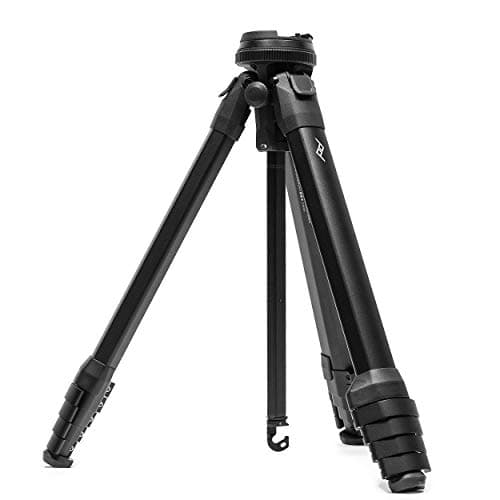
Buy the Peak Design Travel Tripod if the reason you do not use a tripod is that carrying one is a nuisance. Its legs and center column nest into each other instead of sitting in a bundle, which is why a tripod rated by Peak Design to 20lb (9.1kg) packs to about the diameter of a drink bottle. It deploys in seconds and it is genuinely steady for its size. The catches are real: the built-in ball head will not tilt until you raise the center column slightly, there is no dedicated pan control, you need a small hex wrench to fit the camera plate, and it costs several times what a competent budget tripod costs.
The usual disclosure: we have not put this tripod on a vibration rig. What follows is Peak Design's published specification list, the documented findings of reviewers who used one — named and linked in Sources — and our own read on who it suits, scored against our rubric. Informed judgment from research, not bench measurements. Any price on this page comes from our live price check, never from memory.
The one idea behind the whole product
Every tripod folds. Almost all of them fold badly. Three round leg tubes and a round center column packed side by side leave a surprising amount of empty air between them, and that air is why a travel tripod ends up strapped to the outside of a bag instead of inside it.
Peak Design's answer was to redraw the cross-section. The leg tubes are shaped so they close around the center column with almost no gap, and the ball head is built into the top casting rather than bolted on top of it. The listed result is a packed length of about 39cm (15.5in); Fstoppers measured the collapsed bundle at 15.2 by 2.75 inches. That is slim enough to slide into a bag's water-bottle pocket or down the side of a daypack, which is the difference between a tripod you own and a tripod you bring.
Hold on to that idea, because it explains everything else on this page. The nested shape is why the legs have five thin sections instead of three chunky ones. The flush-mounted head is why the head has to come up before it can move. The recessed plate mount is why a hex wrench is involved. None of those are oversights. They are the bill for the packing trick, and whether the trick is worth the bill is the only real question here.
Who it's for
This is a tripod for somebody who travels or walks with a compact mirrorless kit — a Sony a6400 or ZV-E10, a Canon R50 or R10, a Nikon Z50 II, a Fujifilm X-S20 — and who has previously bought a tripod and then stopped taking it anywhere. Peak Design rates the capacity at 20lb (9.1kg), which is far more headroom than that class of camera needs, so the rating is not the limiting factor; the packed size is the whole reason to choose it. It is the top pick in our best tripods for mirrorless cameras ranking for exactly that reason.
It suits landscape and city shooters in particular, because those are the people who need a tripod at the far end of a walk rather than at the near end. Long exposures at dusk, blue-hour cityscapes, waterfalls with a neutral density filter on the front — all of it needs a steady camera, and none of it happens if the tripod is at home. Digital Camera World shot sharp long exposures on it with a full-frame mirrorless body and a 70-200mm lens, and got usable results with a medium format camera, so the stability is real rather than a marketing claim.
Who should look elsewhere? Three groups, honestly. If you are much taller than average, the roughly 60in (152cm) maximum height means bending to the viewfinder — Fstoppers raised exactly that point. If you mainly shoot video and want smooth pans, a compact ball head is the wrong tool and a fluid head is the right one; our tripod ranking includes a video-head option, and if you need to move while filming you want a gimbal, not a tripod at all. And if your tripod lives in the trunk of a car and goes twenty feet, you are paying a large premium for a packing problem you do not have.
Where it's strong
It packs like nothing else, and that is not a small thing
The aluminum version is listed by Peak Design at 1.56kg (3.44lb) and the carbon at 1.29kg (2.81lb). Neither number is remarkable on its own — plenty of travel tripods weigh that. What is remarkable is the volume. A conventional tripod of the same height and load rating takes up roughly twice the space in a bag, and space is the constraint that actually decides what you carry. Digital Camera World's summary of it was "extremely compact", and it is the single most defensible reason to spend this much.
Setup is fast enough that you will not talk yourself out of it
The three leg-angle catches release together, and the cam levers on each of the five leg sections flip open in one movement rather than needing a twist per section. Digital Camera World described the legs as deployable "with one movement" and called the whole thing "fast to deploy"; Fstoppers agreed it was "fast and easy to deploy". This matters more than spec sheets suggest. Most missed tripod shots are not missed because the tripod was inadequate — they are missed because setting it up felt like too much work for the shot in front of you.
Steadier than its size implies
Fstoppers found it stable at full extension with the center column up, and noted it did not "walk" in strong wind — a failure mode that plagues light tripods. Peak Design uses anodized 6061-T6 aluminum for the legs and a powder-coated A380 aluminum ball head, so the load-bearing parts are metal rather than plastic. Digital Camera World's verdict was "stable for its size and weight", which is the right framing: this is not a studio tripod, and it is markedly steadier than the flimsy travel tripods it competes against on size.
The details that turn out to matter
Three of them. The center column inverts, and with its removable section out the camera drops to a listed 5.5in (about 14cm) off the ground, which covers low-angle and close-up work that most travel tripods cannot reach. There is a phone mount stowed inside the center column, so a creator shooting both phone and camera on one trip carries one object instead of two. And the plate is Arca-Swiss, so it fits the clamps and L-brackets you may already own. Fstoppers also lists a load hook in the box, for hanging a bag to add ballast in wind.
It is built to be repaired
The box includes 4mm and 2.5mm hex wrenches, a bushing removal tool and a soft case, and Peak Design covers it under a limited lifetime warranty. That is unusual at any price and it changes the arithmetic on a purchase like this: a tripod you can service and re-bush is a ten-year object, and the cost per year of a ten-year object is a different number from the one on the listing.
The honest catches
The ball head has to be raised before it will move
This is the complaint every reviewer lands on, and it is the direct cost of a head that sits flush in the packed profile. Digital Camera World listed it as a con outright: the center column has to be raised before the head will move. Shotkit put it plainly: "You can't rotate the ball head when it's sitting in its 'resting' place." So a quick reframe is not one action, it is three — raise the column a little, move the head, re-lock. It is a habit you learn in an afternoon, but it is a habit you have to learn, and Fstoppers explicitly asked for "simple single-action ballhead operation" in a future version.
There is no dedicated pan lock
One ring locks the head, and it locks everything. You cannot lock the tilt and leave the pan free, which is what you want for a panorama or for tracking something moving across a frame. Shotkit listed the missing panning function as a con. If stitched panoramas are a regular part of your work, this is a genuine functional gap rather than a nuisance, and a separate pan-and-tilt or geared head on a conventional tripod is the better buy.
You need the hex wrench, and it is easy to lose
The camera plate fastens with a hex screw rather than a thumbwheel. A folding wrench is included and stows on the tripod, but Digital Camera World's con list says the "supplied tool is easily lost", and Shotkit makes the sharper point: without it you cannot attach a camera at all. Our advice is unglamorous and practical — buy a spare 4mm hex key, leave it in the bag you actually use, and treat the included one as the backup.
The bubble level disappears under the camera
The level sits on top of the ball head, where a mounted camera covers it. Shotkit flagged this, and it is a real irritation if you level by bubble rather than by the electronic level in the camera. Most current mirrorless bodies have one on screen, which is the workaround, but it is odd to pay this much and end up ignoring a feature.
Portrait orientation with a heavy lens can slip
Digital Camera World found that shooting in portrait with a heavy camera and lens could cause slipping on the quick-release plate. The fix is an L-bracket, which keeps the camera upright on the plate instead of hanging sideways off it — but that is another purchase, and if you shoot portrait-orientation stills with long glass you should budget for it rather than discover it on location.
Two smaller structural points
Fstoppers noted "some vertical bounce" with the legs fully extended and the center column retracted — an unusual configuration, and they said so, but worth knowing. They also wanted intermediate leg-angle positions and spiked feet in the box; the rubber feet are fine on rock and pavement and less convincing in soft ground. And the five-section legs are inherently thinner at the bottom than a three-section design, which is the trade the packed size demands.
The price is the biggest objection and it is a fair one
This tripod costs several times what a competent full-height budget tripod costs, and Digital Camera World listed "high price" as its first con while still awarding five stars. Fstoppers' conclusion was "you do get what you pay for and that's quality". Both can be true. Check the live price in the pick below before you decide, because the honest test is not whether it is expensive — it is whether packed size is the thing stopping you using a tripod. If it is not, the money is better spent on a lens that improves every photo.
The verdict
The Peak Design Travel Tripod is the rare premium accessory whose premium buys one specific, measurable thing rather than a vague sense of quality. It buys volume — roughly half the space in your bag for the same height and load rating — and it buys the speed of setup that keeps you from skipping the shot. Stability at this size class is largely solved; what differs between travel tripods is whether you are still carrying one in month six.
Buy it if you have already owned a travel tripod and abandoned it. Buy the aluminum version unless you regularly walk long distances with it, because the carbon saves a few hundred grams for a large premium. Buy something else if you are tall, if you shoot video pans, if you make stitched panoramas, or if your tripod never leaves the car. And whichever you buy, put a spare hex key in the bag.
Aluminum or carbon — how to decide
They are the same tripod. Same geometry, same head, same packed profile, same 20lb (9.1kg) rating, same box contents. The only difference is the leg material, and therefore the weight: Peak Design lists the aluminum at 1.56kg (3.44lb) and the carbon at 1.29kg (2.81lb). Digital Camera World put the gap at 290g for roughly $270 more at the time of their review — check both live, but the shape of the trade rarely changes.
Our read: buy the aluminum. Around 290g is the weight of a small water bottle, and for a tripod that spends most of its life in a bag rather than on a shoulder, that is not a meaningful saving at that price. Two cases genuinely flip it — multi-day hiking, where every gram compounds, and cold-weather work, where carbon tubes are less unpleasant to handle than bare metal. The aluminum version is the one we rank and the one linked below.
What about the newer Peak Design Pro Tripod?
Peak Design now also sells a Pro Tripod line, which Digital Camera World describes as an updated and upgraded version of this design with extra height and quicker operation. It is carbon only and considerably more expensive — Digital Camera World lists it at $799.95, with a stated 168.4cm (66.3in) maximum height, 1.9kg weight and an 18.1kg (40lb) load rating, in Pro, Pro Lite and Pro Tall variants. The Travel Tripod has not been replaced; the Pro sits above it.
For the readers this site is written for, the Pro is the wrong purchase. It is heavier, it costs roughly twice as much, and its advantages — height and load capacity — are advantages for large bodies with long lenses, not for a compact mirrorless camera with a kit zoom. If you are tall and that 60in ceiling is the thing bothering you, the Pro Tall is the answer Peak Design now has. Otherwise this is the one to buy.
Check the load rating against your real kit, not your dream kit
Peak Design rates this at 20lb (9.1kg). A typical beginner mirrorless setup — body plus kit zoom — lands nearer 1kg, so there is enormous headroom, and that headroom is what keeps it steady rather than merely upright. This is the opposite of the usual tripod warning: with this one you are unlikely to run out of capacity, so spend your attention on height and on whether the head suits what you shoot.
Where a tripod sits in a creator budget
Bluntly: after the camera, a microphone and a lens. A tripod earns its place the moment you shoot in low light, film yourself, or want a shot you cannot hold still enough for by hand. Our beginner camera kit guide works through the order of purchases with real numbers, and our camera bag ranking covers the bag this tripod is designed to disappear into. If you are buying gifts rather than gear, it is also the centerpiece of our gifts for travel photographers list.
Before you buy any tripod
Two honest checks. First, name the shot. "Sharper photos" is usually a shutter speed or a lens problem, not a tripod problem — a tripod specifically solves long exposures, low light, self-filming, and repeatable framing. Second, check your camera's stabilization: for handheld stills in moderate light, modern in-body and lens stabilization covers a lot of ground, and our stabilization explainer is the place to work out whether you need a tripod or already have the answer in your camera.