The verdict: buy the Everyday Backpack 30L if a laptop travels with the camera, and skip it if one doesn't. What you are paying for is not padding — it is a bag that expands from 22L to 30L, carries a 16-inch laptop in a dedicated sleeve, reconfigures around whatever kit you brought with three FlexFold dividers, and opens from either side without coming off your back. If your camera lives in the bag alone and nothing else does, the K&F Concept 25L holds the same kit for a fraction of the money, and the rear-access Lowepro Flipside is the one to buy if theft is your worry rather than organisation. Every number on this page is Peak Design's own published specification. We have not tested this bag; see how we pick.
The Everyday Backpack is the bag that gets recommended in every thread, and the reason is not photographic. Most camera backpacks are a padded box with straps: they protect a kit beautifully and then force you to carry a second bag for the laptop, the charger, the lunch and the jacket. Peak Design's bet was that the person buying a camera backpack is mostly not on a photo expedition — they are commuting, travelling, or going out for a day with a camera among other things — and that the bag should be organised around access and reconfiguration rather than maximum padding. Whether that bet fits you is the whole question, and it is answerable from the spec sheet.
The published specification
These are the retail specification numbers for the 30L v2, and they are the reason to buy or not buy it.
| Specification | Published figure | Why it matters |
|---|
| Volume | 22L minimum, 30L maximum | The MagLatch top expands in increments, so the bag is a day pack and a travel pack |
| Weight | 1.76kg (3.88lb) empty; 2.11kg (4.65lb) with the dividers in | Near four pounds before you put anything in it — this is not a light bag |
| Laptop sleeve | 40.6 x 27.4 x 3.8cm (16 x 10.8 x 1.5in) | Takes most 16-inch laptops, which is what separates it from photo-only packs |
| Tablet sleeve | 30.6 x 22.1 x 0.7cm (12 x 8.7 x 0.3in) | A separate sleeve, so a tablet is not sharing the laptop slot |
| Dividers | Three FlexFold dividers included | Each folds into shelves or a flat floor, so the interior is camera space or luggage space on demand |
| Shell | 400D double poly-coated, DWR-impregnated nylon canvas | Weather resistance comes from the fabric treatment, not from a stowed rain cover |
| Base | 900D waterproof bottom liner | The part that sits on wet ground is the heaviest fabric in the bag |
| Hardware | Anodized aluminum and glass-reinforced nylon | The MagLatch and strap hardware are the parts that normally fail first |
| Access | MagLatch top, two weatherproof side UltraZips | Swing it round one strap and reach the camera without setting the bag down |
What the FlexFold dividers actually do
This is the feature worth understanding, because it is the one that justifies the price and the one most reviews describe vaguely. A conventional camera backpack has fixed padded walls: the interior is permanently camera-shaped, and on a day you bring one lens, you carry empty camera-shaped air. A FlexFold divider is a hinged panel that folds into a shelf, folds in half into a narrow shelf, or lies flat against the wall and disappears. With three of them, the main compartment is three camera shelves, or two shelves and a big open space for a jumper and a lunch, or a completely flat-floored 30L bag with no camera organisation at all.
The practical consequence: one bag covers the full-kit day and the one-lens day and the no-camera day, which is a different proposition from owning a camera bag. It is also why the bag reads as expensive rather than overpriced — you are not buying better padding than the Lowepro, you are buying an interior that changes shape.
Where the money does not go
Three honest limitations, all visible in the specification.
It is heavy before it is loaded. 3.88lb empty, 4.65lb with the dividers in. For comparison, that is a meaningful fraction of what a mirrorless body and two lenses weigh. A lighter, simpler pack genuinely is lighter.
Padding is adequate, not maximal. The FlexFold system is thinner than the thick fixed walls of a dedicated photo pack, which is the trade for reconfigurability. For a mirrorless kit this is a non-issue; for long lenses knocking around on rough transport, a dedicated photo pack protects better.
Side access is not secure access. The two side UltraZips are the fast way in, and they face outwards. That is the opposite design decision from the rear-access packs, whose zips sit against your spine and cannot be opened while you are wearing the bag. In a crowd, that difference matters more than any other feature on either bag.
The short answer
Quick picks
| # | Product | Best for | Score | Price |
|---|
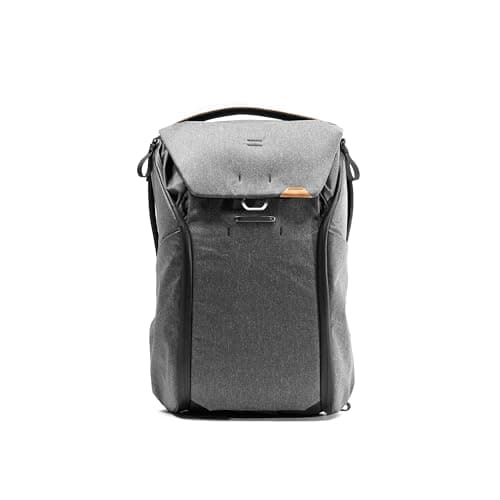
| 01 | Peak Design Everyday Backpack 30LThe do-everything camera-and-life bag. Origami-style FlexFold dividers, a weatherproof shell and dual side access that grabs a camera without taking the pack off fully. | The best everyday carry for camera and life | | $299.95·Amazon |
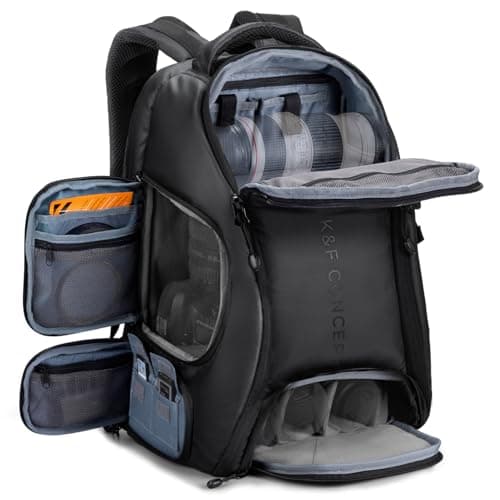
| 02 | K&F Concept 25L Camera BackpackThe value champion. A lot of well-divided camera space, a laptop pocket, tripod straps and a rain cover — for a fraction of the premium-brand money. | The best budget camera backpack | | $51.29·Amazon |
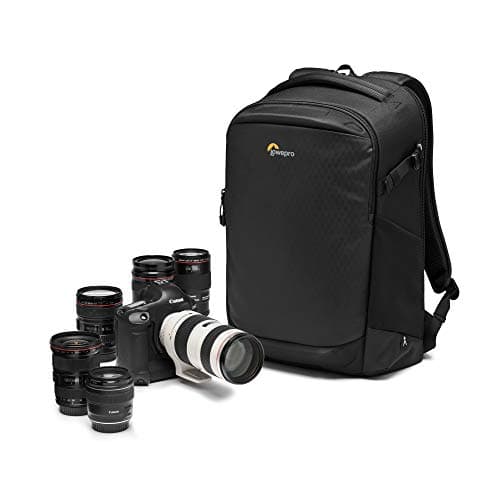
| 03 | Lowepro Flipside BP 400 AW IIIThe security-first pack. The main compartment opens against your back, so the zips face you and cannot be opened while you wear it — and a rain cover tucks in for bad weather. | The best protection and anti-theft carry | | $190.00·Amazon |
#ad · Live prices from the Amazon Product API, as of October 16, 2026. Where we have no verified live price, we show none — we would rather leave a gap than print a number that has rotted.
In detail
The picks, in full
The best everyday carry for camera and life
Peak Design Everyday Backpack 30L
~30L capacityDual side access + MagLatch topFlexFold dividersFits 15in / 16in laptop
The do-everything camera-and-life bag. Origami-style FlexFold dividers, a weatherproof shell and dual side access that grabs a camera without taking the pack off fully.
- Protection
- 8
- Capacity
- 9
- Comfort
- 9
- Build
- 10
- Value
- 6
Pros
- +The FlexFold dividers reconfigure for a big kit, a small kit or everyday items, so one bag flexes to the day
- +Dual side access lets you swing it around and pull a camera fast, without setting it down and opening it fully
- +A premium weatherproof build and lifetime-grade materials that genuinely last years
Cons
- −It is comfortably the most expensive bag here
- −It leans organizer-and-commuter rather than a deep, heavily padded dedicated photo pack
Don't buy this if…
…you want maximum theft protection or the lowest price. The rear-access Lowepro Flipside is more secure, and the K&F Concept holds a full kit for a fraction of the money.
The best budget camera backpack
K&F Concept 25L Camera Backpack
~25L capacitySide access + tripod strapsFits a mirrorless body + 3-4 lensesLaptop compartment + rain cover
The value champion. A lot of well-divided camera space, a laptop pocket, tripod straps and a rain cover — for a fraction of the premium-brand money.
- Protection
- 7
- Capacity
- 9
- Comfort
- 7
- Build
- 6
- Value
- 10
Pros
- +The cheapest real camera backpack here, yet it holds a full beginner kit behind proper padded dividers
- +Includes the extras that usually cost more — a laptop sleeve, tripod straps and a rain cover
- +Side access to the main compartment makes grabbing the camera quick
Cons
- −Zippers and materials feel their budget price and will not wear as long as Peak Design or Lowepro
- −Back padding is adequate rather than plush on long days
Don't buy this if…
…you want premium durability or the best-engineered access. The Peak Design and Lowepro packs are built to last longer and organize better.
The best protection and anti-theft carry
Lowepro Flipside BP 400 AW III
Body-side (rear) accessFits a mirrorless body + 4-5 lensesBuilt-in all-weather coverUp to 15in laptop
The security-first pack. The main compartment opens against your back, so the zips face you and cannot be opened while you wear it — and a rain cover tucks in for bad weather.
- Protection
- 10
- Capacity
- 8
- Comfort
- 8
- Build
- 8
- Value
- 8
Pros
- +Rear body-side access keeps the zippers against your back, deterring pickpockets and shielding gear from rain
- +Holds a serious kit — a body plus several lenses — with adjustable, well-padded dividers
- +The included all-weather cover pulls over the whole pack for sudden downpours
Cons
- −You have to take it off and lay it down to reach your gear, which is the trade-off of the security design
- −Bulkier and more photo-specific than a slim everyday daypack
Don't buy this if…
…you want grab-and-go side access or a smaller everyday bag. The Peak Design opens from the side without coming off, and the compact Tahoe or K&F pack lighter.
Who should buy it, in one paragraph each
Buy it if your camera and your laptop travel together.This is the bag's actual niche and it is a real one: a 16-inch laptop sleeve, a separate tablet sleeve, side access to a camera, and an interior that collapses flat when the camera stays home. If you commute with both, or you travel and work, nothing cheaper on this site does the same job.
Buy the K&F Concept 25L instead if the bag is only for camera gear. It holds a mirrorless body and three to four lenses behind proper padded dividers, has a laptop compartment, tripod straps and a rain cover, and costs a fraction of the Peak Design. On pure gear-carried-per-dollar it is not close. Check the live prices above — the gap is usually several times over.
Buy the Lowepro Flipside BP 400 AW III instead if you worry about theft. Its main compartment opens against your back, so the zips are physically inaccessible while the bag is on, and it carries a body plus four to five lenses with a built-in all-weather cover. That is a different kind of confidence from a nicer interior.
30L or 20L?
Peak Design sells the same design in both sizes, and the honest answer is that the 30L is the right one only if you use the expansion. At 22L collapsed it is already a large day bag; the extra 8L exists for the travel case — a second body, a jacket, a couple of days of clothes. If you will never carry that, the smaller version is lighter and cheaper for the same feature set, and the 16-inch laptop sleeve is the one thing to check against your own machine before you decide.
Does it work as carry-on?
Collapsed, it is a conventional large backpack and is routinely used that way; expanded to its full 30L it is a bigger object, and airline personal-item allowances vary enough that we are not going to make a promise on your behalf. The relevant fact from the specification is that the expansion is reversible in seconds via the MagLatch, so the bag can be shrunk at the gate. Check your own carrier's stated dimensions.
Is it actually waterproof?
Water-resistant, not waterproof, and the specification says so in the way it is written: a DWR-impregnated 400D shell and a 900D waterproof bottom liner, with weatherproof zips. That combination shrugs off rain and wet ground, which is what most people need. It is not a submersion rating, and unlike the Lowepro packs there is no separate rain cover stowed in the base — if you expect genuinely sustained downpours, the bag with the cover is the safer choice.
The long-term argument
The specification lists anodized aluminum and glass-reinforced nylon hardware, leather or Hypalon accents depending on colour, and a high-visibility grey interior. Those are durability-and-usability choices rather than features: metal hardware outlasts moulded plastic, and a light-coloured lining is the difference between finding a black lens cap and not. Peak Design's warranty position is the other half of that argument and is worth reading on their own site before you buy, because a bag you keep for a decade is a different purchase from a bag you replace.
If you are still weighing it against the rest of the field, the full ranking with live prices is on best camera bags and backpacks, and the company's tripod gets the same treatment in our Peak Design Travel Tripod review.
How we picked
We do not run a testing lab
We compiled the manufacturers' published specifications and manuals, did the cost math, and scored each product against a published rubric. The scores are judgments from that documented research — they are notmeasurements we took, because we do not have a lab and we are not going to pretend we do. Where a number came from someone else's testing, we name and link them in Sources.
Questions
Frequently asked
Is the Peak Design Everyday Backpack 30L worth the money?+
Yes if a laptop travels with the camera, no if it doesn't. The specification that justifies the price is the combination of 22-30L expansion, a 16-inch laptop sleeve, a separate tablet sleeve and three FlexFold dividers that let the interior be camera space or luggage space. If you only ever carry camera gear, the K&F Concept 25L carries a similar kit for a fraction of the price — compare the live prices above.
How much does the Everyday Backpack 30L weigh?+
Peak Design's published figures are 1.76kg (3.88lb) without the dividers and 2.11kg (4.65lb) with all three fitted. That is heavy for an empty bag, and it is the clearest trade-off in the design - you are carrying structure and hardware rather than the lightest possible shell.
Does the 30L fit a 16-inch laptop?+
The published laptop sleeve is 40.6 x 27.4 x 3.8cm (16 x 10.8 x 1.5in), which takes most 16-inch machines, and there is a separate tablet sleeve listed at 30.6 x 22.1 x 0.7cm (12 x 8.7 x 0.3in). Measure your own laptop against those numbers rather than trusting the screen-size label, because thickness varies a lot between models.
How many lenses fit in the Everyday Backpack 30L?+
It depends entirely on how you fold the dividers, which is the point of the design rather than a dodge. Three FlexFold dividers set as full shelves give you three tiers for a body and several lenses; folded in half or laid flat they trade camera slots for open space. There is no single fixed capacity number, because the interior has no fixed shape.
Is the Peak Design Everyday Backpack waterproof?+
Water-resistant. The shell is a 400D double poly-coated, DWR-impregnated nylon canvas, the base has a 900D waterproof bottom liner, and the side zips are weatherproof UltraZips. That handles rain and wet ground. It is not a submersion rating, and unlike the Lowepro packs there is no separate stowed rain cover.
Everyday Backpack 30L or 20L?+
Take the 30L only if you will use the expansion - a second body, a jacket, travel clothes. Collapsed it sits at 22L, which is already a large day bag, so the extra capacity is specifically for the travel case. Otherwise the smaller version is lighter and cheaper for the same features; check the laptop sleeve size against your machine first.
Is side access or rear access better?+
Different jobs. Side access, which is what this bag has, is faster: swing the pack round one strap and reach the camera without putting it down. Rear access, like the Lowepro Flipside, puts the zips against your back so they cannot be opened while you wear it. Speed versus security - in a crowded city the second one is worth more.
What are FlexFold dividers?+
Hinged panels that fold into a shelf, fold in half into a narrow shelf, or lie flat against the wall and effectively vanish. Three come with the 30L. They are why one bag covers a full-kit day, a one-lens day and a no-camera day - a conventional padded box has a permanently camera-shaped interior you carry whether you fill it or not.
Receipts
Sources
We do not run a testing lab, and we do not pretend to. Specs come from manufacturer sheets and manuals; where a figure came from someone else's measurement, we name and link them. Where we could not verify something, we say so on the page rather than quietly leaving it out. Read our full method.