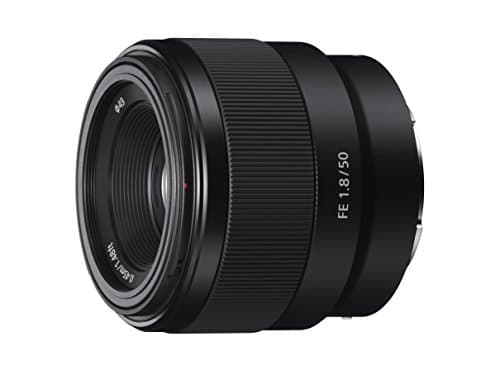
If you shoot an APS-C Sony such as the ZV-E10, a6400 or a6700, buy the Sigma 56mm f/1.4 DC DN. It gathers more light, blurs the background further, focuses quietly without the barrel moving, and the lab reviewers rate it sharper wide open. Buy the Sony FE 50mm f/1.8 if you already shoot full frame, if you are genuinely about to move to it, or if the lowest price is the whole brief. Both are fast primes that turn a kit-lens camera into a portrait camera. The Sigma is the better lens on the cameras most of our readers own. The Sony's one structural advantage is that it covers a full-frame sensor, and that advantage is worth less than it first looks.
The usual disclosure: we have not tested either lens. What follows comes from Sigma's and Sony's published specifications and the documented findings of reviewers who measured or used them. OpticalLimits lab-tested both, and Amateur Photographer shot the Sigma on a Sony a6500. Every source is named and linked at the bottom of the page. Informed judgment, not measurements of our own.
First, a note on the price you will see
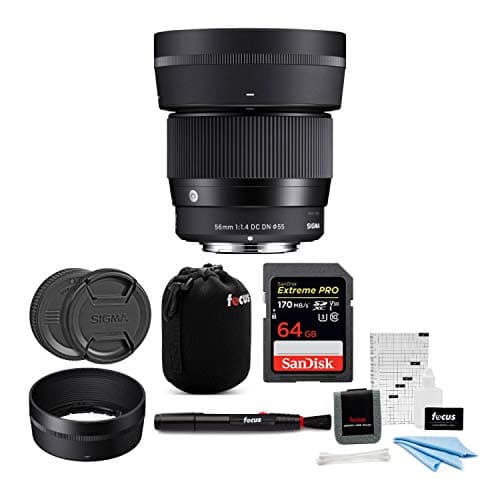
When we checked for this page, the Sigma listing we link was a bundle. Its title reads "Sigma 56mm f/1.4 DC DN Contemporary Lens for Sony E with 64GB Extreme PRO Bundle", so a 64GB memory card comes in the box with the lens. The Sony FE 50mm listing is the plain lens, and so is the Viltrox listing further down. On those listings the Sigma cost nearly twice as much as the Sony, and part of that gap is the card. If you need a card anyway, it is not wasted money; if your drawer is already full of them, mentally subtract it. Either way, compare the live prices in the picks below knowing the three boxes do not hold the same things.
At a glance
| Spec | Sigma 56mm F1.4 DC DN | Sony FE 50mm F1.8 |
|---|
| Sensor coverage | APS-C only | Full frame (also fits APS-C bodies) |
| Framing on an APS-C Sony | About 84mm equivalent | About 75mm equivalent |
| Maximum aperture | f/1.4 | f/1.8 |
| Depth of field on APS-C, in full-frame terms | About f/2.1 | About f/2.7 |
| Focusing | Stepping motor, internal focusing | Front of the lens extends as it focuses |
| Minimum focus distance | 0.5m | 0.45m |
| Maximum magnification | 1:7.4 | 0.14x (about 1:7) |
| Filter thread | 55mm | 49mm |
| Weight | 280g (Sony E version) | 186g |
| Aperture blades | 9, rounded | 7 |
| Optical stabilization | None | None |
| Sealing | Sealed at the mount only | None |
| Sold for | Sony E, Fujifilm X, Canon RF, Nikon Z, L-Mount, Micro Four Thirds, Canon EF-M | Sony E only |
Figures come from Sigma's specification page for the Sony E version and DPReview's specification listing for the Sony. The APS-C equivalents use the 1.5x crop factor that DPReview's equivalence explainer gives for APS-C, applied to both the focal length and the f-number.
The six things that actually differ
1. Sensor coverage: the Sony's one real advantage
The Sony FE 50mm is a full-frame lens, and DPReview lists its maximum format as 35mm full frame. It mounts and works properly on every Sony E body, whichever sensor size is inside. The Sigma is the opposite: Sigma's own page lists its sensor format as "APS-C [DC]", and its image circle only covers the smaller sensor. It will physically mount on a full-frame Sony, but the camera then records a cropped image. Sony's help guide for its full-frame bodies describes an APS-C/Super 35mm setting that, left on Auto, "automatically sets the capture range according to the lens". In other words, put the Sigma on a full-frame Sony and you are shooting with the middle of the sensor and giving up the rest of its resolution.
If you are unsure which sensor your camera has, our APS-C vs full-frame guide explains the difference in plain terms. The ZV-E10, a6400 and a6700 are all APS-C, which is why the rest of this page is written for them.
2. Framing: a classic portrait length against a slightly wider one
On an APS-C Sony, multiply the focal length by 1.5 to get the full-frame equivalent. The Sigma frames like an 84mm lens, and Sigma quotes exactly that figure. The Sony FE 50mm frames like a 75mm. Both are short-telephoto views, which is what makes faces look natural and lets you stand a comfortable distance from the person you are photographing. The Sigma sits right on the traditional 85mm portrait length; the Sony is a little wider, which is slightly easier in a small room and slightly less flattering for a tight head-and-shoulders frame. Neither is an everyday walk-around view on APS-C. Our crop factor explainer walks through the math if the equivalents are new to you.
3. Light and blur: f/1.4 against f/1.8
On the standard third-stop aperture scale, f/1.4, f/1.6 and f/1.8 sit a third of a stop apart, so the Sigma is two-thirds of a stop brighter wide open. In practice that means the same shutter speed at a lower ISO: ISO 1600 on the Sigma where the Sony needs roughly ISO 2500. It is not a night-and-day gap, but indoors and at dusk it is the difference between a clean file and a grainy one.
The blur gap is bigger than the light gap, because the Sigma is also the longer lens. Using DPReview's rule of multiplying both focal length and f-number by the crop factor, the Sigma on APS-C behaves like an 84mm f/2.1 on full frame, while the Sony behaves like a 75mm f/2.7. That is a longer lens with a wider effective aperture, so the Sigma melts a background visibly further. If background blur is the reason you are buying a prime at all, this difference alone settles it.
4. Autofocus, and why it matters most for video
This is where the two lenses separate most clearly. Sigma says the 56mm combines an optical design built for video autofocus with a stepping motor for "smooth and quiet autofocus", and focusing happens inside the lens, so nothing moves on the outside. OpticalLimits found its autofocus "quite fast" and effectively silent, while noting it is about average for a modern mirrorless lens and not an action lens. Amateur Photographer found it brisk and "very quiet indeed", with one honest caveat: a high-frequency whir was audible when recording video on its Sony a6500. If you record sound on the camera itself, an external microphone mounted away from the lens is the sensible precaution.
The Sony FE 50mm is the weak link here, and the reviews do not soften it. OpticalLimits nicknamed it "Captain Slow", describing a slow motor that makes a moderate amount of sound, and DPReview lists its focusing method as an extending front: the front of the lens moves in and out as it focuses. For stills of people who are sitting still, that is manageable. For video on a ZV-E10, where the camera refocuses constantly and the internal microphone sits a few centimeters away, it is the single strongest argument for the Sigma.
5. Image quality: what the lab reviewers measured
OpticalLimits tested the Sigma and found it "already very sharp in the image center and just a tad less so in the outer image field" at f/1.4, and superb from f/2 to f/5.6. It praised the bokeh for "nicely rendered out-of-focus highlights and a smooth blur in the focus transition zones", with highlights turning cat's-eye shaped toward the corners. Its weaker points are correctable: roughly 2.8% pincushion distortion and heavy vignetting in raw files, both handled by in-camera or raw-converter profiles. OpticalLimits rated it "Highly Recommended" and called it "an excellent example for how mirrorless lenses should be"; Amateur Photographer gave it 4.5 out of 5.
The Sony's results were more mixed. OpticalLimits, testing on full frame, rated its center at f/1.8 very good but its borders "downright dismal with heavily smeared corners", improving substantially by f/2.8. The worst of that is in the far corners of a full-frame image, an area an APS-C sensor never records, so it matters less on a ZV-E10 than on an a7-series body. The Sony is essentially free of distortion, which is a real point in its favor. Its bigger optical flaw is longitudinal color fringing, the purple and green edges around out-of-focus high-contrast detail: OpticalLimits found it significant at f/1.8 and still obvious at f/2.8. The Sigma shows the same effect at f/1.4 and f/2, fading by f/2.8, which OpticalLimits called typical of a lens without apochromatic correction. Lateral color fringing is very low on both.
6. Size, weight, filters and sealing
The Sony is the lighter lens at 186g against the Sigma's 280g, and it takes smaller, cheaper 49mm filters where the Sigma takes 55mm. The two are close to the same length, but the Sony's front grows as it focuses closer while the Sigma's stays put. Sealing is a partial win for the Sigma: Sigma fits a special seal at the mount, which OpticalLimits described as "basic sealing" limited to the mount, while DPReview lists no sealing at all on the Sony. Neither is a weather-sealed lens in the full sense, so treat both as fair-weather gear. Neither has optical stabilization, either, so on a body without in-body stabilization you are relying on shutter speed or the camera's electronic stabilization for video.
A note on mounts
The Sony FE 50mm exists only for Sony E. Sigma sells the 56mm for Sony E, Fujifilm X, Canon RF, Nikon Z, L-Mount, Micro Four Thirds and Canon EF-M, and the framing shifts with the sensor: Sigma lists a 28.5-degree angle of view on Sony E, 26.9 degrees on Canon RF, where the crop is slightly tighter, and 21.9 degrees on Micro Four Thirds. The listing we link is the Sony E version. If you shoot Fujifilm, Canon or Nikon, check the mount on the product page before you order, because the versions do not cross-fit.
Who should buy which
- You shoot a ZV-E10, a6400 or a6700 and want portraits: the Sigma 56mm f/1.4. Classic portrait framing, more blur and a brighter aperture.
- You film yourself or other people on an APS-C Sony: the Sigma. Quiet internal focusing is the difference that shows up in every clip.
- You already own a full-frame Sony: the Sony FE 50mm f/1.8, used as the true 50mm it was designed to be. The Sigma would force the camera into crop mode.
- You want the smallest, lightest fast prime for a Sony bag: the Sony, at 186g with 49mm filters.
- You shoot Fujifilm, Canon RF or Nikon Z: the Sigma, in your mount. The Sony FE 50mm does not exist for your camera.
- You want the 84mm-equivalent look for the least money: the Viltrox 56mm f/1.4, explained below.
If you might move to full frame
This is the argument people make for the Sony, and it deserves a straight answer. Yes, the FE 50mm will follow you to a full-frame body and use the whole sensor. But on that body it stops being a portrait lens. At 50mm on full frame it is a normal lens, the everyday walk-around view, not the 75mm-equivalent portrait framing you bought it for on APS-C. So an upgrade does not preserve the job the lens was doing; it changes the job. If portraits are the point, a full-frame shooter ends up wanting an 85mm anyway, which is exactly what our best portrait lenses ranking recommends on full frame.
That makes the decision simpler. If a full-frame body is a vague someday, buy the lens that is better on the camera you own today, which is the Sigma; the used market for well-regarded lenses is a reasonable exit if you change systems later. If a full-frame body is already on order, buy the Sony and enjoy it as a light, affordable normal prime. And if you are still choosing the APS-C body itself, our ZV-E10 vs a6400 comparison covers which one suits your mix of video and stills.
The third option: Viltrox 56mm F1.4
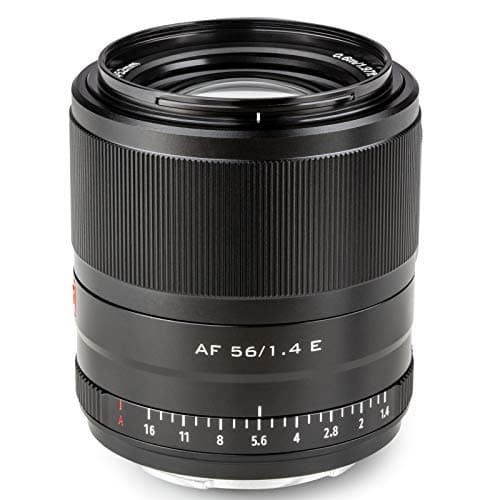
If neither fits the budget, the Viltrox 56mm f/1.4 gives you the same 84mm-equivalent framing and the same f/1.4 aperture on an APS-C Sony. When we checked, it was a little cheaper than the Sony FE 50mm and roughly half the price of the Sigma bundle. Viltrox lists it as an APS-C lens with a stepping motor, eye-autofocus support and a USB port for firmware updates, weighing about 290g with a 52mm filter thread. It focuses no closer than 0.6m, a little further than the Sigma's 0.5m, and like the Sigma it is sold in several mounts: Sony E, Fujifilm X, Nikon Z, L-Mount and Canon EF-M.
The catch is autofocus confidence. Its focusing is a step behind the Sigma's, which is why it ranks third in our portrait lens ranking. For posed portraits and relaxed sessions it is excellent value; for kids, pets or events you cannot reshoot, the Sigma is the safer lens. It is also the portrait prime we rank in our best budget Sony E-mount lenses, alongside cheaper ways to grow a Sony kit.
What neither lens is for
Both are portrait and short-telephoto lenses on APS-C, not everyday normal lenses. If what you really want is the classic nifty-fifty view on a crop-sensor Sony, you want something closer to 30mm; our best 50mm primes page explains why, and which lens gives that framing. Neither is a close-up lens either: both top out around one-seventh life size, so small products and food will not fill the frame. And neither is stabilized, which matters on a camera like the ZV-E10 if you film handheld. Our Sony ZV-E10 review covers what that camera does and does not do for steady video.
The bottom line
On an APS-C Sony, the Sigma 56mm f/1.4 is the better lens in every way that shows up in the picture or the soundtrack: more blur, more light, the classic portrait framing and focusing you will not hear or see. The Sony FE 50mm f/1.8 is the right buy for full-frame owners and for anyone who values the lightest, cheapest fast lens above everything else. Mind the bundle when you compare prices, and buy the one whose advantage you will actually use.