Skip to content
Focal & Frame

Kit · Accessories

LED Video Light Specs Explained

Two lights can both say "high CRI, dimmable, bicolor" and differ by a factor of 300 in output. These are the four numbers that tell you which one is a key light.

By Stephen V.Updated How we research
#ad

We earn a commission when you buy through our Amazon links, at no extra cost to you. It never decides our rankings — we say so when the cheaper pick is the better buy. How this works.

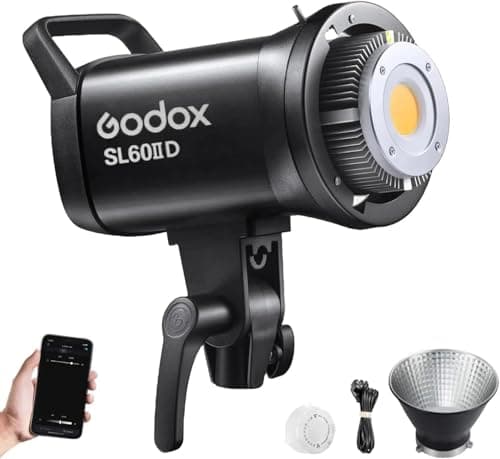
The short answer: lux at 1mis the number that decides whether a light can be your main light, and it is the one most listings bury. The Godox SL60IID publishes 18,600 lux at 1m; the amaran 100x S publishes up to 30,500 lux at 1m with its hyper reflector at 5,600K; the pocket-sized Aputure amaran MC publishes 100 lux at 1m. All three are "high CRI LED video lights". Only two of them can light a face. After output, the number that matters is CRI (or better, TLCI) — above about 95 you can stop worrying about colour; below about 90 skin tones go strange in a way no editor fixes.

Lighting listings are written to make every light sound like every other light. "High CRI", "dimmable 0-100%", "bicolor", "app control", "professional". The four specs below are the ones that actually separate a key light from a fill light from a decorative accent, and three of them are plain physics. Learn to read them once and listings stop being persuasive.

1. Output: lux at a stated distance

Lux is illuminance — how much light actually lands on a surface. It is quoted at a distance because light obeys the inverse square law: double the distance and you get one quarter of the light. A light quoting 18,600 lux at 1m delivers roughly 4,650 lux at 2m and about 2,070 lux at 3m, before you have put any diffusion in front of it. That is why the distance in the spec is not a footnote — a number quoted at 0.5m and a number quoted at 1m differ by four times for the same light.

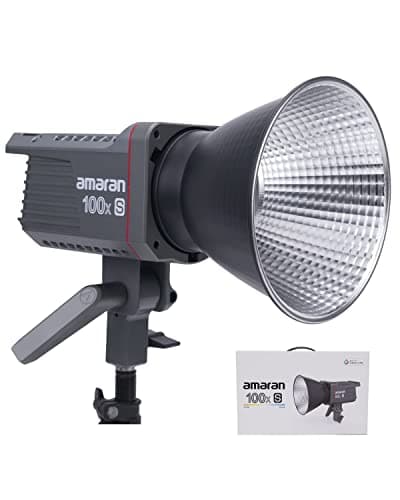
Watts are not output. A wattage figure tells you what the light consumes, and LED efficiency and optics vary enough that two 100W lights can differ substantially in delivered lux. Likewise, a lux figure quoted with a hyper reflector— a narrow optic that concentrates the beam — is not comparable to one quoted bare or with a standard reflector. The amaran 100x S's published 30,500 lux at 1m is specifically with the hyper reflector at 5,600K, and that is the honest way to read it.

2. Colour accuracy: CRI, TLCI, TM-30 and SSI

CRI (Colour Rendering Index) scores how faithfully a light renders colour against a reference, out of 100. It is an old metric with known weaknesses — it is weak on deep reds in particular — which is why better spec sheets publish more than one figure:

  • CRI — the common one. Above 95 is genuinely good; 90-95 is usable; below 90 shows up as muddy or sickly skin tones.
  • TLCI — Television Lighting Consistency Index, which weights what a camera sensor sees rather than what an eye sees. For video it is the more relevant of the two.
  • TM-30 Rf and Rg — fidelity and gamut. Rf is accuracy, Rg is saturation; Rg near 100 means colours are neither flattened nor pushed.
  • SSI — Spectral Similarity Index, how closely the actual spectrum matches tungsten or daylight. The strictest of the four, and the one where cheap lights fall apart.

Here is why publishing several matters. The Godox SL60IID publishes CRI 96 and TLCI 97. The amaran 100x S publishes CRI 95+, TLCI 97+, TM-30 Rf 96 and Rg 102, with SSI of 89+ against tungsten and 87+ against daylight. The pocket amaran MC publishes CRI 96 and TLCI 97+ but SSI of 84 tungsten and 74 daylight — the CRI headline is identical to the big lights, and the SSI number is where the difference lives. A light that only publishes "CRI 95+" and nothing else is not necessarily bad, but it has told you the least demanding thing it could.

3. Colour temperature and bicolor

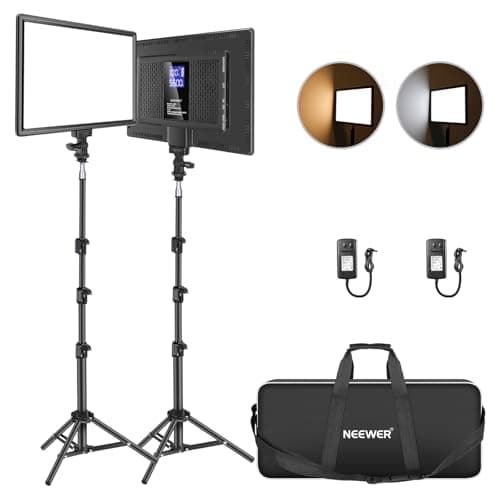
Colour temperature is measured in kelvin: around 2,700-3,200K is warm household and tungsten light, around 5,600K is midday daylight, and 6,500K is a cool overcast sky. A daylight-only light is fixed near 5,600K. A bicolor light mixes warm and cool LEDs so you can dial anywhere in a published range — 2,700-6,500K on the amaran 100x S, 3,200-5,600K on the Neewer panels.

Why you care: mixed colour temperature is the most common thing that makes home video look amateur, and it is invisible to your eye because your brain corrects for it in a way a camera does not. Point a 5,600K daylight light at someone in a room lit by warm bulbs, and half the frame goes orange while half goes blue. Bicolor lets you match the room instead of fighting it. Daylight-only lights are usually brighter per watt and cheaper, and the fix for them is free — turn the room's own lamps off, or gel them.

A third category, RGB (or RGBWW), adds full hue and saturation control on top of tunable white — 360 degrees of hue and 100 levels of saturation on the amaran MC. That is not a key-light feature; it is for colour in the background, a practical lamp effect, or a deliberate wash. Never buy RGB in place of output.

4. Mount, control and the boring specs that decide the setup

Bowens mount is the one spec that quietly determines your next five years of lighting. It is the industry-standard bayonet for modifiers, and a light that has it can take any softbox, umbrella, dome or reflector from any brand. Both the Godox SL60IID and the amaran 100x S use it. A panel light with a proprietary or no modifier mount can only ever be the light it is on the day you buy it — and since the single biggest quality jump in any lighting setup is putting a big diffuser in front of a small bright source, that limit is a real one.

Power splits the field more than people expect. Mains-powered COB lights are bright and tethered; battery panels and pocket lights are portable and weak. The Neewer kit publishes built-in 4,000mAh batteries, which is what makes a two-light setup possible outdoors with no power run at all.

Fan noise is a video spec, not a comfort spec. Anything over about 60W has a fan, and a fan two feet from a microphone is on your audio track forever. Listings that mention a quiet fan are telling you something real.

Reading four real spec sheets side by side

Same four lights, their own published numbers, no commentary. This is the table the listings do not print.

LightPublished outputPublished colour accuracyColour tempMount / power
Godox SL60IID18,600 lux at 1m (70W daylight COB)CRI 96 / TLCI 975,600K +/-200K, daylight onlyBowens, mains
Aputure amaran 100x SUp to 30,500 lux at 1m with hyper reflector at 5,600K (100W bicolor COB)CRI 95+ / TLCI 97+ / TM-30 Rf 96, Rg 102 / SSI 89+ tungsten, 87+ daylight2,700-6,500K bicolorBowens, mains
Neewer 13in LED Panel Kit (2-pack)Two bicolor panels, 0-100% dimming (no published lux figure)Listed as high CRI; no published number3,200-5,600K bicolorStand mount, built-in 4,000mAh batteries
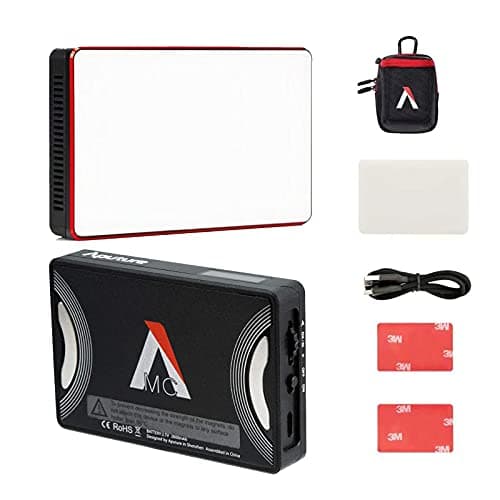
Aputure amaran MC100 lux at 1m (1,100 lux at 0.3m)CRI 96 / TLCI 97+ / SSI 84 tungsten, 74 daylight3,200-6,500K plus full RGBMagnet and 1/4in thread, USB-C battery

The amaran MC and the amaran 100x S publish an identical CRI headline and differ by 305 times in output at the same distance. That is the entire argument for reading the lux figure first — and it is why the pocket light is an accent and the COB is a key.

The short answer

Quick picks

#ProductBest forScorePrice
01
Godox Godox SL60IID
Godox SL60IID

The classic first studio light, a generation on. A 70W daylight COB on a universal Bowens mount, now with published CRI 96 color, app control and a quieter fan than the SL60W it replaced.

The best first studio key light
8.0
$139.00Amazon
02
Aputure Aputure amaran 100x S
Aputure amaran 100x S

The step-up key light. More power than the Godox, warm-to-cool bicolor control, app control and built-in effects — with Aputure's excellent, true-to-life color accuracy.

The best bicolor key light
8.2
$199.00Amazon
03
Aputure Aputure Amaran MC
Aputure Amaran MC

The pocket problem-solver. A palm-sized RGB light that adds a pop of color, a catchlight or a hair light anywhere, charges over USB-C and sticks to metal with a magnet.

The best pocket RGB accent light
8.2
$76.00Amazon
04
Neewer Neewer 13in LED Panel Kit (2-Pack)
Neewer 13in LED Panel Kit (2-Pack)

The do-it-all lighting kit. Two bicolor panels with stands and built-in batteries — enough to set up a key-and-fill in minutes, indoors or out, straight from one box.

The best two-light starter kit
7.8
$149.89Amazon

#ad · Live prices from the Amazon Product API, as of October 16, 2026. Where we have no verified live price, we show none — we would rather leave a gap than print a number that has rotted.

In detail

The picks, in full

01
Godox Godox SL60IID

The best first studio key light

Godox SL60IID

70W daylight COB (5600K ±200K)18,600 lux at 1mCRI 96 / TLCI 97Bowens mount + Bluetooth app control
8.0/10

The classic first studio light, a generation on. A 70W daylight COB on a universal Bowens mount, now with published CRI 96 color, app control and a quieter fan than the SL60W it replaced.

Output
9
Color quality
9
Control
9
Portability
5
Value
8

Pros

  • Real output for a home studio — far brighter than any on-camera panel, enough to light a face or a set cleanly
  • Published CRI 96 / TLCI 97 color accuracy is the clearest gain over the older SL60W, and it is the spec that keeps skin tones honest
  • The universal Bowens mount opens up cheap softboxes, umbrellas and grids, with Bluetooth app control and eight built-in effects included

Cons

  • Single-color daylight only — no warm-to-cool bicolor control and no RGB
  • Needs mains power, a stand and ideally a modifier to look its best, so it is a fixed rather than portable tool

Don't buy this if…

…you want on-camera portability or adjustable color temperature. A pocket light like the Amaran MC or Ulanzi VL49, or a bicolor panel kit, travels far better.

$139.00View on Amazon

Price as of October 16, 2026. Prices change — Amazon's is the one that counts.

#ad · we may earn a commission from this link to Godox SL60IID

02
Aputure Aputure amaran 100x S

The best bicolor key light

Aputure amaran 100x S

100W bicolor COB (2700-6500K)Bowens mountBluetooth app + 9 lighting effectsUltra-quiet fan, high CRI/TLCI
8.2/10

The step-up key light. More power than the Godox, warm-to-cool bicolor control, app control and built-in effects — with Aputure's excellent, true-to-life color accuracy.

Output
9
Color quality
10
Control
9
Portability
5
Value
8

Pros

  • Strong 100W output with full bicolor control, so you match warm rooms or cool daylight without gels
  • High measured color accuracy keeps skin tones natural — a real step up for interviews and portraits
  • Bluetooth app control and built-in effects (fire, TV, lightning) add production value on tap

Cons

  • Pricier than a single-color COB like the Godox
  • Still a mains-powered studio light, not something you clip on the camera

Don't buy this if…

…you only need a simple daylight key or want to spend the least. The Godox SL60IID covers the basics for less money.

$199.00View on Amazon

Price as of October 16, 2026. Prices change — Amazon's is the one that counts.

#ad · we may earn a commission from this link to Aputure amaran 100x S

03
Aputure Aputure Amaran MC

The best pocket RGB accent light

Aputure Amaran MC

Pocket RGBWW LED (3200-6500K + full color)USB-C rechargeableApp + built-in effectsMagnetic back, palm-sized
8.2/10

The pocket problem-solver. A palm-sized RGB light that adds a pop of color, a catchlight or a hair light anywhere, charges over USB-C and sticks to metal with a magnet.

Output
5
Color quality
9
Control
9
Portability
10
Value
8

Pros

  • Full RGB plus tunable white in something that genuinely fits a pocket
  • The magnetic back and app control make creative color accents and catchlights effortless
  • USB-C rechargeable, so there are no spare batteries to buy or carry

Cons

  • Low output on its own — it is an accent or fill light, not a key for a whole scene
  • You will want two or three of them for bigger setups

Don't buy this if…

…you need a main key light to properly light a face or product. Pair it with, or choose, a COB like the Godox SL60IID or Aputure 100x S.

$76.00View on Amazon

$90.0016% off

Price as of October 16, 2026. Prices change — Amazon's is the one that counts.

#ad · we may earn a commission from this link to Aputure Amaran MC

04
Neewer Neewer 13in LED Panel Kit (2-Pack)

The best two-light starter kit

Neewer 13in LED Panel Kit (2-Pack)

Two bicolor panels + light stands3200-5600K, high CRIBuilt-in 4000mAh batteriesOn-panel dimming, 0-100%
7.8/10

The do-it-all lighting kit. Two bicolor panels with stands and built-in batteries — enough to set up a key-and-fill in minutes, indoors or out, straight from one box.

Output
7
Color quality
8
Control
8
Portability
7
Value
9

Pros

  • Two lights plus stands in one box makes a proper key-and-fill setup affordable from day one
  • Bicolor and fully dimmable, so you can match any room's color and brightness
  • Built-in batteries let you shoot on location away from wall power

Cons

  • Flat panels give soft, even light but less punch than a COB with a softbox
  • The plastic panels and stands are functional rather than sturdy

Don't buy this if…

…you want maximum output and modifier flexibility for a fixed studio. A COB like the Godox or Aputure with a softbox hits harder and shapes light better.

$149.89View on Amazon

$169.9912% off

Price as of October 16, 2026. Prices change — Amazon's is the one that counts.

#ad · we may earn a commission from this link to Neewer 13in LED Panel Kit (2-Pack)

So which numbers do you actually need?

For a key light on a face indoors: you want a mains COB with a Bowens mount and a published lux figure in the thousands at 1m, CRI/TLCI in the mid-90s, and a quiet fan. Both the Godox and the amaran qualify; the difference between them is bicolor control and roughly 60% more output.

For a two-light setup you can carry: you want battery panels and stands, and you accept that no panel competes with a COB on output. The Neewer kit exists for exactly this and is the cheapest honest route to a key and a fill.

For fill on a close subject, a catchlight, or colour in a background: a pocket light is correct and a COB is overkill. 100 lux at 1m is useless as a key and perfectly adequate at 0.3m, which is where a pocket light actually gets used.

The full rankings with live prices are on best lighting for video, and the product-specific set is on best lights for product photography.

The spec that beats every other spec

Modifier size. A bare bulb is a small, hard source and it produces hard-edged shadows and specular highlights on skin no matter how good its CRI is. Put a softbox, dome or umbrella in front of the same light and the apparent source becomes large relative to the subject, which is the entire mechanism behind flattering light. The honest ranking of what changes an image is: modifier size first, position second, output third, colour accuracy fourth. A CRI-98 light pointed bare at a face from the camera position still looks like a flash photo.

That is also the practical reason to insist on Bowens. A $139 light with a standard mount and a $40 softbox beats a $250 light with no modifier option, in every image, forever. The technique side of this is in how to light a YouTube video.

Is higher CRI always better?

Up to a point, then it stops mattering. The gap between CRI 80 and CRI 95 is visible on skin and in fabric; the gap between CRI 95 and CRI 98 is mostly a line on a box. Past the mid-90s, spend the money on output, a modifier mount or a second light instead — those change images, and three more CRI points do not.

What do lumens mean on a video light?

Lumens measure total light emitted in all directions; lux measures what arrives on a surface at a distance. For video lighting lux is the useful one, because a light's optics determine how much of its lumen output actually reaches the subject. A high lumen figure with a wide, uncontrolled beam can deliver less usable light on a face than a lower-lumen light with a reflector. If a listing quotes only lumens, treat it as a marketing number.

Do I need a light meter?

No. Your camera has one, and for video the waveform or zebras in the camera are more useful than a handheld meter anyway. Use the published lux figures to decide what to buy, and use the camera's own exposure tools to decide where to put it — the settings side is in best camera settings for video.
How we picked

We do not run a testing lab

We compiled the manufacturers' published specifications and manuals, did the cost math, and scored each product against a published rubric. The scores are judgments from that documented research — they are notmeasurements we took, because we do not have a lab and we are not going to pretend we do. Where a number came from someone else's testing, we name and link them in Sources.

Questions

Frequently asked

What does CRI mean on an LED video light?
Colour Rendering Index - how faithfully the light renders colour against a reference, out of 100. Above 95 is genuinely good, 90 to 95 is usable, and below 90 tends to show up as muddy or sickly skin tones. TLCI is the better metric for video because it weights what a camera sensor sees rather than what an eye sees.
What is a good lux at 1m for a video light?
For a key light on a face indoors you want a figure in the thousands: the Godox SL60IID publishes 18,600 lux at 1m and the amaran 100x S publishes up to 30,500 lux at 1m with its hyper reflector. A pocket light like the amaran MC publishes 100 lux at 1m, which is fine as fill at close range and useless as a key.
Is bicolor or daylight-only better?
Bicolor if you shoot in rooms lit by other lights, because mixed colour temperature is what makes home video look amateur and your eye cannot see it happening. Daylight-only lights are usually brighter per watt and cheaper, and the free fix is to turn the room's own lamps off. Published bicolor ranges to look for are roughly 2,700-6,500K.
Do watts tell you how bright a light is?
No. Watts are what the light consumes, and LED efficiency plus optics vary enough that two 100W lights can deliver noticeably different lux. Always compare lux at a stated distance, and check that distance - a figure quoted at 0.5m is four times the same light's figure at 1m, because light falls off with the square of distance.
What is a Bowens mount and do I need one?
It is the industry-standard bayonet for light modifiers, and it is the most future-proof spec on a light. A Bowens-mount light takes any softbox, dome, umbrella or reflector from any brand - which matters because modifier size changes images more than any other variable. A light with no modifier mount can only ever be the light it is today.
What is the difference between CRI, TLCI and SSI?
CRI scores colour fidelity for the human eye, TLCI scores it as a camera sensor sees it, and SSI measures how closely the actual spectrum matches tungsten or daylight. SSI is the strictest. The amaran MC and amaran 100x S both publish CRI 96-ish, but the MC's SSI is 84 tungsten and 74 daylight against the 100x S's 89+ and 87+ - the headline hides the gap.
Does fan noise on an LED light matter?
Yes, if you record audio in the same room. Anything much over 60W has a fan, and a fan a couple of feet from a microphone is on your audio track permanently - noise reduction does not remove it cleanly. When a listing makes a point of a quiet or ultra-quiet fan, that is a real video specification rather than a comfort claim.
Do I need RGB on a video light?
Only for background colour, practical lamp effects or a deliberate wash - never as a substitute for output. RGB and RGBWW lights add hue and saturation control on top of tunable white, which is genuinely useful for an accent in the frame. The key light that lights your face wants brightness, colour accuracy and a modifier mount instead.

Keep reading

Receipts

Sources

We do not run a testing lab, and we do not pretend to. Specs come from manufacturer sheets and manuals; where a figure came from someone else's measurement, we name and link them. Where we could not verify something, we say so on the page rather than quietly leaving it out. Read our full method.