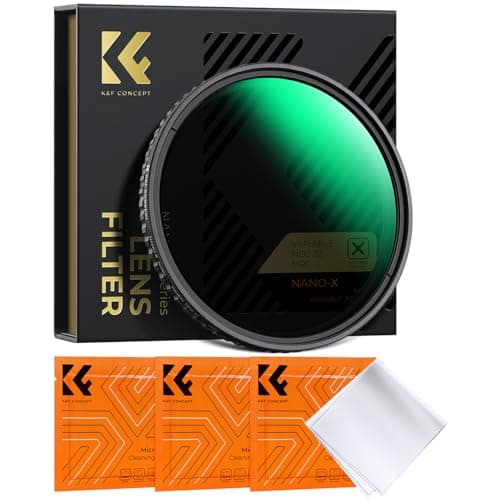
The best ND filter under $100 is the K&F Concept Variable ND. It covers ND2 to ND32 - one to five stops - and it stops short of the range where variable filters start producing the dark X across the frame, which is the single most common way a cheap variable ND ruins a shot. It is for the video shooter who wants to hold f/2.8 and a 1/50s shutter outdoors without carrying four filters. Our budget pick is the Tiffen ND 0.9, the cheapest filter here and a single fixed three-stop that has no variable mechanism to go wrong. Prices come from the live price layer with an "as of" date; where there is no verified purchasable offer, we show no price.
An ND filter is sunglasses for a lens: it cuts light without changing color, so you can keep a setting you have chosen for a reason. For video that reason is almost always shutter speed - the 180-degree rule puts your shutter at roughly twice your frame rate, so 1/50s at 25fps, and in daylight that combination badly overexposes at any aperture you would want to use for a blurred background. For stills it is the opposite problem: you want a long exposure to smooth water or blur a crowd, and daylight will not let you leave the shutter open.
Under $100 the decision is variable versus fixed, and it is a genuine trade rather than a budget compromise. A variable ND is two polarizing elements that rotate against each other, so one filter replaces a set - and when you rotate them past a certain point they begin to cross-polarize and lay a dark X-shaped band across wide frames. A fixed ND has no mechanism and no X, and it does exactly one strength. The full ranking without a price ceiling is best ND filters, and what filters do in general is explained in camera lens filters explained.
What we required of a filter to rank here
- A live price under $100 read from the price layer, in a common thread size. A filter with no verified purchasable offer is not in the band whatever it used to cost.
- A stated, honest stop range.Variable filters sold as "ND2 to ND400" are advertising the far end of a range they cannot deliver cleanly; we prefer a narrower range that works to a wide one that does not.
- Neutral means neutral. The point of an ND is to cut light without adding a color cast, and the cheapest filters on the market fail at exactly that. Each pick below is noted for where it stands.
- One clear job per pick. A variable ND, a hybrid ND and polarizer, a starter set and a single fixed filter - four different answers rather than four versions of one.
The four, and what each one is for
| Filter | Type | Range | Main compromise |
|---|
| K&F Concept Variable ND | Variable | ND2-ND32 (1-5 stops) | Five stops is not enough for a daylight long exposure |
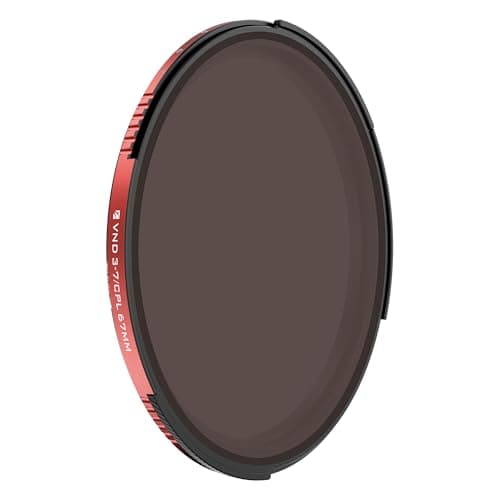
| Freewell Hybrid Variable ND/CPL | Variable, with polarizer | 3-7 stops | Two effects on one ring - less control over each |
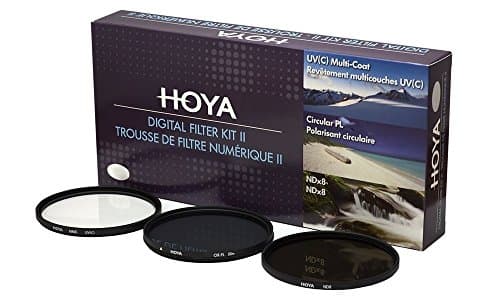
| Hoya Digital Slim Filter Set II | Fixed set (UV, CPL, ND16) | ND16 (4 stops) fixed | One ND strength only; the UV filter does little |
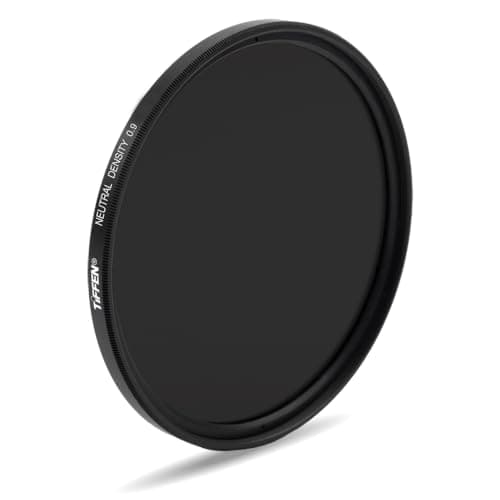
| Tiffen ND 0.9 | Single fixed | 3 stops fixed | One strength, and you will want two |
Why the K&F Concept Variable ND wins
It wins on what it does not try to do. The X-cross problem on cheap variable NDs comes from pushing two polarizers close to perpendicular, and it appears at the strong end of a wide advertised range - which is why a filter sold as nine stops of variable ND is usually unusable at nine stops. K&F publishes this one as ND2 to ND32, one to five stops, and that is a range it holds without the cross. Five stops is enough to shoot wide open in daylight at a video shutter speed, which is what most people buy a variable ND for.
The compromise follows from the same choice: five stops will not give you a thirty-second exposure of moving water in sunshine, so landscape photographers who want that effect need a stronger fixed filter. It is also sold in several thread sizes, so check your lens's filter thread before ordering - the diameter is printed on the front of the lens barrel after a circle-with-a-line symbol.
If you shoot video outdoors: the Freewell Hybrid Variable ND/CPL
This one combines the two filters a video shooter actually uses into a single ring, covering three to seven stops of ND while also polarizing. That matters outdoors because polarization is what removes the glare off water, glass and car paint and deepens a pale sky, and swapping between an ND and a CPL mid-shoot is how you get dust on your sensor. For a creator filming in daylight it is the most practical filter on this page.
The honest cost of a hybrid is control: both effects are adjusted on the same mechanism, so you have less independent say over each than you would with two separate filters, and the polarizing effect changes with your angle to the sun whether you want it to or not. The dedicated polarizers are ranked in best CPL filters.
If you are buying your first filters: the Hoya Digital Slim Filter Set II
A set is the efficient purchase if you own no filters at all, and this one is three slim, multi-coated filters with a case: a circular polarizer, a fixed four-stop ND16 and a UV. The slim frames matter on a wide lens, where a thick filter ring can clip the corners of the frame. Hoya's coatings are the reason to pick this over an unbranded set - cheap uncoated glass flares badly into the sun and adds a color cast.
Two caveats. The ND is a single fixed strength, so it is the right exposure in one set of conditions and the wrong one in others. And the UV filter is largely a holdover from film: on a digital sensor it does essentially nothing optically, and is worth having only as physical protection for the front element.
The budget pick: Tiffen ND 0.9
The cheapest filter on this page is a single fixed three-stop, and it is the budget pick precisely because there is nothing in it to go wrong. No rotating elements, so no X-cross, no uneven darkening across the frame and no color shift from cross-polarization. Three stops is the most generally useful single ND strength: it is enough to bring a bright afternoon back to f/2.8 at a video shutter speed, and enough to let you drag a shutter in shade.
The limitation is obvious and we will not dress it up - one strength means one set of conditions, and the second filter you buy will be a six-stop. If you expect to shoot in a wide range of light, the variable at the top of this page costs more and saves you from carrying three. The full field, including the stronger fixed sets, is in best ND filters.
What we would actually buy
For video: the K&F variable, or the Freewell hybrid if you film outdoors near water or glass. For stills: the Tiffen three-stop now and a six-stop fixed filter later, because fixed glass at this price is optically better than variable glass at this price. For someone with no filters at all: the Hoya set, which gets a polarizer and an ND onto the lens in one purchase. And whatever you buy, buy the thread size of your largest lens and a step-up ring for the rest - it is cheaper than a filter per lens. The accessories worth owning at this kind of money are collected in best camera accessories under $100.