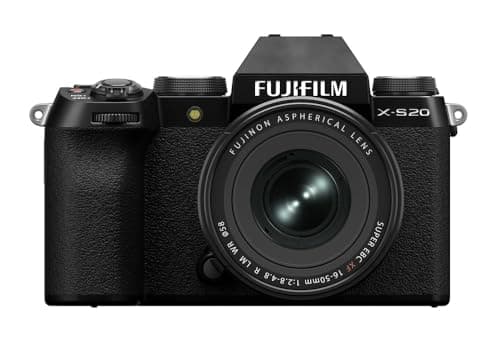
The Fujifilm X-S20 is the beginner camera to buy when you already suspect you'll grow fast: it adds in-body stabilization, a genuinely big battery, serious 6.2K and 4K video, and film simulations that get color right in the file. The catches are an honest set — it costs more, it has a single card slot, and Fujifilm lenses run pricier than the rivals.
As always, here is how we work. We have not lab-tested the X-S20. This review is compiled from Fujifilm's published specifications and the reported experience of owners, scored against our rubric. The verdicts are informed judgments from documented research, not readings from a bench we do not have.
Who it's for
The X-S20 is for the creator who wants one camera to carry them from beginner to genuinely capable without a second purchase in a year. It is a true hybrid: it shoots stills as happily as it shoots video, and it has the features — stabilization, battery life, deep video specs — that people usually discover they want only after they have outgrown a cheaper body. If you know you are ambitious, buying this first can save you money over starting cheap and upgrading.
It also suits the person who dislikes editing. Fujifilm's film simulations bake a finished look straight into the file, so a great many owners shoot, transfer and post with no editing step at all. If your goal is lovely images with the least fuss, this camera flatters that workflow more than any rival here.
Who should look elsewhere? The absolute first-timer on a tight budget shooting in automatic. The X-S20 is a lot of camera, and a beginner who never leaves auto will pay for depth they do not touch. For them, a simpler, cheaper body from our budget ranking is the smarter start, with this as the step-up later.
There is also the hybrid shooter who does not want to own two cameras. If you photograph a family event in the afternoon and film a piece to camera that evening, the X-S20 handles both in one bag without the tilt-screen and battery headaches that trip up stills-first bodies. That versatility is the quiet reason it earns a place in our under $1,000 shortlist despite the higher price — it does the work of two simpler cameras.
Where it's brilliant
In-body stabilization no rival here offers
The headline feature is IBIS — in-body image stabilization — which none of the other beginner bodies in this class include. It steadies handheld stills so you can shoot at slower shutter speeds in dim rooms, and it smooths walking video enough that a lot of casual footage no longer needs a gimbal. For a creator who shoots handheld, this single feature changes what the camera can do, and it is the clearest reason to pay the step-up price.
A battery that lasts a real day
The X-S20 uses a much larger battery than the older Fujifilm bodies, and it is the standout of this group for stamina. Where smaller creator cameras have you swapping cells at lunch, this one runs a genuine full day of mixed shooting. If you have ever missed a shot to a dead battery, you will feel the difference immediately.
Serious video and in-camera color
On paper and in practice the video is a class above the entry-level bodies: 6.2K capture, 4K at higher frame rates, a deep recording buffer, and the stabilization to hold it steady. Paired with the film simulations, you get footage with a finished look before you touch an editor. For color specifically, the simulations are the reason people fall for Fujifilm — reds, skin tones and greens land right in-camera in a way that flatters both stills and clips.
If video is your main focus, it is worth seeing how it stacks up against the dedicated creator bodies in our content-creation ranking, and budgeting for a fast 4K-rated SD card to keep up with the high-bitrate modes.
Stills that stand on their own
It is easy to frame the X-S20 as a video camera, but the 26MP APS-C sensor makes lovely stills too. Detail is abundant in good light, the color science flatters skin and foliage, and the in-body stabilization lets you hand-hold slower shutter speeds in dim rooms than a beginner could otherwise manage. Portrait, travel and street shooters get a genuinely strong photo camera here, not an afterthought bolted to a video body. Add a fast prime from our 50mm guide and it competes with anything in its class for photos.
Handling and the vlogging flip screen
The X-S20 keeps the traditional mode dial and a comfortable grip, so it stays approachable for a beginner while giving an enthusiast the direct controls they will grow into. The fully articulating screen swings out to the side and faces forward for filming yourself, and it clears a top-mounted microphone — the exact problem that hampers tilt-only bodies. Between the screen, the controls and the deep buffer, it feels like a camera designed by people who actually shoot both stills and video rather than one or the other.
The honest catch
It is the pricier way in
The X-S20 costs meaningfully more than the entry-level bodies here, and that is the first thing to be honest about. You are paying for stabilization, battery and video depth. If you will not use those, the money is better spent on a cheaper body and a good lens. This is a step-up camera wearing beginner-friendly clothes, not the cheapest door into the hobby.
One card slot, and a fuller learning curve
There is a single SD card slot, so there is no in-camera backup to a second card as you would get on pro bodies — a small point for a beginner, but worth knowing if you ever shoot can't-repeat events. The deeper feature set also asks more of you: there are more dials, modes and menus to learn than on a point-and-shoot-friendly body, so expect a longer settling-in period before it feels second nature.
Fujifilm lenses cost more
The X-mount is a lovely system, but its lenses generally run pricier than the cheap third-party primes that flood Sony E-mount, and the bargain-basement options are fewer. You are not short of great glass — you simply pay a little more to grow the kit. Factor the lens budget in before you commit, because the system cost outlives the body cost every time.
A camera you accessorize, and a curve to climb
The X-S20 rewards a shooter who is willing to learn it. There are more dials, custom buttons and menu options than on a point-and-shoot-friendly body, so plan on a settling-in period before it feels like second nature — this is a camera you grow into, not one you master in an afternoon. To get the most from the video modes you will also want a fast 4K-rated card, and for run-and-gun days an external microphone; the IBIS reduces how often you reach for a gimbal, but it does not replace one for the smoothest walking shots.
Autofocus that trails the class benchmark
Fujifilm's subject detection has improved a great deal and it is perfectly reliable for everyday shooting, portraits and vlogging. But if we are being straight, it is not quite the equal of Sony's benchmark tracking on fast, erratic subjects — the occasional missed grab on a sprinting child or a bird in flight is a little more likely here than on a comparable Sony body. It is a difference of degree rather than kind, and most creators never bump into it; for a parent shooting youth sport every weekend, though, it is worth weighing honestly before you commit.
If the price and lens math give you pause, weigh it head to head against a cheaper classic in our X-S20 vs Sony a6400 comparison, or see where it lands in the best under $1,000 ranking. For a creator who knows they will grow, though, the stabilization and battery alone make it worth the stretch.
Step back and the X-S20 makes a simple promise: buy once, grow into it. It costs more up front than the entry-level bodies, and its lenses ask a little more of your budget, but you get stabilization, stamina, strong video and finished color in a single body that will still feel capable years from now. If you already sense you are the kind of creator who will keep pushing, paying for that headroom today is usually cheaper than buying twice. If you are not sure yet, start cheaper and step up to this when your ambitions catch up.